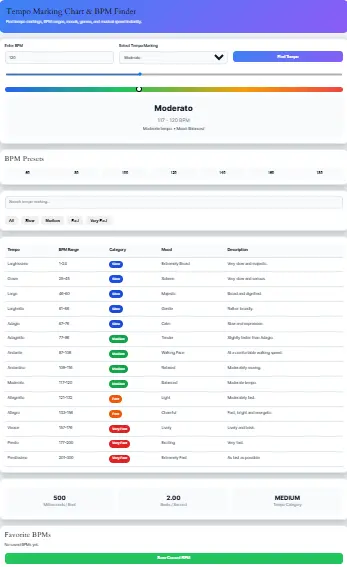
Tempo Marking Chart & BPM Finder
Find tempo markings, BPM ranges, moods, genres, and musical speed instantly.
Fast, bright and energetic.
BPM Presets
| Tempo | BPM Range | Category | Mood | Description |
|---|
Favorite BPMs
Tempo Comparison
Dark Mode
Music is built on rhythm, timing, and movement. Therefore, understanding tempo is essential for musicians, composers, producers, DJs, students, music teachers, and performers. A tempo marking chart helps you understand how fast or slow a piece of music should be played. Moreover, it connects traditional musical tempo markings with modern BPM (beats per minute) measurements.
Our Tempo Marking Chart Tool allows you to instantly find tempo markings, BPM ranges, musical speed categories, and tempo descriptions. Furthermore, it helps users convert BPM into recognizable tempo names such as Largo, Adagio, Andante, Moderato, Allegro, Vivace, and Presto.
Whether you are learning music theory, producing electronic dance music, practicing piano, composing orchestral scores, or analyzing song tempos, this music tempo chart provides a quick and accurate reference.
Features of the Tempo Marking Chart Tool
Our Tempo Marking Chart Tool is designed to help musicians, producers, students, teachers, and composers understand musical tempo quickly and accurately. Moreover, it combines traditional music theory with modern BPM analysis.
Instant BPM to Tempo Marking Finder
Simply enter a BPM value, and the tool instantly identifies the corresponding tempo marking. Therefore, users can quickly determine whether a song falls into Adagio, Andante, Moderato, Allegro, Vivace, or Presto categories.
Tempo Marking to BPM Conversion
In addition to BPM lookup, the tool allows users to select a tempo marking and instantly view its BPM range. Consequently, learning music terminology becomes much easier.
Interactive BPM Slider
The BPM slider provides a visual way to explore tempo ranges. Furthermore, users can instantly see how tempo markings change as BPM values increase or decrease.
Tempo Comparison Tool
The comparison feature allows users to compare two different tempo markings side by side. Therefore, musicians can better understand the differences between various musical speeds.
BPM Presets
The tool includes commonly used BPM presets such as:
- 60 BPM
- 80 BPM
- 100 BPM
- 120 BPM
- 140 BPM
- 160 BPM
- 180 BPM
As a result, users can jump directly to popular tempo ranges without manual input.
Tempo Categories
The chart automatically groups tempos into categories:
- Slow Tempo
- Medium Tempo
- Fast Tempo
- Very Fast Tempo
Therefore, users can identify musical speed categories immediately.
Milliseconds Per Beat Calculator
The tool automatically calculates milliseconds per beat. Consequently, music producers can use these values when setting delay times, effects, and synchronization parameters in digital audio workstations.
If you need additional timing calculations, you may also find our BPM to Milliseconds Converter helpful.
Beats Per Second Display
Besides BPM values, the tool calculates beats per second. Therefore, users gain another useful perspective on tempo measurement.
Favorite BPM Storage
Users can save frequently used BPM values. Moreover, favorites remain available through browser storage for future sessions.
Search and Filter Options
The search function allows users to locate tempo markings quickly. Likewise, category filters help users focus on specific tempo groups.
Export Options
Users can export tempo information as:
- CSV files
- TXT files
Consequently, tempo data can be used in projects, lessons, and research.
Dark Mode Support
The built-in dark mode improves usability during extended practice and production sessions. Furthermore, it reduces eye strain in low-light environments.
Advanced Features of the Tempo Marking Chart Tool
While many tempo charts only provide basic BPM ranges, this tool offers several advanced capabilities.
Visual Tempo Scale
The visual tempo scale provides an intuitive understanding of musical speed. Therefore, users can see where a BPM value falls within the overall tempo spectrum.
Tempo Mood Descriptions
Every tempo marking includes mood descriptions. As a result, musicians can better understand the emotional character associated with each tempo.
For example:
- Largo = Broad and majestic
- Adagio = Calm and expressive
- Allegro = Bright and energetic
- Vivace = Lively and spirited
- Presto = Fast and exciting
URL Sharing
Users can share tempo results through URL parameters. Consequently, teachers and students can easily exchange tempo references.
Keyboard Controls
Keyboard shortcuts improve workflow efficiency. Therefore, users can adjust BPM values quickly without relying entirely on mouse input.
Local Storage Integration
The tool saves preferences and favorites directly within the browser. As a result, no account registration is required.
Mobile-Friendly Design
The responsive layout works on:
- Desktop computers
- Laptops
- Tablets
- Smartphones
Therefore, musicians can use the tool from virtually any device.
How to Use the Tempo Marking Chart Tool
Using the tool is straightforward.
Step 1: Enter a BPM Value
Type a BPM value into the input field.
For example:
- 60 BPM
- 90 BPM
- 120 BPM
- 140 BPM
- 180 BPM
Step 2: View the Tempo Marking
The tool automatically identifies the corresponding tempo marking.
For example:
- 60 BPM → Largo
- 90 BPM → Andante
- 120 BPM → Moderato
- 140 BPM → Allegro
- 180 BPM → Presto
Step 3: Review Additional Information
The tool displays:
- BPM range
- Tempo category
- Mood description
- Milliseconds per beat
- Beats per second
Consequently, users receive comprehensive tempo information.
Step 4: Compare Tempos
Select two tempo markings in the comparison section. Then, review the BPM differences between them.
Step 5: Save Favorites
If you frequently use specific BPM values, save them to your favorites list. Therefore, they remain accessible in future sessions.
Step 6: Export Results
Export tempo information in CSV or TXT format whenever necessary.
Common BPM Values and Music Genres
Different music genres often use specific BPM ranges.
60–80 BPM
Common genres include:
- Ballads
- Ambient music
- Slow worship music
80–100 BPM
Common genres include:
- R&B
- Soul
- Relaxed pop
100–120 BPM
Common genres include:
- Mainstream pop
- Rock
- Contemporary worship
120–130 BPM
Common genres include:
- House music
- Dance music
- EDM
130–150 BPM
Common genres include:
- Trance
- Eurodance
- Festival EDM
150–180 BPM
Common genres include:
- Drum and Bass
- Hardcore
- Speed metal
Therefore, understanding BPM ranges can help producers and DJs organize music more effectively.
Tempo Markings in Classical Music
Classical composers relied heavily on tempo markings. Consequently, these terms remain essential in music education today.
Some of the most recognized composers who used tempo markings extensively include:
- Ludwig van Beethoven
- Wolfgang Amadeus Mozart
- Johann Sebastian Bach
- Frédéric Chopin
Furthermore, organizations such as Berklee College of Music and Juilliard School continue teaching tempo terminology as a core component of music education.
Related Tools You May Find Useful
If you work with tempo, rhythm, and music production, several related tools can improve your workflow.
- Tap Tempo BPM Calculator – Find BPM by tapping a key or clicking your mouse.
- BPM Calculator – Calculate beats per minute quickly and accurately.
- BPM to Milliseconds Converter – Convert BPM values into precise timing intervals.
- Online Metronome – Practice rhythm and timing with a customizable metronome.
- Time Value Calculator – Perform advanced timing calculations.
- Time Calculator – Calculate durations and time differences for music projects.
Together, these tools provide a complete rhythm, timing, and tempo workflow for musicians, producers, and students.
What Is a Tempo Marking?
A tempo marking is a musical instruction that tells performers how fast or slow a piece of music should be played. Traditionally, composers used Italian tempo markings because Italian became the standard language of classical music notation.
For example:
- Largo indicates a very slow tempo.
- Adagio indicates a slow and expressive tempo.
- Andante indicates a walking pace.
- Moderato indicates a moderate speed.
- Allegro indicates a fast and lively tempo.
- Vivace indicates a brisk and energetic tempo.
- Presto indicates a very fast tempo.
However, modern musicians often use BPM instead of relying solely on tempo names. Therefore, a tempo marking chart with BPM ranges makes it much easier to understand the intended speed of a musical composition.
What Is BPM in Music?
BPM stands for Beats Per Minute. In simple terms, BPM measures how many beats occur in one minute.
For instance:
- 60 BPM equals one beat every second.
- 120 BPM equals two beats every second.
- 180 BPM equals three beats every second.
Consequently, BPM provides a precise measurement of musical speed, while tempo markings provide descriptive guidance.
Because of this relationship, producers, composers, and performers frequently use both BPM and tempo markings together.
Tempo Marking Chart with BPM Ranges
The following tempo chart provides common tempo markings and BPM ranges.
Larghissimo
BPM Range: 1–24 BPM
Larghissimo is among the slowest tempo markings used in music. Consequently, it creates a broad, dramatic, and monumental feeling.
Grave
BPM Range: 25–45 BPM
Grave represents a solemn and serious musical mood. Therefore, composers often use it in dramatic passages.
Largo
BPM Range: 46–60 BPM
Largo is slow, dignified, and majestic. Moreover, it creates a spacious musical atmosphere.
Larghetto
BPM Range: 61–66 BPM
Larghetto is slightly faster than Largo. Nevertheless, it still maintains a relaxed character.
Adagio
BPM Range: 67–76 BPM
Adagio is one of the most recognizable tempo markings. Furthermore, it is commonly associated with expressive and emotional music.
Adagietto
BPM Range: 77–86 BPM
Adagietto is somewhat faster than Adagio. As a result, it retains emotional depth while increasing movement.
Andante
BPM Range: 87–108 BPM
Andante literally means “walking pace.” Therefore, it is often considered one of the most natural and comfortable musical tempos.
Andantino
BPM Range: 109–116 BPM
Andantino is slightly faster than Andante. Consequently, it feels smooth and flowing.
Moderato
BPM Range: 117–120 BPM
Moderato indicates a moderate speed. Moreover, it balances energy and control effectively.
Allegretto
BPM Range: 121–132 BPM
Allegretto is moderately fast. Therefore, it feels cheerful and light without becoming aggressive.
Allegro
BPM Range: 133–156 BPM
Allegro is one of the most commonly used tempo markings. Furthermore, it creates excitement, brightness, and forward momentum.
Vivace
BPM Range: 157–176 BPM
Vivace means lively and energetic. Consequently, it is often used in energetic classical and modern compositions.
Presto
BPM Range: 177–200 BPM
Presto is very fast. Therefore, it generates excitement and urgency.
Prestissimo
BPM Range: 201–300 BPM
Prestissimo represents the fastest traditional tempo marking. As a result, it is used for extremely rapid passages.
Why Tempo Matters in Music
Tempo influences nearly every aspect of musical performance. Therefore, choosing the correct tempo is essential.
Emotional Impact
A slower tempo often creates feelings of sadness, reflection, or calmness. In contrast, a faster tempo usually creates excitement, happiness, and energy.
Performance Consistency
Musicians rely on tempo markings to maintain consistency. Consequently, ensemble performances become more synchronized.
Music Production
Modern producers use BPM to organize projects. Therefore, understanding tempo markings and BPM ranges is valuable for recording and mixing music.
Practice Efficiency
Students often begin learning difficult passages at slower tempos. Subsequently, they increase speed gradually as accuracy improves.
Who Can Benefit from This Tempo Marking Chart Tool?
This tool is useful for many different users.
Musicians
Musicians can quickly identify tempo names and BPM ranges.
Music Students
Students can learn music theory concepts more effectively.
Music Teachers
Teachers can explain tempo markings using accurate BPM references.
Composers
Composers can select appropriate tempos for emotional impact.
Producers
Producers can match project BPM values to traditional tempo terminology.
DJs
DJs can compare song speeds and organize playlists more efficiently.
Conductors
Conductors can use tempo charts to communicate performance expectations clearly.
Tempo Markings vs BPM
Although tempo markings and BPM are closely related, they are not identical.
Tempo markings are descriptive. Meanwhile, BPM is numerical.
For example:
- Allegro describes a fast and lively character.
- 140 BPM provides an exact measurement.
Therefore, combining both systems provides the greatest level of musical accuracy.
If you frequently work with BPM values, you may also find our BPM Calculator, BPM to Milliseconds Converter, Tap Tempo BPM Calculator, and Online Metronome useful for music production and tempo analysis.
Popular Music Tools
Now that you know the exact BPM range for terms like Allegro or Andante, you can put them into practice. Set your device to the perfect speed for your sheet music by using our Online Metronome. If you are analyzing a piece of music and need to figure out its exact speed rather than just the general tempo marking, our BPM Calculator will give you the precise numbers. For music theory students, understanding the space between pitches is just as important as speed, so explore our Music Interval Calculator.
Frequently Asked Questions (FAQs)
A tempo marking is a musical instruction that indicates how fast or slow a piece of music should be performed. Traditionally, composers use Italian terms such as Largo, Adagio, Andante, Moderato, Allegro, Vivace, and Presto. Moreover, these tempo markings help performers understand the intended character and speed of the music.
BPM stands for Beats Per Minute. In other words, BPM measures the number of beats that occur in one minute. Therefore, BPM provides an exact numerical representation of musical tempo.
Allegro generally falls between approximately 120 and 156 BPM. However, the exact BPM range may vary slightly depending on the source and musical style. Nevertheless, Allegro is widely recognized as a fast, lively, and energetic tempo.
Tempo markings provide descriptive guidance, while BPM provides precise numerical measurements. For example, Allegro describes a musical character, whereas 140 BPM specifies an exact speed. Therefore, musicians often use both systems together.
In many tempo charts, 120 BPM is typically classified as Moderato or the lower range of Allegro. Consequently, it is one of the most commonly used tempos in modern music.
Larghissimo is generally considered the slowest traditional tempo marking. Furthermore, it represents an extremely slow and broad musical pace.
Prestissimo is generally recognized as the fastest traditional tempo marking. Therefore, it is used for extremely rapid musical passages.
Understanding Tempo Categories
Tempo markings are often grouped into broader categories. Therefore, understanding these categories can make tempo selection easier.
Slow Tempo
Slow tempos create a calm, emotional, and reflective atmosphere.
Examples include:
- Larghissimo
- Grave
- Largo
- Adagio
These tempos are frequently used in classical music, film scores, and emotional ballads.
Moderate Tempo
Moderate tempos provide balance and natural movement.
Examples include:
- Andante
- Andantino
- Moderato
Consequently, they are common in pop music, folk music, and educational repertoire.
Fast Tempo
Fast tempos increase excitement and energy.
Examples include:
- Allegretto
- Allegro
Therefore, they are frequently used in rock, pop, and upbeat orchestral works.
Very Fast Tempo
Very fast tempos create intensity and momentum.
Examples include:
- Vivace
- Presto
- Prestissimo
As a result, they are common in electronic music, virtuoso classical works, and high-energy genres.
Why Learning Tempo Markings Improves Musical Skills
Learning tempo markings offers benefits beyond simple speed recognition.
Better Music Reading
When musicians understand tempo terminology, they can interpret sheet music more accurately. Consequently, performance quality improves.
Stronger Rhythm Development
Tempo awareness strengthens rhythmic accuracy. Furthermore, it helps musicians maintain consistent timing.
Improved Ensemble Performance
Groups rely on shared tempo understanding. Therefore, ensemble coordination becomes easier.
Enhanced Music Theory Knowledge
Tempo markings form a fundamental part of music theory. As a result, students develop a more complete understanding of musical notation.
More Effective Practice Sessions
Practicing at appropriate tempos helps musicians build technique gradually. Therefore, learning becomes more efficient.
EEAT: Why You Can Trust This Tempo Marking Chart
Experience
This tool was created specifically for musicians, music students, producers, educators, and hobbyists who need a reliable tempo reference. Moreover, it is designed for real-world music applications rather than theoretical use alone.
Expertise
The BPM ranges and tempo terminology used throughout this guide are based on widely accepted music theory references and standard tempo conventions used in education and performance settings.
Authoritativeness
Tempo markings such as Largo, Adagio, Andante, Moderato, Allegro, Vivace, and Presto have been used by composers and educators for centuries. Furthermore, respected institutions such as Berklee College of Music and The Juilliard School continue teaching these concepts today.
Trustworthiness
Our goal is to provide accurate, easy-to-understand, and practical music resources. Therefore, this tempo chart is designed to help users make informed musical decisions quickly and confidently.
Tempo Marking Chart vs Metronome
Although a tempo marking chart and a metronome are related, they serve different purposes.
A tempo chart helps users identify musical speed categories and BPM ranges. Meanwhile, a metronome provides audible beats that help musicians maintain consistent timing.
Therefore, many musicians use both tools together. After identifying a tempo marking with this chart, you can practice that tempo using our Online Metronome.
Tempo Marking Chart for Music Production
Modern music production relies heavily on BPM values. Therefore, producers often convert traditional tempo markings into exact BPM settings.
For example:
- House Music often uses 120–130 BPM.
- EDM frequently uses 128 BPM.
- Trance commonly ranges from 130–145 BPM.
- Drum and Bass often uses 160–180 BPM.
- Hip-Hop commonly ranges from 80–100 BPM.
- Pop music frequently falls between 100–130 BPM.
Consequently, a tempo marking chart helps bridge the gap between traditional music theory and modern production techniques.
Quick Reference Tempo Chart
For convenience, here is a simplified tempo reference:
- Larghissimo: Extremely Slow
- Grave: Very Slow
- Largo: Broad and Slow
- Adagio: Slow and Expressive
- Andante: Walking Pace
- Moderato: Moderate Speed
- Allegretto: Moderately Fast
- Allegro: Fast and Bright
- Vivace: Lively and Quick
- Presto: Very Fast
- Prestissimo: Extremely Fast
Therefore, musicians can quickly identify tempo categories without memorizing every BPM range.
Final Thoughts
A tempo marking chart is one of the most valuable resources for musicians, producers, composers, teachers, students, and conductors. Because tempo affects rhythm, emotion, performance quality, and musical interpretation, understanding tempo markings is essential for anyone involved in music.
Whether you need a music tempo chart, BPM tempo chart, tempo markings chart, Italian tempo markings reference, musical tempo markings guide, or BPM-to-tempo converter, this tool provides a fast and reliable solution. Moreover, it helps users understand the relationship between traditional tempo terminology and modern BPM measurements.
By using this Tempo Marking Chart Tool, you can instantly find tempo names, explore BPM ranges, compare musical speeds, analyze tempo categories, and improve your overall understanding of music theory. Furthermore, when combined with our Tap Tempo BPM Calculator, BPM Calculator, BPM to Milliseconds Converter, and Online Metronome, you gain access to a complete tempo and rhythm toolkit for practice, performance, composition, and production.
Whether you are learning your first tempo marking or refining professional music projects, this tool can help you work more efficiently, practice more effectively, and understand music at a deeper level.