Wake up feeling refreshed by timing your sleep with your natural sleep cycles
How Sleep Cycles Work
Sleep isn’t a continuous state. Instead, your brain cycles through different stages throughout the night, each lasting about 90 minutes on average.
The Stages of Sleep
- N1 (Light Sleep): The transition between wakefulness and sleep (1-5 minutes)
- N2 (True Sleep): Your body temperature drops and heart rate slows (10-25 minutes)
- N3 (Deep Sleep): Restorative sleep when tissue repair occurs (20-40 minutes)
- REM Sleep: When dreaming occurs and memories are consolidated (10-60 minutes)
Waking up during lighter sleep stages (N1 or REM) makes you feel more refreshed, while waking during deep sleep (N3) causes grogginess.
Tips for Better Sleep
Try to go to bed and wake up at the same time every day, even on weekends.
Wind down with activities like reading, gentle stretching, or meditation before bed.
The blue light from phones and computers can disrupt your natural sleep-wake cycle.
Try to avoid caffeine after 2 PM and large meals within 2-3 hours of bedtime.
This calculator is based on widely accepted sleep science from sources like the National Sleep Foundation and NIH research.
Welcome to the definitive resource for understanding and optimizing your sleep using our sophisticated Sleep Cycle Duration Calculator. Consequently, if you have ever woken up feeling groggy and disoriented despite getting a full night's rest, you have likely experienced the frustration of being awoken in the middle of a deep sleep cycle. Therefore, this guide will not only explain how to use our powerful tool but will also delve into the fascinating science of sleep cycles, empowering you to wake up feeling refreshed and energized every single day.
You can also combine this tool with our Pomodoro Timer with Task List or Time Tracking Tool to take your productivity to the next level.
Features of the Sleep Cycle Tool
- Dual Calculation Modes: Firstly, you can calculate forward from your bedtime to find your best wake-up times. Alternatively, you can calculate backward from your desired wake-up time to find the optimal periods to fall asleep. Consequently, this flexibility makes it perfect for both planners and spontaneous individuals.
- Intuitive Interface: The tool features a clean, simple design with clearly labeled input fields. As a result, you can get your personalized sleep schedule in just a few clicks, without any confusion or technical knowledge.
- Accurate Cycle Modeling: Furthermore, the calculator is programmed with the latest scientific understanding of sleep architecture. It automatically factors in the average 15-minute period it takes for most people to fall asleep, ensuring the recommendations are grounded in physiological reality.
- Multiple Recommendations: Instead of offering a single time, the tool provides a range of options, typically spanning six full cycles. Therefore, this allows you to choose a sleep duration that fits your lifestyle, whether you need a full 9 hours or a more efficient 6 hours of quality sleep.
- Clear, Actionable Results: The results are presented in an easy-to-read list, showing both the number of complete cycles and the total sleep time for each option. Accordingly, you can make an informed decision at a glance.
Need to convert units like temperature or weight for health purposes? Use our Temperature Conversion Calculator or Weight Conversion Calculator for accurate results.
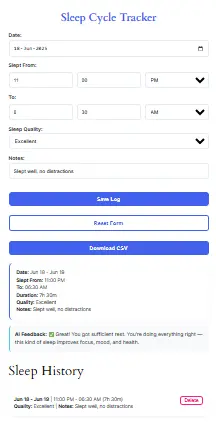
Advanced Features Of Sleep Cycle Duration Calculator
Dual-Mode Intelligent Calculation
Firstly, our sophisticated calculator features two distinct calculation modes for ultimate flexibility. Consequently, you can effortlessly switch between calculating from your bedtime or your desired wake-up time. Moreover, this dual-mode functionality seamlessly adapts to your specific planning needs, whether you have a fixed schedule or flexible hours.
Scientifically-Backed Cycle Analysis
Additionally, the tool employs evidence-based sleep science to generate precise recommendations. Specifically, it calculates optimal times using the proven 90-minute sleep cycle model, which encompasses all stages from light sleep to deep and REM sleep. Furthermore, each calculation automatically incorporates the average 15-minute sleep onset period, thereby ensuring more accurate results.
Multiple Cycle Optimization
Similarly, the calculator provides four different cycle options to accommodate varying sleep needs. For instance, it displays complete 3, 4, 5, and 6-cycle durations, giving you multiple healthy choices. Importantly, the system highlights 5 and 6 cycles as optimal recommendations, since these align with most adults' sleep requirements.
Personalized Sleep Architecture
Moreover, this advanced tool recognizes that sleep needs are highly individual. Therefore, it encourages personal experimentation through its multiple cycle options. Consequently, you can systematically track which cycle count works best for your unique physiology and lifestyle requirements.
Real-Time Adaptive Interface
Meanwhile, the user interface dynamically adjusts based on your selected calculation mode. Specifically, the input fields and results instantly reconfigure between bedtime and wake-time calculations. As a result, you receive immediate, context-appropriate recommendations without page refreshing or delays.
Comprehensive Sleep Intelligence
Beyond basic calculations, this tool integrates educational resources directly alongside the calculator. Consequently, you can immediately understand the science behind each recommendation. Additionally, the integrated FAQ section provides instant answers to common sleep cycle questions, thereby enhancing your understanding of sleep optimization.
Data-Driven Personalization
Furthermore, the calculator serves as a foundation for ongoing sleep optimization. Subsequently, by regularly using the tool and noting your morning energy levels, you can identify your personal ideal sleep duration. Ultimately, this process transforms generic recommendations into personalized sleep intelligence tailored specifically to your body's needs.
Cross-Platform Accessibility
Finally, the responsive design ensures full functionality across all devices. Whether accessing from desktop, tablet, or mobile, the calculator maintains all advanced features and accuracy. Therefore, you can reliably calculate optimal sleep times wherever and whenever needed.
These sophisticated features collectively create more than just a simple calculator; instead, they form a comprehensive sleep optimization system designed to deliver genuinely transformative results for your daily energy and overall well-being.
How to Use This Sleep Cycle Calculator
Using our tool is incredibly straightforward. However, to achieve the best results, follow this simple, three-step guide.
- Choose Your Calculation Mode.
- Scenario A: "I know when I need to wake up." This is the most common use case. For instance, if you have to be up at 7:00 AM for work, you would select the "Wake Up Time" option and input 7:00 AM. The tool will then calculate backwards to show you the ideal times to fall asleep (e.g., 9:45 PM, 11:15 PM, or 12:45 AM).
- Scenario B: "I know when I'm going to bed." Conversely, if you are heading to bed right now at 11:00 PM, select the "Bedtime" option and input the time. The calculator will then project forward to show you the best times to set your alarm (e.g., 6:30 AM, 8:00 AM, or 9:30 AM).
- Click "Calculate" and Review Your Results.
- After clicking the button, you will be presented with a list of times alongside the number of sleep cycles and total duration. Importantly, look for the options that give you between 5 to 6 full cycles for optimal rest.
- Implement Your Schedule and Observe.
- Finally, set your alarm for one of the suggested times and commit to it for at least three nights. Meanwhile, pay close attention to how you feel upon waking. Consequently, you should notice a significant reduction in morning grogginess and an increase in daytime alertness.
Understanding the Science of Sleep: Why Cycles Matter
Firstly, to truly appreciate the power of our calculator, you must understand what a sleep cycle is. Essentially, sleep is not a uniform state of unconsciousness; instead, it is a dynamic process composed of multiple cycles that repeat throughout the night. Each cycle consists of distinct stages, including both Non-Rapid Eye Movement (NREM) and Rapid Eye Movement (REM) sleep.
Typically, a single sleep cycle duration lasts about 90 to 110 minutes. Subsequently, throughout an ideal night, you will progress through four to six of these complete cycles. For instance, the composition of these cycles changes as the night progresses; specifically, early cycles feature more deep NREM sleep, while later cycles contain richer, longer periods of REM sleep, which is crucial for memory consolidation and mood regulation. Therefore, timing your wake-up time to coincide with the end of a cycle, during a period of light sleep, is the fundamental secret to waking up easily. For detail information please refer to National Institute of Neurological Disorders and Stroke - Brain Basics: Understanding Sleep. Sleep Foundation - REM Sleep - A trusted .org resource for in-depth information on REM sleep. American Psychological Association - The Dangers of Sleep Deprivation - An authoritative source on the cognitive and psychological effects of poor sleep.
Introducing Your Personal Sleep Cycle Duration Calculator
Our Sleep Cycle Duration Calculator is a meticulously designed, user-friendly tool that eliminates the guesswork from your sleep schedule. Instead of simply counting hours, it calculates the optimal times for you to fall asleep or wake up based on the natural architecture of your sleep cycles.
Understanding Your Results
The calculator provides multiple time options based on different numbers of sleep cycles:
- 3 cycles (4.5 hours): Minimum recommended - good for naps or emergency rest
- 4 cycles (6 hours): Short night - you might feel slightly sleep-deprived
- 5 cycles (7.5 hours): RECOMMENDED - ideal for most adults
- 6 cycles (9 hours): RECOMMENDED - great for catching up or when you need extra rest
Why These Times Work:
Each option represents completion of full 90-minute sleep cycles. Waking at the end of a cycle (during lighter sleep stages) helps you feel more refreshed than waking in the middle of deep sleep.
Tips for Best Results
- Account for Fall-Asep Time: Firstly, the calculator automatically adds 15 minutes for the time it typically takes to fall asleep. Therefore, if you usually take longer to fall asleep, consider going to bed 15-30 minutes earlier than suggested.
- Experiment and Adjust: While 90 minutes is the average sleep cycle length, individual variations do exist. Consequently, try different cycle counts and see which one makes you feel the most refreshed.
- Be Consistent: For best results, specifically try to maintain consistent sleep and wake times, even on weekends. As a result, your body's internal clock will become more regulated.
- Create a Bedtime Routine: Similarly, start winding down 30-60 minutes before your calculated bedtime. As a result, you will help your body prepare for sleep more effectively.
- Track Your Experience: Finally, make sure to note how you feel when waking up at different cycle counts. In order to, ultimately, find your personal sweet spot.
Example Scenario
If you need to wake up at 7:00 AM for work:
- Use "Calculate by Wake Time"
- Enter 7:00 AM
- The calculator will suggest bedtimes around 11:15 PM (5 cycles) or 9:45 PM (6 cycles)
- Choose the option that fits your schedule and see how you feel
Important Note
Primarily, this calculator uses the average 90-minute sleep cycle; however, individual cycles can vary between 80-110 minutes.
Therefore, the results are intended as recommendations, rather than medical advice.
Consequently, if you consistently feel tired despite optimal sleep timing, consider consulting a healthcare professional.
Additionally, factors like age, lifestyle, and sleep disorders can significantly affect your ideal sleep needs.
Ultimately, by using this tool consistently and paying attention to how you feel each morning, you can optimize your sleep schedule to wake up feeling more refreshed and energized.
Frequently Asked Questions (FAQs)
A 90-minute pattern of light, deep, and REM sleep. Waking up at the end of a cycle helps you feel fresh.
Ideally, 5 to 6 cycles are perfect. That’s around 7.5 to 9 hours of sleep.
That’s often better than more hours interrupted. 6 hours = 4 complete cycles, which is still good.
Yes, it adds an average of 15 minutes to help calculate realistic sleep times.
Yes! It works great on all screen sizes.
Absolutely. Bookmark it or add it to your home screen.
It's primarily a calculator, but you can combine it with tools like our Time Calculator or Reading Time Estimator for better daily planning.
Yes. Reset your cycle by choosing new sleep-wake times for your new timezone. Pair with our Time Zone Converter Tool if you’re traveling.
Totally. We don’t track or save any data.
No problem—just input your current bedtime or desired wake-up time, and the logic still applies.
Yes. Just plan 1.5-hour naps to complete one cycle or 3-hour naps for two cycles.
Yes! For example, our Body Fat Calculator and Age Calculator are great for tracking overall health.
Consistency is key for good sleep hygiene. While sleeping in on weekends is tempting, a drastically different schedule can lead to "social jet lag." Ideally, try to stay within an hour of your weekday sleep and wake times.
They are complementary. A sleep tracker (like an Oura ring or Fitbit) measures your personal biometrics, while our calculator provides a theoretical model based on established science. Using them together gives you the most complete picture.
Conclusion
To wrap it up, sleep isn’t just about how much—you need to think when and how. Completing full sleep cycles is key to feeling fresh and focused throughout the day. And now, thanks to this Sleep Cycle Duration Calculator, anyone can plan smarter, sleep better, and wake up feeling amazing.
Whether you're a student, gamer, parent, or professional, this tool is for you. Pair it with our Hours Calculator, Date Calculator, or 2025 Budget Planner to master both your sleep and schedule.
So, why wait? Try the calculator now, and finally take control of your nights—for better days ahead.