Memorizing dates and events is not enough preparation for Advanced Placement History exams. Success also requires learning how AP rubrics work, understanding historical thinking skills, practicing essay writing, organizing evidence, and reviewing content efficiently.
This hub is designed to support every stage of AP exam preparation with free tools. Therefore it helps you write Document-Based Questions (DBQs), practice Long Essay Questions (LEQs), calculate your expected AP score, build flashcards, and review timelines.
Instead of searching for separate tools, this hub gives you one central starting point for your AP History study journey.
Why Use AP History Study Tools?

Modern AP History preparation is a combination of content knowledge as well as writing skills and self-assessment.
These tools help students:
- Practice essays
- Understand scoring rubrics
- Improve thesis writing
- Strengthen contextualization
- Organize evidence
- Build historical reasoning
- Track progress
- Prepare efficiently
Together, they reinforce the historical thinking skills emphasized on AP exams.
APUSH Essay Tools
These resources focus specifically on AP United States History writing.
| Tool | Purpose | Best For |
| APUSH Contextualization Builder | Practice introductions | DBQ & LEQ |
| APUSH Evidence Organizer | Organize supporting evidence | Essays |
| APUSH SAQ Grader | Evaluate Short Answer Questions | SAQ practice |
| APUSH DBQ Grader + Feedback | Improve DBQ writing | Essay revision |
| APUSH Rubric Mastery Tool | Learn scoring criteria | Score improvement |
Recommended Internal Links
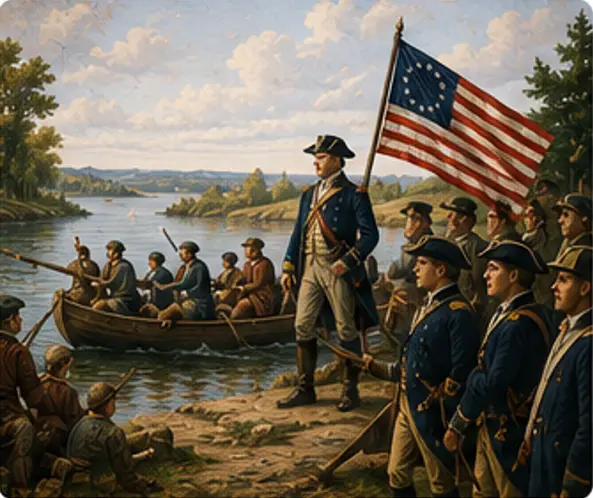
Example: Contextualization
Prompt
Explain one cause of the American Revolution.
Weak Response
The American Revolution started because Britain raised taxes.
Strong Response
After the French and Indian War, Britain increased taxes to reduce its debt. These new policies angered many colonists and helped create the political tensions that eventually led to the American Revolution.
Want to improve your own response? Try the APUSH Contextualization Builder tool linked above.
AP World History Tools
AP World History is less about memorizing a pile of dates and more about seeing the big picture — how societies changed over time, what stayed the same even as empires rose and fell, and how different regions stacked up against each other. It’s really a course about patterns, not just facts.
Helpful resources include:
| Tool | Purpose |
| AP World History LEQ Grader | Evaluate LEQ responses |
| AP World History DBQ Grader | Grade DBQ essays |
| DBQ Complexity Analyzer | Improve complexity point |
| DBQ Thesis Generator | Create stronger thesis statements |
These tools help students develop stronger analytical writing aligned with AP World History expectations.
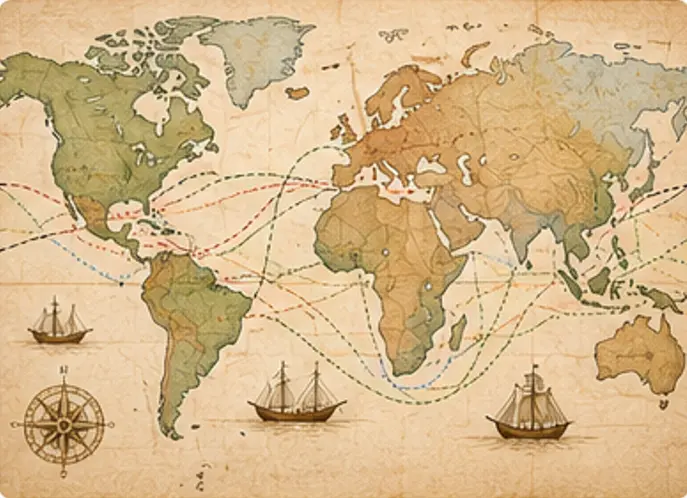
Example: DBQ Thesis
Prompt
Evaluate the impact of the Silk Roads between 1200 and 1450.
Weak Thesis
The Silk Roads helped trade.
Strong Thesis
Between 1200 and 1450, the Silk Roads expanded trade, encouraged cultural exchange, and spread new technologies, making them one of the most influential trade networks of the medieval world.
Practice creating stronger arguments with the DBQ Thesis Generator.
AP European History Resources

European History essays require accurate historical evidence and nuanced argumentation.
Available resources include:
Students can use these together to strengthen both content knowledge and writing quality.
Example: LEQ
Prompt
Evaluate one major cause of the French Revolution.
Weak Response
People were unhappy.
Strong Response
Rising government debt, social inequality under the Estates System, and Enlightenment ideas combined to fuel widespread dissatisfaction that led to the French Revolution in 1789.
Improve your essays with the LEQ Grader.
AP Government Essay Resources

Argument-based essays are central to AP Government.
Helpful resources include:
These tools encourage clear reasoning, constitutional analysis, and evidence-based writing.
Example: Argumentative Essay
Prompt
Should the federal government have greater authority than state governments?
Weak Claim
Yes, because it is stronger.
Strong Claim
The federal government should have greater authority in matters affecting national security and interstate commerce because these issues require consistent policies across all states.
Practice with the AP Government Essay Grader.
AP Score Calculators
Using a score calculator lets you see your projected score, helping you identify strengths and weaknesses before exam day.
Available calculators include:
| Calculator | Purpose |
| APUSH Score Calculator | Estimate APUSH exam score |
| AP US History Score Calculator | Practice scoring |
| AP DBQ Scoring Sheet 2026 | Track rubric points |
Benefits
Understand scoring
Monitor progress
Set improvement goals
Practice under exam conditions
Example: Calculating Your Composite Score
Suppose your scores are:
- MCQ: 42/55
- SAQ: 8/9
- DBQ: 6/7
- LEQ: 5/6
The APUSH Score Calculator estimates your overall AP Exam score and helps identify which section offers the greatest opportunity for improvement.
DBQ Tools
The DBQ isn’t really about memorizing history — it’s about reading a handful of documents and figuring out what story they tell together, then arguing that case with actual evidence instead of just restating what each document says.
Available resources include:
| Tool | Purpose |
| DBQ Thesis Generator | Draft thesis statements |
| DBQ Complexity Analyzer | Evaluate sophistication |
| APUSH DBQ Rubric Calculator | Score essays |
| AP World History DBQ Grader | Essay evaluation |
| AP European History DBQ Grader | Essay grading |
Recommended Workflow
- Read documents
- Generate thesis
- Organize evidence
- Write essay
- Analyze complexity
- Grade response
- Revise
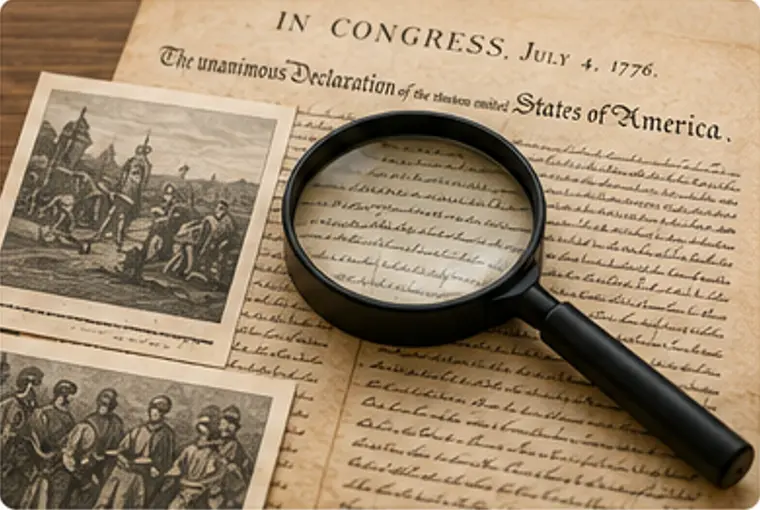
LEQ Tools
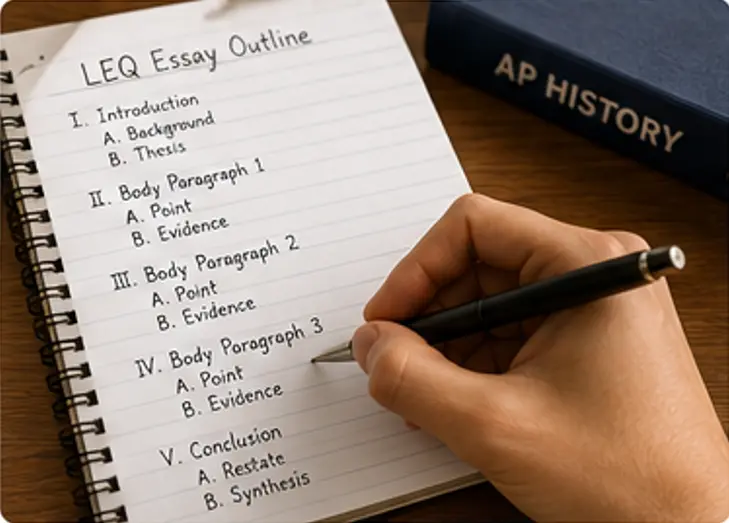
Long Essay Questions test historical reasoning without provided documents.
Helpful resources include:
LEQ Preparation Checklist
| Task | Complete |
| Read prompt carefully | ☐ |
| Build thesis | ☐ |
| Add contextualization | ☐ |
| Organize evidence | ☐ |
| Explain reasoning | ☐ |
| Review rubric | ☐ |
Study & Review Tools
Strong AP preparation combines writing practice with content review.
Resources include:
These resources reinforce historical events, periods, and major themes while preparing students for essays.
Flashcards & Learning Tools
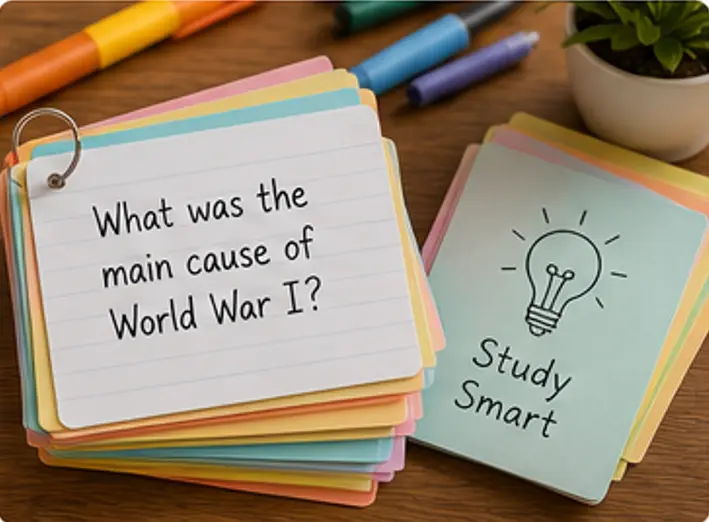
Active recall is one of the most effective study methods.
Available resources:
| Tool | Purpose |
| Flashcard Maker | Create custom cards |
| APUSH Study Tool (Flashcards & Quiz) | Review key concepts |
Flashcards are especially useful for:
- vocabulary
- historical figures
- Supreme Court cases
- legislation
- timelines
- key events
Example: Front and Back of a Card
Front
What was the purpose of the Monroe Doctrine?
Back
It warned European nations against further colonization or interference in the Americas and asserted U.S. influence in the Western Hemisphere.
Create personalized review cards with the APUSH Flashcard & Quiz Tool.
Understanding AP History Rubrics
Most AP History essays are evaluated using consistent historical thinking criteria.
Core scoring categories include:
| Skill | Why It Matters |
| Thesis | Establishes argument |
| Contextualization | Places topic historically |
| Evidence | Supports claims |
| Analysis | Explains significance |
| Complexity | Demonstrates advanced reasoning |
Learning these categories helps students write stronger essays regardless of subject.
Example: Weak vs. Strong Essay Elements
| Essay Element | Weak | Strong |
|---|---|---|
| Thesis | General statement | Clear historical argument |
| Evidence | Few examples | Multiple specific examples |
| Analysis | Limited explanation | Explains how evidence supports the argument |
| Complexity | Missing | Demonstrates nuanced historical understanding |
Use the APUSH Rubric Mastery Tool above to understand how essays are evaluated.
Suggested AP History Study Workflow
| Step | Tool |
| Learn content | APUSH Study Guide |
| Review timeline | Timeline Generator |
| Build flashcards | Flashcard Maker |
| Practice thesis | DBQ Thesis Generator |
| Organize evidence | Evidence Organizer |
| Write essay | LEQ / DBQ |
| Grade essay | Essay Grader |
| Review rubric | Rubric Mastery Tool |
| Estimate score | Score Calculator |
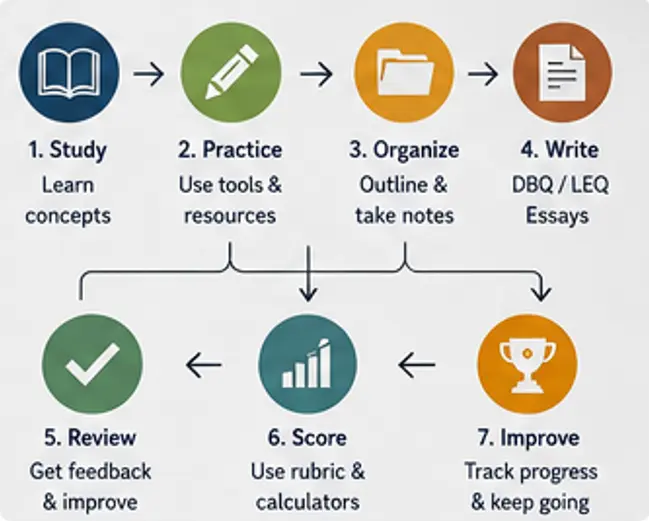
Example Study Plan
Monday
- Read the APUSH Study Guide
Tuesday
- Review Flashcards
Wednesday
- Write one DBQ thesis
Thursday
- Practice one LEQ
Friday
- Check your score with the APUSH Score Calculator
Following a consistent weekly routine can help you build confidence before the AP History exam.
How to Choose the Right Tool
| If You Want To… | Use |
| Improve essays | Essay Graders |
| Learn rubrics | Rubric Tools |
| Practice DBQs | DBQ Tools |
| Practice LEQs | LEQ Tools |
| Build flashcards | Flashcard Maker |
| Estimate scores | Score Calculator |
| Review history | Study Guides |
| Learn timelines | Timeline Generator |
Best Practices
- Practice writing regularly.
- Review official scoring guidelines.
- Revise essays after grading.
- Focus on historical reasoning, not memorization alone.
- Build evidence before writing.
- Use flashcards consistently.
- Review timelines weekly.
- Compare multiple essay responses.
- Track your progress over time.
Common Mistakes
| Mistake | Better Approach |
| Memorizing facts without analysis | Explain historical significance |
| Weak thesis | Make a clear historical claim |
| Limited evidence | Use multiple relevant examples |
| Ignoring contextualization | Connect events to broader history |
| No revision | Review feedback and improve |
Related Resources
Explore additional resources to strengthen your AP History preparation:
AP History Time Management Guide
Frequently Asked Questions
Start with the study guide — you need the content before the writing tools are useful. Flashcards and timelines come next to lock in facts and dates. DBQs and LEQs come last, once you have material to argue with.
No, and they’re not trying to be. They’re good for extra reps outside of class, but your teacher (and the actual College Board rubrics) is still the real authority here.
Yep — some of the tools, like the DBQ and LEQ graders, were basically built with World History in mind.
They do. There’s a lot here for APUSH specifically — essay graders, a score calculator, contextualization builders, timeline stuff, all of it.
One or two timed ones a week is plenty once you’re in exam-prep mode. You don’t need to grind out an essay every single day — that’ll just burn you out before the test even happens.
Yes. Active recall combined with spaced repetition is one of the most reliable study methods, especially for names, dates, and vocabulary you’d otherwise forget.
A few things matter most: read the documents closely instead of skimming, write a thesis that actually takes a stance, back it up with real evidence, and explain why it matters instead of just dropping facts in. Then run it through a rubric-based grader and see where you’re losing points — that part’s key.
Key Takeaways
Memorizing facts alone isn’t enough for AP History — you also need to write and argue like a historian.
The more DBQs and LEQs you practice, the better you get at thinking through historical evidence on the fly.
Rubric feedback is the real game-changer here — it shows you exactly where you’re losing points, not just that something feels “off.”
A solid timeline in your head makes it way easier to connect events during the exam — flashcards and study guides help build that.
At the end of the day, it’s about mixing the right tools together to build a study plan that actually works for you.
Conclusion
Preparing for AP History exams is an ongoing process that combines learning historical content with practicing the skills needed for high-scoring written responses. This hub brings all of those resources together in one organized learning center for APUSH, AP World History, AP European History, and AP Government.

Whether you need to strengthen your thesis, improve contextualization, analyze evidence, estimate your exam score, or review historical events, these tools are designed to support every stage of your preparation. Together, they help you build a strong understanding of historical thinking, refine your writing, and gain confidence for exam day. Use this hub as the starting point for your study journey, and return to it throughout your preparation to find the tools that best match your current goals.