Most students treat AP History time management as a scheduling problem — block out hours, fill a calendar, hope it works. It’s actually a system with moving parts that interact with each other: cognitive science, exam architecture, content volume, and skill development all pull on the same limited resource, which is your time. Understanding how those parts connect is what separates a study plan that survives contact with a real semester from one that quietly falls apart by week three.
This guide goes beneath the surface-level “study X hours a week” advice and explains the mechanics of why AP History time management works the way it does — the cognitive principles behind it, the exam structures that shape it, and the relationships between content mastery, skill practice, and pacing that determine your final score.
What AP History Time Management Actually Means
AP History time management is the deliberate allocation of study time and exam time across three interacting domains: content knowledge (periods, turning points, causation), writing skills (thesis construction, evidence use, argumentation), and pacing discipline (matching time spent to point value, both during prep and during the exam itself). These three domains aren’t independent — they compound. A student with strong content knowledge but poor pacing discipline still runs out of time on the DBQ. A student with excellent pacing but thin content knowledge writes fast, empty essays. The system only works when all three domains receive proportional attention.
This applies across AP World History, APUSH, and AP European History alike, since the College Board structures all three exams around the same core assessment architecture: multiple-choice questions, short answer questions (SAQs), a document-based question (DBQ), and a long essay question (LEQ).
| Goal | Best Tool | Time Needed |
|---|
| Improve DBQ | DBQ Grader | 10 min |
| Learn LEQ | LEQ Grader | 15 min |
| Build Thesis | Thesis Generator | 5 min |
| Practice Evidence | Evidence Organizer | 10 min |
| Estimate Score | Score Calculator | 2 min |
The Cognitive Science Behind Effective Study Scheduling
Cognitive Load and Why Cramming Fails
Cognitive load theory explains why marathon study sessions produce diminishing returns. Working memory — the mental workspace where you actively process information — has a limited capacity. When students try to absorb multiple centuries of content in one unbroken session, working memory saturates, and retention drops sharply after the first 45 to 50 minutes. This is why time-boxed study, not raw hours, predicts performance. A Pomodoro-style structure that breaks review into focused intervals with recovery breaks directly addresses cognitive load by giving working memory periodic reset points.
30-Day AP History Exam Preparation Timeline
Preparing for the AP History exam doesn’t have to feel overwhelming. Breaking your study time into manageable phases helps you build confidence while covering every important skill.
| Days Before Exam | Focus | Daily Study Time |
|---|---|---|
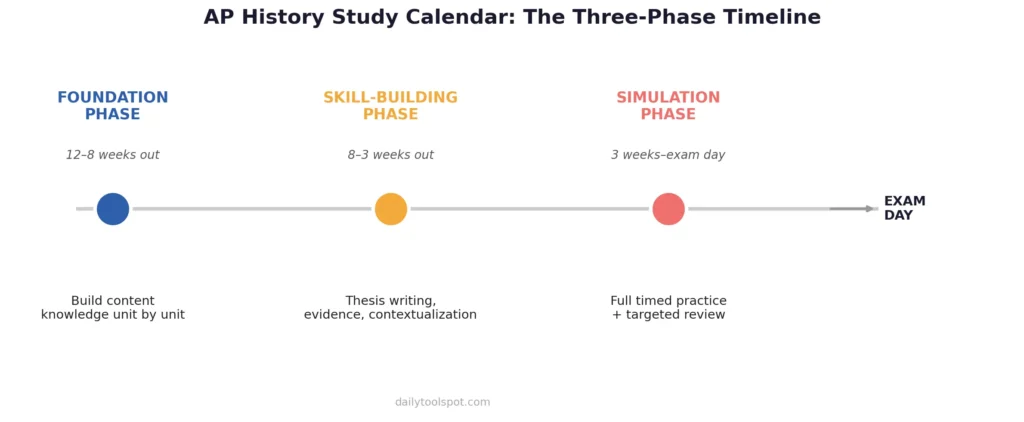
| 30–21 Days | Review Units 1–4, build flashcards, identify weak topics | 45–60 minutes |
| 20–14 Days | Practice SAQs and LEQs while reviewing Units 5–7 | 60 minutes |
| 13–7 Days | Complete DBQs under timed conditions and review scoring rubrics | 60–75 minutes |
| 6–3 Days | Take one full-length practice exam and analyze mistakes | 90 minutes |
| Final 2 Days | Light review, vocabulary refresh, timeline review, and adequate sleep | 30–45 minutes |
Spaced Repetition and Long-Term Retention
Spaced repetition — reviewing material at increasing intervals over time rather than once — is the mechanism behind durable memory formation. AP History covers an enormous span of content (in AP World History, roughly 1200 CE to the present), and single-pass review rarely survives to exam day. Tools built around active recall, such as an AI flashcard maker, work because they force retrieval practice rather than passive rereading, and retrieval practice is consistently shown to outperform highlighting or re-reading for long-term retention.
Interleaving Versus Blocked Practice
Blocked practice (studying one unit exhaustively before moving to the next) feels productive but produces weaker transfer than interleaved practice, where students mix periods and question types within a single session. This matters directly for AP History because the exam requires connecting causation across periods — a DBQ or LEQ prompt might ask students to compare industrialization’s effects across two different centuries. Interleaved review during the skill-building phase of a study plan trains exactly that kind of cross-period reasoning.
How Exam Architecture Shapes Time Allocation
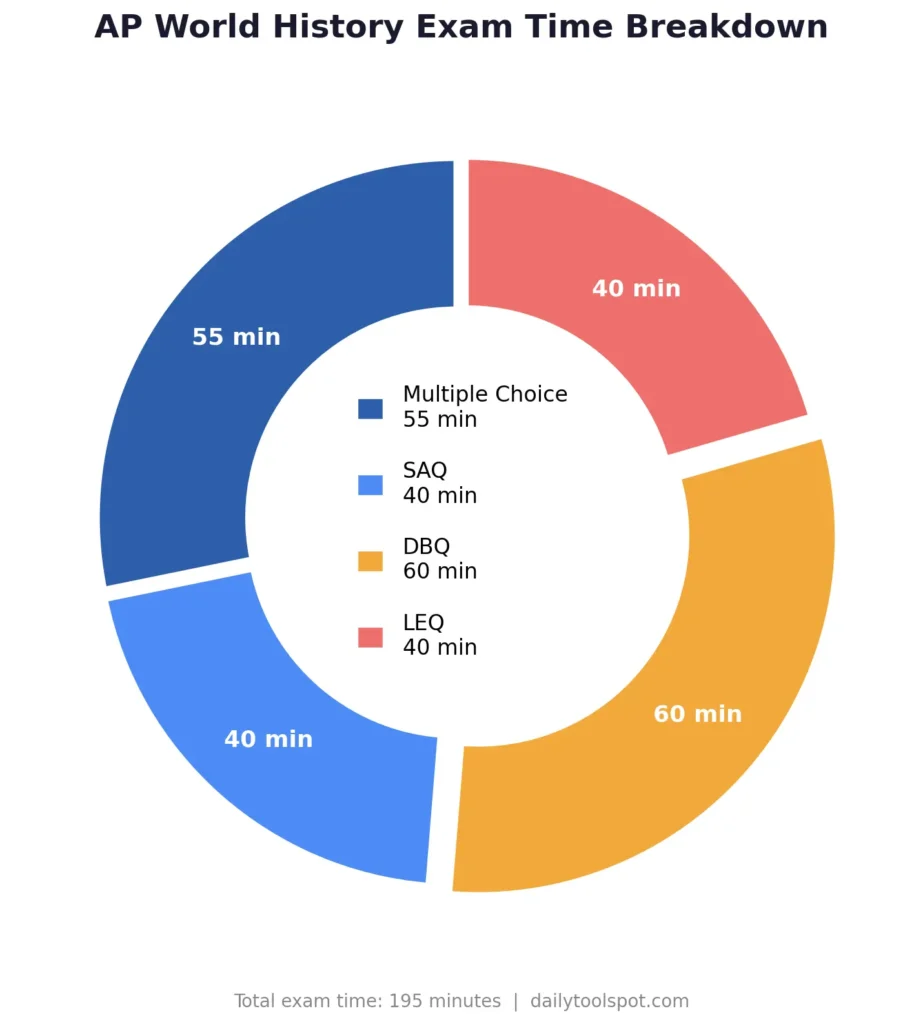
The College Board designs each AP History exam with fixed time blocks per section, and those blocks are not arbitrary — they reflect the cognitive demand of each task. Multiple-choice questions test recognition and require roughly one minute each. SAQs test targeted recall and analysis in short form, allowing about 13 minutes per question. The DBQ, which requires document sourcing, contextualization, and synthesis across six to seven sources, receives the longest single block (60 minutes) because it demands the most cognitive integration. The LEQ, which tests the same argumentative skills without document analysis, gets less time (40 minutes) because it removes the sourcing and synthesis burden.
Understanding this relationship — that time allocation on the exam mirrors cognitive complexity — helps explain why practicing pacing separately from content review matters. A student can check pacing directly by running timed drafts through an AP World History DBQ grader or an LEQ grader, both of which reveal whether time spent on a section is actually producing proportional rubric points.
The College Board designs each AP History exam with fixed time blocks per section, and those blocks are not arbitrary — they reflect the cognitive demand of each task, as detailed on College Board’s official AP World History exam page.
The Relationship Between Rubric Structure and Time Investment
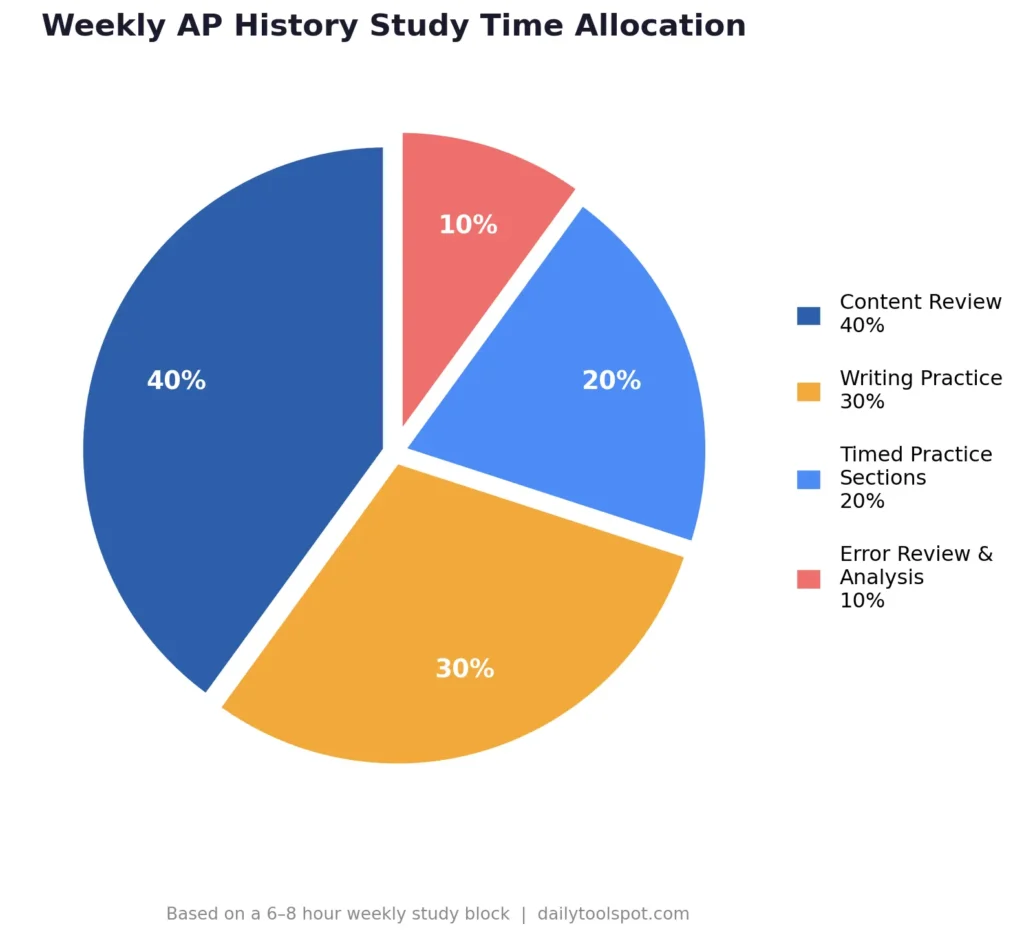
AP History essays are scored against fixed rubric categories: thesis, contextualization, evidence, and analysis/reasoning (which includes complexity). Each category is worth a specific point value, and understanding that distribution changes how students should spend their writing minutes. A thesis, for example, is typically worth just one point but sets up every other category — a vague thesis makes it nearly impossible to earn complexity points later. This is why time spent refining a thesis statement, even briefly, produces outsized returns relative to its point value. Students working on this specific skill often use a DBQ thesis generator to see stronger thesis models quickly, then apply that structure under timed conditions.
Complexity — the highest-order reasoning skill on the rubric — is also the most time-expensive to execute well, since it requires demonstrating nuanced understanding (contradiction, corroboration, or change over time) rather than simple description. Checking essays against a DBQ complexity analyzer helps students see whether their writing is reaching that level or stalling at surface-level description, which is one of the most common ways students lose points despite spending adequate time writing.
AP World History Exam Time Breakdown
Tap a column to sort ↕| Section ▲ | Time ▲ | % of Exam ▲ | Priority ▲ |
|---|---|---|---|
| Multiple Choice | 55 min | 40% | Steady pace |
| Short Answer (SAQ) | 40 min | 20% | Prioritize weight |
| Document-Based (DBQ) | 60 min | 25% | Highest stakes |
| Long Essay (LEQ) | 40 min | 15% | Tight outline |
Common Problems in AP History Time Management and Their Root Causes
Problem: Running out of time on the DBQ. Root cause is usually spending too long in the 15-minute planning window or writing overly long body paragraphs early, leaving no time for the final analytical paragraph.
Problem: Rushed, underdeveloped LEQ responses. Root cause is often poor outlining discipline — students skip the five-minute outline step entirely and write reactively, leading to disorganized arguments that need mid-paragraph correction.
Problem: Strong content knowledge that doesn’t convert to score. Root cause is a mismatch between content study and skill practice — students who memorize the encomienda system, mercantilism, or Cold War alliances thoroughly but never practice applying that knowledge inside a timed essay structure often underperform relative to their actual knowledge base.
Problem: Study plans that collapse mid-semester. Root cause is almost always an unrealistic initial calendar that didn’t account for school, extracurriculars, and other coursework. Mapping available study days honestly with a custom workday calculator prevents this before it happens rather than after motivation has already eroded.
Best Practices That Connect the System Together
- Treat pacing as a trainable skill, not an instinct — practice it with the same regularity as content review.
- Score practice writing against the actual rubric structure using an APUSH DBQ rubric calculator so time investment gets measured against real point outcomes, not self-assessment.
- Use interleaved review sessions in the weeks closer to the exam, mixing periods rather than studying them in isolation.
- Track projected readiness periodically with an AP US History score calculator to see whether time spent is closing gaps in specific sections.
- Build recovery time into the schedule deliberately — cognitive load research supports this as a performance factor, not a luxury.
- When mapping out your weekly study blocks, make sure you allocate specific days for essay practice. You can find all of our automated graders and outline generators linked together in our main AP History Study Tools hub.
AP History Study Schedule for Different Goals
Every student has different goals. Your study plan should match the score you’re aiming for.
| Target Score | Recommended Daily Study Time | Main Focus |
|---|---|---|
| Score 3 | 30–40 minutes | Content review and basic practice |
| Score 4 | 45–60 minutes | Essay writing and timed practice |
| Score 5 | 60–90 minutes | Full practice exams, rubric mastery, and advanced analysis |
Students aiming for a 5 should regularly practice writing DBQs and LEQs under realistic exam conditions rather than simply rereading notes.
Sample Weekly APUSH Study Schedule
Many students ask how to organize an entire week of study. Here’s one example that balances review with practice.
| Day | Activity | Time |
|---|---|---|
| Monday | Review textbook chapter and notes | 45 min |
| Tuesday | Practice SAQs | 45 min |
| Wednesday | Complete one LEQ | 60 min |
| Thursday | Review mistakes and flashcards | 30 min |
| Friday | Practice DBQ document analysis | 60 min |
| Saturday | Timed multiple-choice questions | 60 min |
| Sunday | Review weak topics and prepare next week’s plan | 45 min |
Consistency is far more effective than studying for several hours only once each week.
How DailyToolSpot Can Help You Prepare
After following the study strategies above, reinforce your preparation with these free AP History resources:
- APUSH Score Calculator – Estimate your AP exam score before test day.
- APUSH LEQ Grader – Receive structured feedback on your Long Essay Question using rubric-based practice feedback.
- DBQ Grader – Evaluate document-based essays using rubric-based scoring.
- SAQ Grader – Improve short-answer responses with targeted feedback.
- AP History Study Hub – Access all APUSH, AP World, and AP European History study tools in one place.
Using these tools alongside a consistent study schedule helps you identify weak areas early and practice more efficiently.
Frequently Asked Questions
Because every other rubric category builds on it. A weak or vague thesis makes contextualization and complexity harder to demonstrate clearly, even if the underlying content knowledge is strong.
For long-term retention and cross-period reasoning, yes — interleaving trains the kind of comparative thinking the DBQ and LEQ actually require, even though blocked practice can feel more organized in the moment.
Working memory fatigue accumulates across a multi-hour exam. Students who practiced under similarly long, unbroken conditions typically manage late-exam fatigue better than those who only ever studied in short bursts.
They’re multiplicative, not additive. Strong content with weak pacing produces incomplete essays; weak content with strong pacing produces fast but empty ones. Improving both simultaneously produces compounding score gains.
DBQ generally deserves slightly more practice time since it carries more exam minutes and requires an additional skill (document sourcing) that LEQ does not.
Map your actual available time honestly, including school and other obligations, before assigning study hours — plans built on idealized free time are the most common reason study schedules collapse.
Key Takeaways
AP History time management is a connected system, not a checklist. Cognitive load theory explains why study sessions need structure and breaks. Spaced repetition and interleaving explain why review timing matters as much as review volume. Exam architecture explains why the DBQ and LEQ receive different time allocations, and rubric structure explains why some categories deserve disproportionate attention relative to their point value. Understanding these relationships — rather than memorizing isolated tips — is what allows a study plan to hold up under real academic pressure and translate into stronger performance on exam day.
Leave a Reply