🔍 DBQ Complexity Analyzer
Score your DBQ essay for the complexity point — the hardest rubric point to predict. Get instant, sentence-by-sentence feedback on thesis tension, reasoning, evidence, sourcing, and contextualization.
Why the Complexity Point Is the Hardest One to Predict
Most students can tell whether their DBQ has a thesis, cites documents, or includes outside evidence — those are visible, checkable things. The complexity point is different. It’s not a box you tick; it’s a quality that either runs through an essay’s reasoning or doesn’t, and that makes it almost impossible to judge from the inside. A sentence that feels sophisticated to the person who wrote it can read as a flat assertion to an AP reader who’s scored five hundred other essays that week.
That gap between intended complexity and demonstrated complexity is exactly what this tool is built to expose.
What This Tool Actually Checks
To be transparent about how it works: the analyzer doesn’t “understand” your essay the way a human reader does. It scans your text for the specific language patterns that historically correlate with each part of the rubric — the kind of phrasing AP readers are trained to notice.
This is a useful diagnostic, not a verdict. A sentence can contain “however” and still be shallow, and a sentence without it can still be genuinely complex. Treat the score as a prompt to reread your own writing more critically, not as a final grade.
Reading Your Results
Each of the five feedback categories maps to a different piece of the rubric’s Analysis and Reasoning and Evidence categories. If a category comes back weak, that’s a pointer to where to revise — not just that something’s wrong. A missing “Contextualization” flag, for instance, usually means your essay jumps straight into the argument without giving the reader a sense of what came before.
Common Reasons Students Lose the Complexity Point
Recognizing these patterns is often more useful than reading abstract rubric language, because they describe what actually shows up in student essays:
- The thesis restates the prompt instead of making an arguable claim, leaving nothing complex to build toward.
- Documents are summarized rather than analyzed — the essay says what a document contains but never explains what that content means for the argument.
- Contextualization is a single generic sentence disconnected from the rest of the essay, rather than a thread that informs the analysis.
- The essay picks one side of a debate without acknowledging tension, contradiction, or nuance, even when the prompt invites it.
- Change is described but continuity is ignored, or vice versa, when the historical reality involves both.
- Outside evidence is dropped in without connection to the surrounding argument, functioning as a fact rather than support for reasoning.
Best Practices for Building Complexity Into an Essay
Complexity is easier to build in from the outline stage than to retrofit into a finished draft. A few practical habits make a measurable difference:
Write a thesis with built-in tension. Instead of a single-clause claim, structure a thesis around two or three lines of reasoning that interact — for example, acknowledging a driving cause and a limiting factor. This gives the rest of the essay somewhere to go.
Group evidence by argument, not by document. Organizing body paragraphs around ideas (economic pressure, social resistance, political response) rather than “Document 1, Document 2, Document 3” naturally pushes toward synthesis instead of summary.
Use explicit connective language. Phrases that link one idea to another — “this reinforced,” “in contrast,” “this shift, however, coexisted with” — signal reasoning to a reader far more effectively than sophisticated vocabulary alone.
Bring in outside context deliberately. A well-placed reference to a broader trend (a prior war, a preceding economic policy, a parallel development elsewhere) demonstrates the cross-period thinking the rubric specifically rewards.
Revisit the thesis in the conclusion with development, not repetition. A conclusion that shows how the argument evolved through the essay — rather than restating the opening line — reinforces the sustained reasoning graders are trained to look for.
If you’re consistently missing the sophistication point, you might need to review your document analysis skills. Our central AP History Study Tools hub features several resources dedicated to helping you build more nuanced historical arguments and cross-document connections.
Building Complexity Before You Draft, Not After
Complexity is far easier to build in from the outline stage than to bolt onto a finished essay:
- Write a thesis with built-in tension — a driving cause and a limiting factor, not a single flat claim.
- Organize paragraphs by idea, not by document — “economic pressure,” “political response,” rather than “Document 1, Document 2.”
- Use connective language deliberately — phrases like “this reinforced” or “in contrast” do more work than advanced vocabulary alone.
- Tie context to your argument — a sentence about what preceded the period only counts if it actually informs your reasoning, not if it’s dropped in and abandoned.
Complexity isn’t a trick or a formula — it’s what happens when a thesis, its evidence, and its reasoning are actually arguing with each other instead of sitting side by side. This tool exists to help you see, sentence by sentence, whether that’s happening in your own draft. For a broader review of the full rubric, the APUSH DBQ Grader covers all four scoring categories together.
Frequently Asked Questions (FAQs) About the DBQ Complexity Analyzer
The DBQ Complexity Analyzer focuses intensely on the single complexity point and the skills required to earn it. Conversely, the full APUSH DBQ Grader provides a comprehensive score and feedback on all rubric categories.
No. The rubric explicitly rejects complexity manufactured through a single inserted phrase. The tool flags language patterns because they tend to accompany genuine complexity — not because the words themselves earn points on the real exam.
Some essays synthesize evidence without saying “Document 4” outright. That’s fine stylistically, but on the actual AP exam, readers need to trace your evidence back to a specific source, so explicit references are still the safer habit for scoring purposes.
No. This is a self-review tool for catching structural gaps before you submit an essay for real feedback — from a teacher, a study group, or the exam itself.
Because the scoring is pattern-based, small wording changes near a threshold can shift the result. Use the score as a rough signal, and reread the actual sentences the feedback references rather than chasing a number.
Editorial and Tool Information
This page provides a free diagnostic tool for analyzing the complexity of Document-Based Question essays in AP History courses.
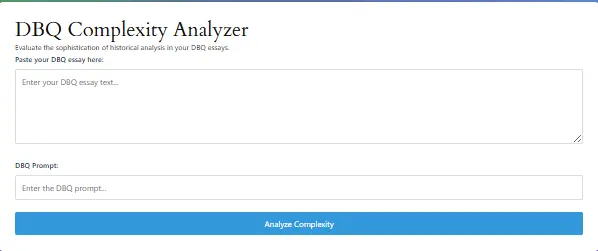
The tool was developed around a simple workflow: paste essay → enter prompt → analyze → review sentence-by-sentence feedback.
The page and tool information are reviewed periodically to improve clarity and reflect changes to the tool. When discussing AP exam requirements or scoring criteria, students should use current official College Board materials as the authoritative source.
Last reviewed: September 2026
Keep Building Your DBQ Skills
Use the analyzer to see where your complexity is strong and where it’s thin, then revise with the feedback in mind. For a full rubric review, try the DBQ Grader — it scores all 7 points.
When you’re ready, try the DBQ Grader, Thesis Generator, or explore the AP History Study Tools hub for more resources.