APUSH Evidence Organizer
Collect, categorize, and manage historical evidence for your DBQs and LEQs
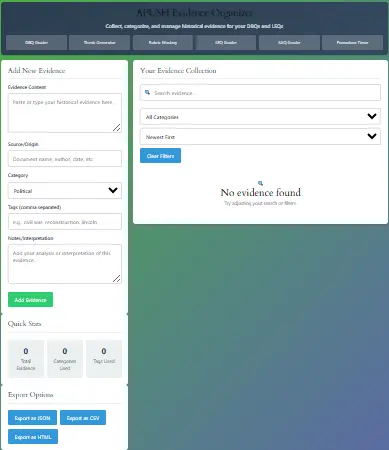
Add New Evidence
Quick Stats
Export Options
Your Evidence Collection
No evidence added yet
Start by adding your first piece of historical evidence using the form on the left.
In today’s demanding AP United States History curriculum, students consistently face the challenge of organizing vast amounts of historical evidence effectively. Consequently, the APUSH Evidence Organizer emerges as an essential digital tool that transforms how students approach document-based questions and long essay questions. Moreover, as a companion to our popular DBQ Grader and Thesis Generator, this organizer completes a comprehensive suite of APUSH preparation tools designed to elevate student performance.
Furthermore, understanding the critical role of evidence organization in historical argumentation, this tool addresses a fundamental need in historical thinking skills. Specifically, the College Board emphasizes the importance of “argument development” and “use of evidence” in its scoring rubrics. Therefore, by systematically categorizing and managing historical evidence, students can dramatically improve their analytical writing capabilities. Ultimately, this leads to more sophisticated arguments and higher scores on AP examinations.
Key Features of the APUSH Evidence Organizer
Intuitive Evidence Collection System
The APUSH evidence collection tool features a streamlined interface for capturing historical evidence efficiently. Initially, students can input evidence directly from their textbooks, primary source readers, or online resources. Meanwhile, the system automatically timestamps each entry, creating a chronological record of research progress. Furthermore, the clean, distraction-free design ensures focus remains on content rather than complicated navigation.
Comprehensive Categorization Framework
Rather than using generic folders, our DBQ evidence collection system employs historical thinking categories that mirror AP exam expectations. Specifically, students can classify evidence as political, economic, social, cultural, intellectual, diplomatic, or military – the same frameworks historians use to analyze the past. Subsequently, this categorization becomes second nature, improving students’ ability to organize their thoughts during timed examinations.
Advanced Tagging Capabilities
Beyond broad categories, the tool offers sophisticated tagging features that allow for precise evidence identification. For instance, students can create tags for specific time periods (“colonial era”), key figures (“Thomas Jefferson”), major events (“Civil War”), or thematic concepts (“manifest destiny”). As a result, this granular organization enables quick retrieval of relevant evidence when constructing arguments under time constraints.
Source Documentation Tracker
Proper source attribution represents a crucial historical skill, and our historical argument builder includes dedicated fields for documenting origins. Specifically, students can record author, publication date, document type, and contextual information for each piece of evidence. Consequently, this practice reinforces academic integrity while preparing students for college-level research expectations.
Analytical Notes Integration
Unlike simple note-taking apps, this tool encourages deeper engagement through dedicated analysis fields. After adding evidence, students are prompted to record their interpretations, connections to other evidence, and potential uses in arguments. Therefore, the process moves beyond mere collection to active historical thinking and interpretation.

Advanced Features for Sophisticated Historical Analysis
Intelligent Search and Filter System
The APUSH research tool incorporates powerful search functionality that scans across evidence content, source information, tags, and student notes simultaneously. Additionally, multiple filter options allow students to isolate evidence by category, time period, or specific tags. Thus, when preparing for a particular DBQ about Progressive Era reforms, students can instantly access all relevant evidence without sifting through unrelated material.
Statistical Overview Dashboard
Understanding one’s research patterns can reveal gaps in understanding, which is why the tool includes a comprehensive statistics dashboard. Specifically, it displays the total volume of evidence collected, distribution across historical categories, and most frequently used tags. Subsequently, students can identify overrepresented and underrepresented areas in their research, enabling more balanced preparation.
Multi-Format Export Capabilities
Recognizing that students work in various environments, the evidence organizer for historical arguments offers flexible export options. Students can download their evidence collections as JSON files for digital backup, CSV spreadsheets for further analysis in Excel, or formatted HTML documents for printing and review. Moreover, these exports preserve all categorization, tags, and analytical notes for seamless transitions between study environments.
Cross-Platform Compatibility
Designed with modern students in mind, the tool functions flawlessly across devices including laptops, tablets, and smartphones. Consequently, students can add evidence during class, review while traveling, or prepare at home without losing functionality or data synchronization.
Integration with Complementary APUSH Tools
The Evidence Organizer works synergistically with our other APUSH tools. For example, after organizing evidence, students can use our DBQ Thesis Generator to develop sophisticated arguments, then assess their work with our DBQ Grader for immediate feedback. Similarly, the LEQ Grader provides specialized evaluation for long essay questions, while the Rubric Mastery Tool helps students internalize AP scoring standards.
How to Use the APUSH Evidence Organizer: A Step-by-Step Guide
Getting Started with Evidence Collection
Begin by opening the APUSH Evidence Organizer and familiarizing yourself with the interface. First, locate the evidence input form on the left side of the screen. Then, as you encounter significant historical evidence in your studies, paste or type it into the “Evidence Content” field. Next, always provide specific source information including author, document title, and date to practice proper historical citation.
Implementing Effective Categorization
After entering evidence, immediately select the most appropriate category from the dropdown menu. For instance, a speech by Abraham Lincoln about emancipation would typically be categorized as “Political,” while data about Southern agricultural production would be “Economic.” Simultaneously, consider whether the evidence might fit multiple categories – this cross-categorical thinking often leads to more nuanced historical analysis.
Mastering the Tagging System
Develop a consistent tagging vocabulary to maximize organizational efficiency. Specifically, create tags for major time periods, key historical figures, significant events, and recurring themes. Subsequently, apply multiple relevant tags to each piece of evidence. For example, a photograph of factory conditions during industrialization might receive tags for “Gilded Age,” “urbanization,” “labor,” and “industrialization.”
Adding Analytical Value Through Notes
The notes field represents where evidence transforms into historical understanding. Here, explain the significance of the evidence, connect it to other knowledge, and suggest how it might support various historical arguments. Furthermore, regularly review and update these notes as your understanding deepens throughout the course.
Leveraging Search and Filter Functions
When preparing for specific assignments or exams, use the search and filter tools to focus your review. For instance, if studying for a DBQ about Cold War foreign policy, filter by “Diplomatic” category and search for tags like “Cold War,” “containment,” or “Truman Doctrine.” Consequently, you’ll immediately access all relevant evidence without distraction.
Regular Review and Organization Sessions
Schedule weekly sessions to review your evidence collection, add new tags, refine categories, and update analytical notes. Additionally, use this time to identify patterns, connections, and gaps in your understanding. Meanwhile, our Pomodoro Timer with Task List can help structure these review sessions for maximum productivity.
Exporting for Different Study Scenarios
Before exams, export your evidence to formats that match your study preferences. For example, create a printed HTML version for group study sessions, or use the CSV export to create visualizations of your evidence distribution. Moreover, JSON backups ensure your work remains secure throughout the academic year.
Why Evidence Organization Matters in APUSH
Firstly, successful historical analysis requires more than just accumulating facts; indeed, it demands strategic organization and contextual understanding. Traditionally, students have struggled with managing disparate pieces of evidence from multiple sources including primary documents, scholarly interpretations, and historical data. Subsequently, our historical evidence organizer provides a structured approach to this challenge, enabling students to see connections and patterns that might otherwise remain hidden.
Additionally, the tool aligns perfectly with the historical thinking skills emphasized in the APUSH curriculum: chronological reasoning, comparison and contextualization, crafting historical arguments, and historical interpretation and synthesis. Specifically, by using categories like political, economic, social, cultural, intellectual, diplomatic, and military frameworks, students learn to analyze evidence through multiple historical lenses. Consequently, this multidimensional approach fosters the sophisticated analysis that earns top scores on DBQs and LEQs.
Why Use an APUSH Evidence Organizer?
This APUSH Evidence Organizer is designed to help students collect, sort, and connect historical evidence before writing a DBQ, LEQ, or SAQ.
Instead of trying to remember every event, law, court case, or historical figure during the exam, students can use this tool to build an organized evidence bank by topic, theme, time period, or historical thinking skill.
The tool helps users:
- Organize evidence by period and theme
- Group evidence into political, economic, and social categories
- Connect outside evidence to a thesis
- Prepare for DBQs, LEQs, and SAQs
- Build stronger historical arguments
- Save time during exam writing
Students who organize evidence before they begin writing usually produce clearer, more focused essays. APUSH readers reward essays that use evidence to support an argument rather than simply listing facts.
How This Tool Improves DBQ and LEQ Writing
One of the biggest challenges in APUSH is knowing which evidence belongs in which paragraph. A strong DBQ or LEQ usually groups evidence into 2–3 major categories, such as political, economic, or social causes and effects. Organizing evidence in advance makes it much easier to build body paragraphs and connect facts back to the thesis.
For example, a student writing about the Progressive Era could organize evidence like this:
- Political evidence: initiative, referendum, direct election of senators
- Economic evidence: trust-busting, regulation of monopolies
- Social evidence: settlement houses, child labor reform, women’s suffrage
By grouping evidence this way, students can create body paragraphs that are easier to write and easier for AP readers to follow.
Designed Around the APUSH Rubric
This tool is based on the same skills required by the APUSH rubric:
- Thesis and line of reasoning
- Contextualization
- Evidence from documents
- Outside evidence
- Sourcing and analysis
- Historical complexity
The strongest APUSH essays use evidence for a purpose. To earn full evidence points, students must not only mention evidence but also explain how it supports the argument. Many students lose points because they list facts without connecting them to the thesis.
The APUSH DBQ rubric currently expects students to use most of the provided documents and at least one piece of outside evidence to earn maximum evidence points.
Why Outside Evidence Matters
Outside evidence is one of the easiest ways to improve an APUSH essay score, but many students forget to include it.
Outside evidence means using a specific fact, event, law, court case, or person that is not included in the provided documents. Good outside evidence strengthens the argument and shows deeper historical knowledge.
Examples include:
- Using the Panic of 1893 in a Populism DBQ
- Using Brown v. Board of Education in a Civil Rights essay
- Using the Marshall Plan in a Cold War DBQ
Strong students often keep a separate “outside evidence bank” so they can quickly pull in relevant facts during the exam.
Study Tips for Using This Tool
To get the best results from this APUSH Evidence Organizer:
- Organize evidence by unit or historical period
- Create separate sections for political, economic, and social evidence
- Include 1–2 sentences explaining why each piece of evidence matters
- Add outside evidence to each major topic
- Review your evidence regularly before the exam
- Practice turning organized evidence into thesis statements and body paragraphs
Many successful APUSH students recommend using an evidence organizer during the 15-minute DBQ planning period. Spend that time grouping documents, writing a quick outline, and deciding where your outside evidence fits.
A student on Reddit who scored well on APUSH described a common structure as:
“2–3 body paragraphs” using documents, outside evidence, and explanation tied back to the thesis.
Another student explained that the easiest way to organize documents is to group them into political, economic, and social categories before writing.
Who Should Use This Tool?
This APUSH Evidence Organizer is useful for:
- AP U.S. History students
- Students preparing for DBQs, LEQs, and SAQs
- Teachers creating classroom evidence banks
- Tutors helping students improve essay writing
- Anyone who wants to strengthen historical thinking and argumentation
Even students who already know the content often struggle because their evidence is not organized. This tool helps solve that problem by turning scattered notes into a clear, usable study system.
Frequently Asked Questions About the APUSH Evidence Organizer
Unlike generic note-taking applications, the APUSH evidence collection tool is specifically designed around historical thinking skills and AP exam requirements. Consequently, it forces students to categorize evidence using historical frameworks, add analytical commentary, and make connections that directly improve their writing for DBQs and LEQs.
Absolutely, while optimized for AP United States History, the organizational framework applies to any history course requiring evidence-based arguments. Specifically, the categorization system works equally well for European History, World History, or any social studies curriculum emphasizing document analysis.
For optimal results, we recommend dedicating 20-30 minutes twice weekly to evidence organization. Initially, this may seem substantial, but the time investment pays significant dividends during exam preparation and writing practice. Furthermore, using our Pomodoro Timer can help maintain focus during these sessions.
When evidence spans multiple categories, choose the primary category that represents its most significant aspect, then use tags and notes to indicate secondary connections. For example, the Louisiana Purchase might primarily be “Diplomatic” but could also have tags for “expansion” and “Jefferson” with notes about economic and political implications.
The Evidence Organizer represents the foundation of our APUSH tool ecosystem. After organizing evidence, students can use our DBQ Thesis Generator to formulate arguments, then assess their practice essays with our DBQ Grader or LEQ Grader. Additionally, the Rubric Mastery Tool helps students understand how their evidence organization translates to scoring criteria.
While no tool can guarantee specific results, students who systematically organize and analyze historical evidence typically show significant improvement in their historical thinking and writing abilities. Specifically, the tool addresses the evidence and analysis components that comprise substantial portions of DBQ and LEQ rubrics.
Teachers can use the Evidence Organizer for document-based activities, research projects, and ongoing historical thinking development. For instance, assigning students to collect and categorize evidence for specific units, then using the export function to review their work. Additionally, the statistical features help identify class-wide understanding gaps.
The Evidence Organizer stores all data locally in your browser, meaning you can continue adding and organizing evidence without internet access. Subsequently, when connection resumes, you can export your work normally. However, for backup security, regularly export your evidence collection.
Quality matters more than quantity, but as a general guideline, 150-200 well-chosen, thoroughly analyzed pieces of evidence typically provide sufficient coverage for the entire APUSH curriculum. Importantly, focus on diverse evidence types spanning different time periods and historical categories.
Currently, the tool requires manual entry, but this process encourages deeper engagement with the material. However, you can copy and paste text from digital sources, then add your categorization, tags, and analysis. Meanwhile, the act of manually processing evidence strengthens retention and understanding.
Our Expertise and Editorial Process
This tool was created using APUSH writing strategies, official rubric requirements, and commonly recommended DBQ and LEQ preparation methods. The page is reviewed regularly to ensure it remains accurate, useful, and aligned with current AP U.S. History exam expectations.
Author: AP History Study Tools Team
Expertise:
- APUSH exam preparation
- DBQ and LEQ writing
- Historical evidence organization
- Academic study tools
Editorial Policy:
Every recommendation, study strategy, and example on this page is reviewed for clarity, historical accuracy, and alignment with the current APUSH rubric.
Conclusion: Transforming Historical Understanding Through Organization
In conclusion, the APUSH Evidence Organizer represents a paradigm shift in how students approach historical evidence and argument construction. By providing a structured yet flexible framework for evidence management, the tool bridges the gap between content knowledge and analytical writing proficiency. Consequently, students transition from passively accumulating facts to actively engaging with historical material as practicing historians would.
Moreover, when used consistently throughout the APUSH course, this organizational system creates a personalized knowledge repository that grows in sophistication alongside student understanding. The statistical features provide valuable metacognitive insights, while the export functions ensure evidence remains accessible across study environments. Furthermore, integration with our complementary tools creates a comprehensive preparation ecosystem that addresses multiple aspects of AP success.
Ultimately, the goal extends beyond exam performance to developing genuine historical thinking skills that serve students in college and civic life. The ability to organize complex information, identify patterns across diverse sources, and construct evidence-based arguments represents perhaps the most valuable outcome of history education. Therefore, we encourage students to begin using the Evidence Organizer early in their APUSH journey, developing consistent habits that will yield compounding benefits as exam season approaches.
For continued improvement, remember to utilize our complete suite of APUSH tools including the DBQ Grader, Thesis Generator, Rubric Mastery Tool, LEQ Grader, and SAQ Grader. Additionally, maintain sustainable study habits with our Pomodoro Timer with Task List. Together, these resources provide the comprehensive support system today’s APUSH students need to excel both on examinations and in their development as historical thinkers.
