Enter a topic, a claim, and up to three supporting points, and the generator fits them into a sentence template for your essay type. Paste a thesis you’ve already written into the grader and it reports how the sentence is built: length, wording, and structure. Both run in your browser on fixed rules, not AI, so you get a starting draft and a quick check, not a verdict.
Thesis Architect
Write it so it can follow the topic: “threatens personal privacy”, “improves student health”.
The draft updates as you type. It is a template starting point — reword it so it says something specific about your essay.
This is a keyword-and-structure check, not a grade. It can’t tell whether your claim is true, arguable, or answers your assignment.
Example theses
“Although renewable energy requires high upfront costs, it is essential for long-term sustainability because it reduces carbon emissions, creates green jobs, and ensures energy independence.”
Why it works: it admits the main objection, takes a position, and gives three reasons the essay can develop.
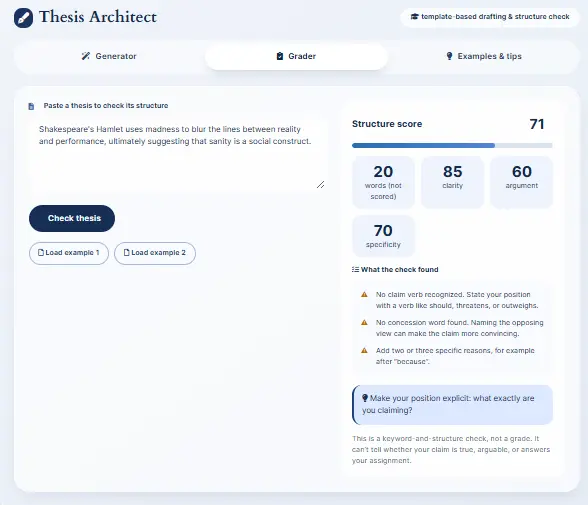
“Shakespeare’s Hamlet uses madness to blur the lines between reality and performance, ultimately suggesting that sanity is a social construct.”
Why it works: it names what is analyzed (madness in the play), how (blurring reality and performance), and a conclusion.
“The rise of remote work has reshaped urban economies by reducing demand for office space, shifting population patterns, and accelerating digital infrastructure.”
Why it works: it states the topic and the three ideas the essay will explain. Note that it explains rather than argues, so the grader may rate its claim wording lower.
Common pattern: concession + topic + position + because + two or three reasons.
Arguable test: could a reasonable person argue the opposite? If not, you probably have a fact, not a thesis.
What the tool does, and what it can't judge
The generator has one template for each essay type and each number of supporting points. The preview updates as you type.
The grader scans your sentence for patterns. It looks for concession words (although, while, despite), claim verbs (should, must, will, reveals, shows), signals of reasons (because, through, commas, lists), and example markers (such as, including, for example). It shows a word count and treats sentences of roughly 12 to 30 words as clearer. What it can't do is understand your topic. It doesn't know whether your claim is true, arguable, or responsive to your assignment. It also recognizes only a short list of claim verbs, so a good thesis built on "threatens" or "threatens" may score lower than it deserves. Treat the number as a rough shape check.
What a strong thesis needs
University writing-center guidance, such as the UNC Writing Center, keeps returning to a few questions. Does the thesis answer the question you were asked? Is it specific enough to support? Would a reader ask "so what?" Does it tell them something they didn't know? A fast test is to ask whether someone could reasonably argue the reverse. If nobody could, you likely have a fact, not a thesis.
The essay type changes what the sentence must contain. An argumentative thesis states a position and the reasons for it. An expository thesis names the topic and the ideas the paper will explain. An analytical thesis says what you're analyzing, which aspects you're examining, and what you conclude. The generator's three modes follow that split. If your assignment says "explain," pick expository. As if it says "evaluate" or "break down," pick analytical. If you're taking a side, pick argumentative.
Entering your claim
The templates join your topic and claim directly, so write the claim as a verb phrase that agrees with your topic: "artificial intelligence threatens personal privacy" (singular), "later start times improve student health" (plural). Skip "I think" and "I believe," since college writing guides generally advise against them. The same phrasing works in all three essay types. If a sentence still reads awkwardly, reword it by hand.
Example
Say the assignment asks whether schools should start later. In argumentative mode, enter the topic "later high school start times," the claim "improve student health," and the points "more sleep," "fewer late arrivals," and "better attendance." The generator produces:
Although some disagree, later high school start times improve student health because of more sleep, fewer late arrivals, and better attendance.
It's grammatical, but it's a draft. "Some claim otherwise" doesn't say who disagrees or why. The three points are topics rather than reasoning: how does fewer late arrivals show better health? A revision that does that work:
It's grammatical, but it's a draft. "Some disagree" doesn't say who disagrees or why. The three points are topics rather than reasoning: how do fewer late arrivals show better health? A revision that does that work:
The revision names the real objection, commits to a judgment, and offers one connected reason the essay can develop. (This is an illustration of structure. A real essay would need evidence for every claim in it.)
Common mistakes
- Chasing the score. The grader counts commas and keywords, so you can raise a number by adding clauses without improving the argument. Revise against the questions above first, then check the grader.
- Listing instead of reasoning. Three nouns after "because" make a topic list. The thesis should hint at how the points connect.
- Pasting the output into your essay. Your instructor may expect your own wording, so check your course's policy.
- Treating the thesis as finished. A thesis begins as a working version and is revised as the essay develops. Reread it against your finished body paragraphs and adjust.
Limits
This is practice feedback, not a grade. It knows nothing about your prompt or rubric. The tool's script doesn't send what you type anywhere, and it uses no AI or outside service.
Frequently Asked Questions (FAQs)
Usually at the end of the introduction. In longer papers it may appear further down.
The grader matches a fixed vocabulary. If your verbs or transitions aren't on its list, it can miss them. Trust your judgment over the number.
Yes, and you often should. Rewrite it to match what the essay actually argues.
Match the assignment's verb: explain, break down or evaluate, or take a position.
No account or login is required. The tool runs entirely in your browser, ensuring your privacy and convenience. Simply visit the page and start using it immediately.
Next steps
Build your structure around the thesis with the Essay Outline Generator, then draft your opening with the Essay Hook Generator. I haven't seen either destination page, so check that the anchor text matches what each one does.