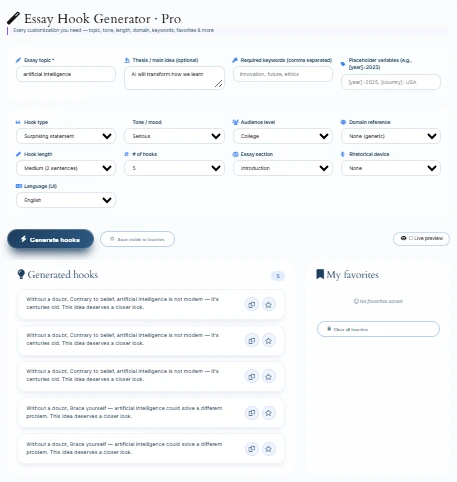
Enter your topic, choose a hook style and tone, and the generator returns opening-line templates you can react to. It’s a starting point for your own opening, not a finished one.
Essay Hook Generator · Pro
Generated hooks
5My favorites
What this tool actually does
The generator is template-based and runs entirely in your browser. There’s no AI model behind it. Each hook starts from one of about thirty prewritten sentence patterns for the style you pick. It drops in your topic, sometimes your thesis or a domain word, then adds whatever you’ve selected: a tone phrase, a transition for a body paragraph or conclusion, or an extra line for length. Favorites are saved in your browser’s local storage, so they stay on your device and vanish if you clear site data.
The consequence is simple: the tool can’t know anything about your subject. It can show you the shape of an opening, but it can’t supply the specifics that make an opening good.
What a hook is for
Writing-center guidance is less about flash than most people expect. The UNC Writing Center describes an introduction as a bridge into your topic. It should tell readers what the topic is, why it matters, and how you’ll proceed. Also suggests opening with an intriguing example, a quotation closely tied to your argument, a puzzling scenario, an anecdote, or a question. It also warns that these openers don’t suit every paper or discipline, so ask your instructor if you’re unsure.
Both UNC and the UW–Madison Writing Center say you needn’t write the introduction first. Draft it whenever it’s easiest, then check that it matches the paper you actually wrote. UNC’s quick test is to hand your introduction to a friend and ask what they expect the paper to cover. If they can predict it, the opening is doing its job.
Choosing a hook style
A question works when your essay answers it. “Have you ever wondered…” almost never does. An anecdote suits personal or reflective writing, but the template only gives you a frame and the story has to be yours. A quote is risky in academic writing: UNC notes that famous or inspirational quotes often fall flat, while a line from one of your own sources usually works. The built-in quotes are a short generic list and don’t come from your reading, so treat them as placeholders. Surprising and rhetorical statements are the easiest to rewrite into something real, provided you can back up the surprise.
Don’t cite what the tool writes
The statistic and fact templates contain illustrative numbers and sweeping claims. None of them is sourced, and none is specific to your topic. They exist to show the pattern. Never carry those figures into an essay. If you like the pattern, find a real number from a source you can cite, and say where it came from.
Example: from generated hook to usable opening
Say your topic is school phone bans, and you choose “surprising statement” with a serious tone. The tool might return:
Without a doubt, Here’s the twist: school phone bans might be opposite of what we’re taught.
There are three problems. The stock phrase at the front reads awkwardly. “What we’re taught” is vague (by whom?). And nothing points toward a thesis. Here is one rewrite, shown purely as an illustration of the reasoning:
Schools that ban phones usually say they’re protecting attention. Few ask whether a ban teaches students anything about managing a device at all.
The rewrite names a specific tension, and it leads naturally into a thesis such as “This essay argues that…”. That connection to the thesis is the part no template can do for you.
Mistakes that cost the most
- Opening too broad. UNC singles out the “dawn of man” opening, such as “Since the beginning of time…”. Match your zoom level to your question.
- Restating the prompt or opening with a dictionary definition. UNC lists both among weaker introductions.
- Leaving the tone phrase in. Phrases like “Without a doubt,” are added automatically and can leave a capital letter mid-sentence. Read every hook aloud.
- Choosing a hook your thesis can’t follow. If the next sentence feels like a jump, change the hook.
- Writing it once and never rechecking it. Revisit it after the draft is done.
Limits
Tone, length, essay-section and rhetorical-device settings add stock phrases rather than rewriting the sentence, and the same added line appears on every hook in a batch. Domain words appear in only some templates. The tool doesn’t check facts, doesn’t know your assignment, and can’t tell whether a hook fits your thesis. If you’re writing a timed or rubric-graded essay, check what the rubric rewards before spending time on a hook.
Frequently Asked Questions About Essay Hooks
No. They’re illustrative. Replace them with a sourced figure or delete them.
Probably similar ones. The output comes from a small fixed set of templates plus your words, so rewrite anything you use.
The tool’s code makes no network requests, so what you type isn’t sent to a server by the generator. Favorites are stored locally in your browser.
Not necessarily. UNC and UW–Madison both say it’s fine to write the introduction last.
Next steps
When your opening points at a claim, sharpen the claim with the Thesis Statement Generator & Grader, then plan the body with the Thesis Outline Generator or draft with the Free Essay Writing Tool. For deeper guidance, read the UNC and UW–Madison handouts linked above.