Build Contextualization
That Earns the Point ✨
Stuck on how to frame your DBQ? Type your topic, hit generate, and get instant historical context suggestions that connect to the broader picture.
Tell us about your DBQ
Fill in what you know — only topic is required
Your context suggestions
Ready to weave into your DBQ intro
Ready when you are!
Fill in your DBQ topic on the left and hit generate to see historical contexts built specifically for your prompt.
How it works
Enter your topic
Type the DBQ topic, theme, or prompt you’re working on.
Pick your focus
Narrow it down by political, economic, social, or diplomatic angle.
Generate contexts
Get instant suggestions for broader historical connections.
Write in your words
Use the suggestions as a launchpad — always write it yourself.
Build broader historical context for an APUSH DBQ. Enter your topic and time period to generate historical context suggestions you can use as starting points for your own contextualization.
Use the suggestions as brainstorming help. Always verify historical details and explain the connection to your DBQ prompt in your own words.
What Is Contextualization in APUSH?
Contextualization means explaining the broader historical developments that relate to the topic in an APUSH question.
Instead of simply naming a historical event, connect the event or development to the larger situation surrounding the topic.
Example: If a DBQ asks about the causes of the American Revolution, you could discuss earlier developments such as colonial political traditions, British imperial policies, and growing tensions over taxation and representation.
The key is to explain how the broader historical context connects to the topic of the question.
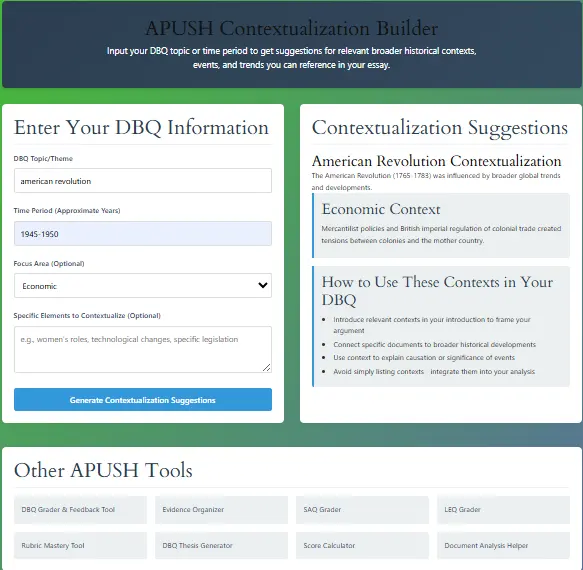
How to Use the Contextualization Builder
- Enter your DBQ topic — Identify the main historical event, development, or issue.
- Enter the time period — Add the approximate period covered by your question.
- Add specific elements — Include important people, events, policies, movements, or developments when relevant.
- Generate context suggestions — Review the broader historical connections provided by the tool.
- Write the connection yourself — Use the suggestions to develop a concise contextualization that directly relates to your DBQ.
The tool provides starting points. It does not write a complete DBQ response for you.
How to Turn a Suggestion Into Contextualization
A useful contextualization does more than list historical facts.
Use this simple process:
Broader development → Specific historical situation → Connection to the DBQ
For example, instead of writing:
The Industrial Revolution changed the United States.
Explain how that development relates to the specific topic you are discussing.
A historical fact becomes useful contextualization when you explain why it matters to the question.
Keep the Context Relevant
Choose historical developments that help explain or frame the DBQ topic. Avoid adding facts simply because they occurred during the same period.
Explain the Connection
After identifying broader historical context, explain how it connects to the issue in the prompt.
Avoid Unrelated Facts
Contextualization should support your historical argument. Unrelated information can make the introduction longer without strengthening your response.
APUSH Contextualization Example
Suppose a DBQ asks about the causes of the Civil War.
Possible broader context could include:
- Expansion of slavery into western territories
- Growing sectional differences between the North and South
- Debates over federal and state power
- Earlier conflicts over slavery and territorial expansion
The important step is not simply mentioning these developments. Your response should explain how they created the historical conditions surrounding the specific issue in the DBQ.
Important Tool Limitation
This Contextualization Builder is an educational brainstorming tool. It provides predefined historical examples and general historical-thinking prompts to help you identify possible connections.
For topics outside its specific examples, the suggestions may be general rather than detailed historical explanations.
Use the generated ideas as a starting point, and verify historical details before including them in an APUSH essay.
Frequently Asked Questions About APUSH Contextualization
Contextualization explains the broader historical situation surrounding an APUSH question. It connects the topic to related historical events, developments, or processes.
Provide relevant historical context and explain how it connects to the topic of the prompt. Simply naming an event or historical fact is not enough.
No. Contextualization provides broader historical background, while evidence uses specific historical information to support an argument.
There is no required number of sentences. Focus on explaining relevant historical context clearly and connecting it to the DBQ topic.
Continue Your APUSH Preparation
After developing your contextualization, you can continue practicing other parts of the APUSH DBQ:
- APUSH Evidence Organizer — organize historical evidence for your argument.
- DBQ Thesis Generator — practice developing a focused thesis.
- APUSH DBQ Grader — review your DBQ response and identify areas to improve.
Final tip: Good contextualization is relevant, specific, and connected to the historical issue in the prompt. Use the builder to find possible connections, then explain those connections in your own words.