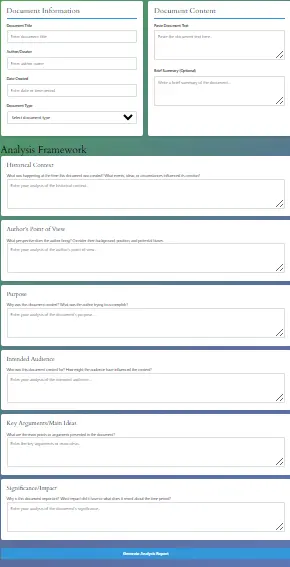
Document Information
Document Content
Analysis Framework
Historical Context
What was happening at the time this document was created? What events, ideas, or circumstances influenced its creation?
Author’s Point of View
What perspective does the author bring? Consider their background, position, and potential biases.
Purpose
Why was this document created? What was the author trying to accomplish?
Intended Audience
Who was this document created for? How might the audience have influenced the content?
Key Arguments/Main Ideas
What are the main points or arguments presented in the document?
Significance/Impact
Why is this document important? What impact did it have or what does it reveal about the time period?
How to use this worksheet
- Paste your document text into the box above. For a picture, such as a cartoon, describe what you see, including labels and captions.
- Fill in the six fields.
- Click Generate Analysis Report.
- Save the report as a .txt file or print it.
Each report covers one document. Save it before you start the next one.
What the worksheet does
The worksheet walks you through HIPP sourcing. HIPP stands for historical situation, intended audience, purpose, and point of view. These are the features AP U.S. History readers expect you to explain for a document. The Key Arguments and Significance fields help you state the claim that your sourcing supports.
The worksheet does not count words or characters, check grammar, grade essays, or accept PDF uploads. It runs in your browser, and nothing you enter is sent to a server.
Why sourcing matters on the DBQ
On the AP U.S. History DBQ, you earn the sourcing point when you explain how or why a document’s point of view, purpose, historical situation, or audience matters to your argument. Naming the feature is not enough. The College Board’s 2025 scoring guidelines require this for at least two documents.
- Identifies (no point): “Jackson was a politician.”
- Explains (earns the point): “Because Jackson was running for reelection against the Bank’s defenders, his account should be weighed against his political interest.”
Example: two documents about the Bank War
Most sourcing guides use one document. This example uses two public-domain sources that attack the same target in different ways.
Source 1: Andrew Jackson’s Veto Message (July 10, 1832). Jackson vetoed a bill to recharter the Second Bank of the United States. The full text is on the Avalon Project at Yale Law School.
Source 2: Edward Williams Clay, “Downfall of Mother Bank” (1833). This lithograph shows President Jackson holding a removal order for federal deposits while the Bank’s pillars topple. Nicholas Biddle is pictured as a devil among Jackson’s fleeing opponents. The catalog record is at the Historical Society of Pennsylvania. The artist is Edward Williams Clay, not Henry Clay, the Whig senator who opposed Jackson.
| Field | Veto message (1832) | Lithograph (1833) |
|---|---|---|
| Historical situation | Congress recharters the Bank, and Jackson vetoes it | Jackson orders federal deposits removed from the Bank |
| Intended audience | Senators, then voters who read the message | Ordinary viewers who see the print |
| Purpose | Justify the veto with a policy argument | Celebrate the Bank’s collapse and ridicule its president |
| Point of view | A Democrat who sees the Bank as a privilege for the rich | A pro-Jackson artist who portrays Biddle as a devil |
A sourcing sentence that connects both documents
“Jackson’s veto message and Clay’s lithograph both present the Bank as a corrupt force, but they reach different audiences in different ways. Jackson argues to senators and voters that a privilege enriches insiders, while the print uses ridicule to make Biddle a villain for viewers who would never read a veto message. Together they show that opposition to the Bank was argued in both legal and popular terms.”
Notice that this sentence explains why each document’s audience and purpose matter. It also draws a conclusion that both documents support.
Weak and revised sourcing
Weak: “This cartoon is biased because it was made by a Jacksonian.”
Revised: “Because the lithograph was made to be seen rather than read, its claim that Biddle is a devil works through ridicule. That shows how Jacksonians turned a financial dispute into a moral one for ordinary voters.”
The weak version only labels the source. The revised version explains what the source’s form does to its message.
Using the worksheet for the DBQ
- During the reading period, fill in one report for each document and save each one.
- Choose at least two documents to source. Look for a pair that agrees on the surface but differs in audience, purpose, or form, as Jackson and Clay do.
- For each document, choose the HIPP element that best supports your thesis.
- After you write, check that each sourced document has an explanation that starts with how or why.
Next, build your thesis with the DBQ Thesis Generator, organize documents by argument in the Evidence Organizer, and check your finished essay with the DBQ Grader.
Sourcing checklist for drafts
- Each sourced document has at least one HIPP element named.
- Each sourced document has a sentence that explains how or why, not just a description.
- Each explanation connects to your thesis.
- At least one connection is made between the documents.
- Pictures are explained by their form: ridicule, captions, symbols, or labels.
Common mistakes
- Summarizing a document instead of analyzing it.
- Calling a source “biased” and stopping there.
- Saving context for the end of the essay.
- Sourcing a document without connecting it to your thesis.
Frequently Asked Questions (FAQs)
No. Use your word processor’s counter for word and character counts.
Yes. It works for any primary source. For cartoons, prints, and other pictures, describe the visual elements in the content box before filling in the fields.
No. Save the report to keep a copy.