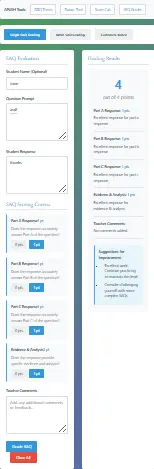
SAQ Evaluation
SAQ Scoring Criteria
Batch SAQ Grading
Upload Student Responses
Prepare a CSV file with columns: Student Name, Question Prompt, Response
Download CSV template
Customize Rubric
Default Rubric Templates
Rubric Criteria
Grading Results
- Add more specific historical evidence
- Connect evidence directly to the question
- Address all parts of the question
The APUSH SAQ Grader is a practice tool for students preparing for the Short Answer Question section of the AP U.S. History exam. It helps students review their responses for historical evidence, explanation, accuracy, and completeness based on common APUSH SAQ expectations.
Instead of simply giving a score, the tool is designed to help you identify what is working in your response and what you should improve before practicing again. It should be used as a study and revision aid, not as an official College Board scoring system.
Key Features of the APUSH SAQ Grader
Our tool incorporates several innovative features designed to maximize your learning efficiency. First, the Instant Rubric Analysis automatically evaluates your response against the official APUSH SAQ grading criteria. Simultaneously, the Specific Feedback Generator identifies exactly which elements of your answer need improvement and, equally importantly, which elements you’ve mastered.
Meanwhile, the Score Prediction feature provides an estimated score based on current performance, helping you track progress over time. Additionally, the Historical Evidence Checker verifies the accuracy and relevance of your factual references, ensuring you’re building arguments on solid foundations. Finally, the Thesis Statement Analyzer evaluates whether your opening claims are sufficiently clear, arguable, and responsive to the prompt.
How to Use the APUSH SAQ Grader: A Step-by-Step Guide
Step 1: Accessing the Tool
Initially, navigate to the APUSH SAQ Grader page from our main website. Alternatively, you can bookmark the direct link for quick access during study sessions. Open the APUSH SAQ Grader and review the instructions before starting your practice response. No official College Board account is required to use the grader.
Step 2: Inputting Your Response
Next, either type your SAQ response directly into the text field or paste it from your document. Meanwhile, ensure you’ve also entered the original question prompt, as this context enables more accurate feedback. Enter or paste the SAQ prompt and your response into the appropriate fields. Make sure your answer addresses the specific part of the question being evaluated.
Step 3: Receiving and Interpreting Feedback
After submitting your response, the tool generates comprehensive feedback within seconds. Specifically, color-coded highlights identify different elements of your answer: green for strong components, yellow for areas needing improvement, and red for significant issues. Consequently, you can quickly prioritize which aspects to focus on first.
Step 4: Implementing Suggestions
Then, revise your response directly within the tool based on the feedback provided. Meanwhile, reference the examples of high-scoring responses from our database to understand what excellence looks like for similar questions. Subsequently, resubmit your improved answer to track your progress.
Step 5: Integrating Feedback into Future Practice
Finally, apply the lessons learned to new practice questions. Moreover, use our interconnected tools like the APUSH Rubric Mastery Tool to deepen your understanding of scoring criteria. Similarly, the Pomodoro Timer with Task List can help structure your study sessions for maximum efficiency.
Understanding the APUSH Short Answer Question
Before exploring the tool itself, let’s first establish what makes SAQs uniquely challenging. Typically, the SAQ section presents students with three required questions that must be answered in approximately 40 minutes. Subsequently, each question may contain multiple parts (A, B, C) that require specific, concise responses. Meanwhile, successful responses must demonstrate both factual knowledge and historical thinking skills, all while maintaining strict time management.
Additionally, the College Board evaluates SAQs based on a precise rubric that rewards specificity, analysis, and direct response to the prompt. However, many students struggle to self-assess whether their answers meet these criteria adequately. Consequently, our APUSH SAQ Grader bridges this critical gap by providing immediate, detailed feedback aligned exactly with official scoring standards.
The Importance of SAQ Practice in APUSH Success
SAQs are an important part of APUSH preparation because they require students to respond directly to historical questions using specific evidence and explanation. Practicing SAQs can also strengthen skills that transfer to longer AP History writing tasks, including selecting evidence and explaining historical relationships.
Moreover, regular SAQ practice develops the concise writing style and precise thinking that college-level history demands. Conversely, neglecting SAQs often results in time management issues during the exam and missed scoring opportunities. Therefore, integrating our SAQ Grader into your weekly study routine creates the consistent practice necessary for mastery.
Connecting SAQ Skills to Other Exam Components
Interestingly, the skills honed through SAQ practice directly transfer to other exam sections. For example, the ability to quickly identify relevant evidence for SAQs strengthens your document analysis for the DBQ Grader. Similarly, the concise argumentation required for SAQs builds discipline for the more extended LEQ Grader responses.
Furthermore, the thesis development practiced in our DBQ Thesis Generator applies directly to crafting effective SAQ responses that go beyond mere description. Consequently, using these tools in concert creates a virtuous cycle of skill development across all exam components.
How APUSH SAQs Are Scored
APUSH Short Answer Questions are evaluated using a point-based approach. Each part of an SAQ asks you to respond to a specific historical task, and students earn credit by providing a historically accurate response that addresses the question.
A strong SAQ response should:
- Directly answer the question being asked.
- Use specific and relevant historical evidence.
- Explain the historical significance of the evidence when the question requires explanation.
- Address every part of the prompt.
What the APUSH SAQ Grader Evaluates
The grader is designed to help you review:
- Historical accuracy — Are your claims historically appropriate?
- Relevant evidence — Did you use specific evidence related to the question?
- Explanation — Did you explain your answer rather than simply name a fact?
- Prompt coverage — Did you respond to each required part?
- Clarity — Is your response understandable and directly connected to the prompt?
The feedback is intended for practice and revision. It should not be treated as an official College Board score.
Common APUSH SAQ Mistakes
Mistake #1: Being Too Vague
Weak:
People wanted change.
Better:
Many Americans supported reforms because industrial monopolies gained significant economic power during the Gilded Age.
Mistake #2: Missing Evidence
Students often make claims without supporting them with historical examples.
Mistake #3: Not Answering Every Part
Many SAQs contain multiple components that must all be addressed.
APUSH SAQ Writing Tips
Use the ACE Method
A — Answer the question
C — Cite evidence
E — Explain the connection
Example:
- Answer: The Progressive Movement grew partly because of industrial monopolies.
- Cite Evidence: Companies such as Standard Oil dominated industries.
- Explain: This concentration of power encouraged calls for government regulation.
Short Answer Questions can be tricky because you have to be incredibly concise. To master the rest of the exam, including the DBQ and LEQ sections, check out our complete suite of AP History Study Tools.
Who Should Use This Tool?
- AP United States History students
- APUSH teachers
- Tutors
- Homeschool students
- Students preparing for practice exams
- Students reviewing graded SAQs
Frequently Asked Questions About the APUSH SAQ Grader
The APUSH SAQ Grader is designed to provide practice feedback based on common APUSH SAQ expectations. It can help identify areas that may need improvement, but automated feedback should not be considered a replacement for official College Board scoring or teacher feedback.
Absolutely! The tool includes a timing feature that helps you practice responding within the recommended 12-15 minutes per question. Additionally, our Pomodoro Timer can structure your practice sessions to build speed gradually.
Unlike static guidelines, our tool provides personalized feedback specific to your writing. It doesn’t just tell you what a good response looks like—it shows you exactly how to improve your particular answer.
The tool evaluates whether your evidence is sufficiently precise (names, dates, specific events) rather than vague generalizations. It will flag responses that need more concrete details to earn points.
Yes, the tool contains assessment criteria for all nine APUSH periods, from 1491 to the present. It recognizes period-specific context and evaluates whether you’ve placed your answer appropriately within historical chronology.
We regularly update our database with new questions, including previously administered AP exam questions and original prompts developed by experienced teachers. The available practice material depends on the prompts currently provided by the tool. You can use the grader with your own APUSH SAQ practice responses as well.
We prioritize student privacy. Check the site’s privacy policy for information about how submitted responses and other user data are handled.
The Short Answer Question (SAQ) section of the AP United States History exam requires students to answer historical questions using specific evidence and historical reasoning. Unlike DBQs and LEQs, SAQs are concise responses that focus on accuracy, evidence, and direct explanation.
The earlier the better! Students who begin using the tool at least 2-3 months before the exam show significantly greater improvement. However, even last-minute practice can help refine technique.
Currently, the tool works on mobile browsers, but we recommend using a computer for the best experience, especially for longer practice sessions. Our Pomodoro Timer, however, is optimized for mobile use during study breaks.
Integrating the SAQ Grader into Your Study Plan
To maximize benefits, we recommend a structured approach to using the tool. Initially, focus on understanding the feedback thoroughly rather than rushing through multiple questions. Subsequently, create a weekly schedule that alternates between SAQ practice, DBQ work using our DBQ Grader, and LEQ development with the LEQ Grader.
Additionally, use the tool at different stages of your learning process. Early in the year, focus on building fundamental skills without time pressure. As the exam approaches, incorporate strict timing to simulate test conditions. Meanwhile, regularly revisit questions you initially struggled with to reinforce your learning and track improvement.
The Educational Philosophy Behind Our Tools
Our approach stems from evidence-based learning principles, particularly the concept of “deliberate practice.” Rather than mindless repetition, our tools break down complex historical thinking into manageable components. Consequently, students can focus on specific skills until they achieve mastery before integrating them into full responses.
Furthermore, we believe immediate feedback is crucial for effective learning. The traditional model of waiting days or weeks for teacher feedback creates a disconnect between effort and improvement. Our tools bridge this gap, creating a tight feedback loop that accelerates learning and builds confidence.
“When analyzing primary sources for your SAQ responses, it’s crucial to consult authoritative repositories like the National Archives to understand historical context. Additionally, the Stanford History Education Group provides excellent frameworks for developing the historical thinking skills. For comprehensive study support, Khan Academy’s AP US History section offers free resources aligned with the AP curriculum.”
How to Get More From APUSH SAQ Practice
The APUSH SAQ Grader is most useful when you treat each result as an opportunity to revise your response. Check whether you answered the prompt directly, used specific historical evidence, and explained your reasoning clearly.
Practice one response, review the feedback, revise it, and then try another question. Over time, this process can help you become more comfortable with the concise writing and evidence-based reasoning required by APUSH SAQs.
Educational Disclaimer
This tool provides educational feedback designed to help students improve historical writing skills. Final AP Exam scoring is determined by official College Board readers using official rubrics and scoring guidelines.
About the Tool
The APUSH SAQ Grader was created to help students receive instant feedback on short-answer responses. The goal is to provide guidance on evidence usage, historical reasoning, and response completeness so students can practice more effectively before exams.
For optimal results, we recommend using the APUSH SAQ Grader alongside our other specialized tools:
- DBQ Grader & Feedback Tool for document-based questions
- DBQ Thesis Generator for crafting powerful arguments
- LEQ Grader for long essay questions
- APUSH Rubric Mastery Tool for deep understanding of scoring criteria
- Pomodoro Timer with Task List for effective study sessions
- APUSH Evidence Organizer for Master DBQs and LEQs with Precision