Instant, rubric-aligned structural analysis and feedback
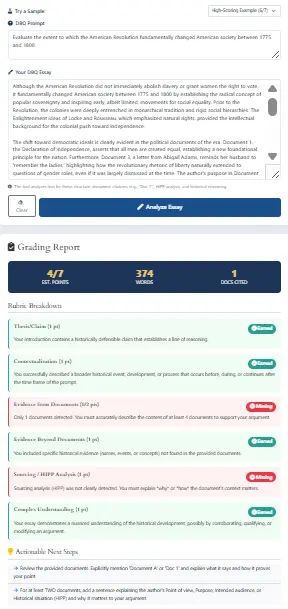
Our APUSH DBQ Grader is a free online scoring tool that helps teachers and students evaluate Document Based Questions (DBQs) for the AP US History exam. Using the official AP rubric, it provides instant scoring, detailed feedback, and actionable suggestions to improve essay writing.
Whether you’re a teacher saving grading time or a student preparing for the AP exam, this automated grader ensures accuracy, consistency, and personalized feedback without the hassle.
For a more in-depth analysis and personalized feedback, try our comprehensive DBQ Thesis Generator for APUSH.
How to Use the APUSH DBQ Grader Tool
Using our grader is simple and user-friendly:
- Paste the student’s DBQ response into the text area.
- Adjust scoring criteria if needed, or keep the default AP rubric.
- Click “Evaluate Response” to generate a score instantly.
- Review the detailed feedback and writing suggestions.
- Use “Generate Comprehensive Feedback” for in-depth analysis.
After grading, you can also check your overall AP score using our AP US History Score Calculator. This tool is fantastic for evaluating your own essays, but don’t forget to review your core historical timelines and vocabulary. You can find links to all our review materials on the main AP History Study Tools page.
Features of the APUSH DBQ Grader
- Free online tool with no registration required
- Instant scoring based on the official AP US History DBQ rubric
- Provides detailed feedback for improvement
- Saves hours of grading time for teachers
- Accessible on desktop and mobile devices
Advanced Features of the APUSH DBQ Grader
- Rubric Breakdown – Evaluates thesis, contextualization, evidence, and analysis.
- Customizable Scoring – Adjust rubric weightings if needed.
- Comprehensive Feedback Mode – Extended suggestions to strengthen essays.
- Consistency Guarantee – Eliminates subjectivity in grading.
- Exam Prep Support – Helps students identify weaknesses before test day.
APUSH DBQ Rubric Breakdown
The AP US History DBQ rubric awards up to 7 points:
- Thesis/Claim (1 point): Defensible thesis that addresses the prompt.
- Contextualization (1 point): Connects essay to broader historical context.
- Evidence (3 points): Uses at least 3–6 documents effectively to support arguments.
- Analysis & Reasoning (2 points): Explains point of view, purpose, audience, and demonstrates complex understanding.
Tips for Writing High-Scoring DBQs
- Start with a clear, argumentative thesis.
- Use contextualization to link the topic to wider historical trends.
- Avoid summarizing documents—analyze them as evidence.
- Consider purpose, audience, and perspective in analysis.
- Practice time management to complete essays under exam conditions.
Why Teachers & Students Love Our APUSH DBQ Grader
Teachers save valuable grading time, while students get clear guidance on improving essays. This tool bridges the gap between manual grading and self-study prep, making it a must-have resource for APUSH success.
What Is an APUSH DBQ?
The AP United States History (APUSH) Document-Based Question (DBQ) requires students to analyze historical documents and build an evidence-based argument. Students must combine document analysis, outside historical knowledge, contextualization, and historical reasoning to earn points on the official rubric.
The DBQ is one of the most important writing tasks on the APUSH exam because it measures both historical understanding and argumentation skills.
How the APUSH DBQ Grader Evaluates Essays
This tool reviews student responses using common APUSH DBQ scoring categories, including:
- Thesis and claim development
- Historical contextualization
- Use of document evidence
- Outside historical evidence
- Document sourcing (HIPP analysis)
- Historical reasoning and complexity
The goal is to help students identify strengths and weaknesses before submitting practice essays or taking the AP exam.
APUSH DBQ Rubric Breakdown
| Skill | What Readers Look For |
|---|---|
| Thesis | A historically defensible argument |
| Contextualization | Broader historical background connected to the prompt |
| Evidence | Accurate use of documents and outside information |
| Sourcing | Analysis of audience, purpose, historical situation, or point of view |
| Complexity | Nuanced historical reasoning and connections |
The modern APUSH DBQ rubric awards up to 7 points across these categories.
Sample APUSH DBQ Feedback
Prompt: Evaluate the causes of the Progressive Movement.
Student Thesis:
The Progressive Movement developed because industrialization created economic inequality, political corruption, and social reform demands.
Feedback Example
Clear historical claim
Establishes a line of reasoning
Responds directly to the prompt
Improvement Suggestion
The thesis could become stronger by specifying how these factors influenced reform efforts.
Estimated Rubric Impact
- Thesis Point: Likely Earned
- Contextualization: Not Yet Demonstrated
- Evidence: Requires document support
Common APUSH DBQ Mistakes
Weak Contextualization
Many students mention background information without connecting it to the argument.
Document Summary Instead of Analysis
Students often describe documents without explaining how they support the thesis.
Missing Outside Evidence
A strong DBQ includes historical knowledge beyond the provided documents.
Weak HIPP Analysis
Many students mention point of view or audience without explaining why it matters to the argument.
These are among the most common issues teachers discuss when grading DBQs.
Understanding HIPP Analysis
HIPP stands for:
- Historical Situation
- Intended Audience
- Purpose
- Point of View
Strong DBQ essays explain why one of these factors affects the document’s usefulness or perspective within the argument.
How to Improve Your DBQ Score
- Write your thesis before drafting body paragraphs
- Group documents into categories before writing
- Use outside evidence that directly supports your argument
- Explain document significance rather than summarizing
- Connect evidence back to the thesis consistently
Who Can Benefit From This APUSH DBQ Grader?
- APUSH students preparing for exams
- AP History teachers
- Tutors
- Homeschool students
- Students practicing timed DBQs
- Study groups reviewing essays together
Frequently Asked Questions (FAQs)
The grader follows the official College Board rubric, providing consistent scoring. For high-stakes grading, we recommend using it alongside teacher evaluation.
Yes, it’s 100% free with no hidden costs or sign-ups.
Absolutely! It’s designed for both teachers and students.
Currently, it’s tailored for APUSH. Support for other AP history exams may be added in the future.
Yes, you can modify rubric settings or stick with the official default.
No automatic saving is available. We recommend copying results to your records.
Yes! Try our AP US History Score Calculator.
No, the grader works entirely online from your browser.
Yes, it’s optimized for both desktop and mobile devices.
It saves time, ensures objective grading, and provides instant improvement tips.
Conclusion
The APUSH DBQ Grader is the perfect free tool for teachers and students looking to streamline DBQ essay evaluation. With instant scoring, rubric-based feedback, and practical improvement tips, it’s a reliable way to boost performance on the AP US History exam.
Try it today, and don’t forget to check out our AP US History Score Calculator to see how your DBQ score fits into your total AP exam score.
Educational Disclaimer
This tool provides automated educational feedback to help students improve historical writing skills. Official AP Exam essays are scored by trained College Board readers using official scoring guidelines.
About Daily Tool Spot
Daily Tool Spot develops educational tools designed to help students practice academic writing, improve historical reasoning, and prepare for standardized exams. Our goal is to make study resources accessible, practical, and easy to use.