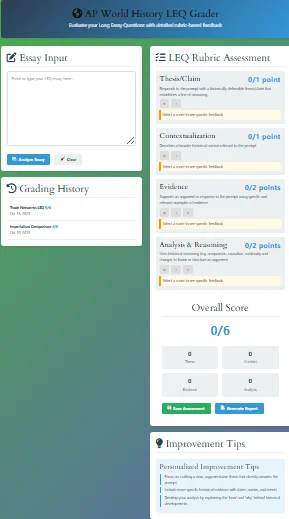
AP World History LEQ Grader
Evaluate your Long Essay Questions with detailed rubric-based feedback
Essay Input
Grading History
LEQ Rubric Assessment
Thesis/Claim 0/1 point
Responds to the prompt with a historically defensible thesis/claim that establishes a line of reasoning.
Contextualization 0/1 point
Describes a broader historical context relevant to the prompt.
Evidence 0/2 points
Supports an argument in response to the prompt using specific and relevant examples of evidence.
Analysis & Reasoning 0/2 points
Uses historical reasoning (e.g. comparison, causation, continuity and change) to frame or structure an argument.
Overall Score
Improvement Tips
Complete the assessment to get personalized improvement tips for your essay.
Certainly, the journey toward AP World History excellence presents significant challenges for students. Consequently, our innovative LEQ Grader emerges as an essential solution.
Specifically, I am an experienced AP World History teacher with over fifteen years in the classroom. I have witnessed countless students struggle with the Long Essay Question’s nuanced demands. Therefore, I developed this comprehensive tool to address those exact challenges.
Moreover, understanding the College Board’s rigorous scoring criteria requires repeated practice and detailed feedback. Subsequently, this tool provides both through advanced technological capabilities.
Meanwhile, traditional grading methods often delay crucial feedback. However, our instant assessment system ensures students receive immediate and actionable insights to improve their writing.
Furthermore, the shift to digital learning environments has created new educational opportunities. Consequently, our LEQ Grader bridges the gap between traditional instruction and modern technology.
Ultimately, this tool is not just another educational application. Rather, it is a complete learning ecosystem designed for AP World History success.
Understanding the AP World History LEQ Challenge
Initially, the Long Essay Question is one of the most demanding parts of the AP World History exam. Students must demonstrate multiple historical thinking skills at the same time.
Specifically, the College Board evaluates essays using a six-point rubric. Consequently, many students find the scoring system complex.
Additionally, time limits during the exam create pressure. Therefore, practice with immediate feedback is essential.
Meanwhile, teachers often face heavy grading workloads. As a result, they cannot always provide fast and detailed feedback.
Furthermore, each LEQ requires a strong argument and historical evidence. Our tool simplifies these requirements into clear steps.
Finally, students improve through structured practice and feedback. Consequently, they enter the exam with greater confidence.
Key Features of Our AP World History LEQ Grader
Comprehensive Rubric-Based Assessment
First, our tool follows the official College Board LEQ rubric. It ensures accurate and reliable scoring.
Specifically, it evaluates thesis, context, evidence, and analysis. Therefore, students understand their true AP-level performance.
Additionally, each category includes explanations and examples. As a result, students learn why they received a specific score.
Meanwhile, a color-coded system provides instant visual feedback. This helps students quickly identify weak areas.
Furthermore, the tool gives clear improvement suggestions. Consequently, students know exactly how to improve.
Real-Time Feedback Mechanism
Immediately after submission, the system generates feedback. Therefore, students do not wait for results.
Specifically, it analyzes multiple aspects of the essay at once. This gives a complete performance overview.
Additionally, feedback is both constructive and encouraging. As a result, students stay motivated.
Meanwhile, suggestions are tied to specific parts of the essay. This makes feedback practical and easy to apply.
Furthermore, the system checks both structure and evidence use. Consequently, students improve both big and small writing issues.
Progress Tracking and Analytics
Over time, the system tracks student progress. Therefore, improvement becomes easy to measure.
Specifically, the dashboard shows performance in each rubric category. This helps identify strengths and weaknesses.
Additionally, it provides visual charts and reports. As a result, students clearly see their growth.
Meanwhile, comparisons with past essays show improvement trends. This builds motivation and consistency.
Furthermore, teachers can view class-wide analytics. Consequently, they can adjust lessons based on real data.

Advanced Features That Set Our Tool Apart
AI-Powered Essay Analysis
Beyond basic rubric assessment, our tool employs sophisticated artificial intelligence; consequently, it provides insights that extend far beyond simple scoring. Specifically, the AI system analyzes writing style, argument coherence, and historical thinking skills; therefore, students receive feedback that addresses both content and presentation aspects. Additionally, the technology identifies patterns in student writing that might escape human graders; subsequently, it can pinpoint subtle issues like inconsistent argumentation or weak evidence integration. Meanwhile, the system continuously learns from expert-graded examples; as a result, its assessments become increasingly accurate and pedagogically sound over time. Furthermore, the AI component can predict potential score ranges for actual exam performance; consequently, students gain realistic expectations and can focus their efforts more strategically.
Comparative Performance Benchmarking
Unlike basic grading tools, our system incorporates benchmarking capabilities; consequently, students understand how their performance compares to successful historical examples. Specifically, the tool provides anonymized examples of high-scoring essays; therefore, students can visualize what excellence looks like in practical terms. Additionally, the system highlights key differences between student writing and exemplary responses; subsequently, the path to improvement becomes clearer and more achievable. Meanwhile, teachers can compare student performance across classes or against national averages; as a result, they can contextualize student achievement and identify areas for instructional emphasis. Furthermore, the benchmarking system adapts to different LEQ types and historical periods; consequently, students receive relevant comparisons regardless of the specific prompt they’re addressing.
Integration With Complementary Learning Tools
Significantly, our LEQ Grader functions within a comprehensive ecosystem of AP History tools; consequently, students benefit from a coordinated learning experience. For instance, students can seamlessly transition to our APUSH DBQ Grader for document-based question practice; therefore, they develop complementary skills across different essay types. Additionally, the tool integrates with our DBQ Thesis Generator for argument development support; subsequently, students strengthen their foundational thesis construction skills. Meanwhile, the APUSH Evidence Organizer helps students develop better evidence usage techniques; as a result, they can transfer these skills directly to their LEQ writing. Furthermore, our DBQ LEQ Outline Generator provides structural support; consequently, students learn to organize their arguments more effectively before beginning actual writing.
How to Use the AP World History LEQ Grader: A Step-by-Step Guide
Initial Setup and Registration
First, users access the tool through our main website; subsequently, they create a free account with basic information. Specifically, students select their current preparation level and target score; therefore, the system can customize feedback and suggestions appropriately. Additionally, teachers can create classroom accounts with student management features; consequently, they can monitor entire classes efficiently while maintaining individual student privacy. Meanwhile, the initial setup includes a brief tutorial on LEQ requirements and scoring criteria; as a result, even new users understand the context for the feedback they’ll receive. Furthermore, the system offers practice prompts for initial familiarization; consequently, users can explore features without pressure before tackling actual preparation essays.
Essay Submission Process
Once registered, students can immediately begin submitting essays for assessment; consequently, the learning process commences without unnecessary delays. Specifically, students either type directly into the platform’s text editor or paste existing writing; therefore, the tool accommodates various workflow preferences. Additionally, the system supports multiple file formats for essay submission; subsequently, students can work in their preferred writing environment before transferring text for assessment. Meanwhile, the tool automatically saves drafts and in-progress work; as a result, students never risk losing their writing due to technical issues or accidental navigation away from the page. Furthermore, the submission interface includes optional planning tools and outlining features; consequently, students can develop their ideas systematically before beginning actual composition.
Interpreting and Applying Feedback
After submission, students receive immediate, comprehensive assessment results; consequently, they can review feedback while their writing decisions remain fresh in mind. Specifically, the system presents scores for each rubric category with detailed explanations; therefore, students understand not just their performance level but the reasoning behind each score. Additionally, the feedback highlights specific text passages that exemplify both strengths and weaknesses; subsequently, students can see concrete examples of what they’re doing well and where they need improvement. Meanwhile, the system provides targeted exercises and resources addressing identified weaknesses; as a result, students receive not just assessment but actual pathways to improvement. Furthermore, the tool encourages multiple revisions of the same essay; consequently, students can implement feedback immediately and observe how changes affect their scores.
Integration With Comprehensive Study Strategies
Complementing Classroom Instruction
Importantly, our LEQ Grader serves as a supplement to quality classroom teaching; consequently, it enhances rather than replaces teacher instruction. Specifically, teachers can assign practice essays with confidence that students will receive immediate basic feedback; therefore, classroom time can focus on higher-level concepts and individual troubleshooting. Additionally, the system provides teachers with detailed analytics on student performance; subsequently, instructors can identify class-wide patterns and adjust instruction accordingly. Meanwhile, the tool helps standardize assessment across multiple teachers or sections; as a result, students receive consistent feedback regardless of their specific classroom instructor. Furthermore, the system includes features for teacher comments and custom feedback; consequently, educators can add personal insights to the automated assessment when appropriate.
Building Consistent Practice Routines
For optimal results, students should incorporate the tool into regular study routines; consequently, they develop consistency in their writing practice and improvement efforts. Specifically, we recommend using our Pomodoro Timer with Task List to structure productive study sessions; therefore, students maintain focus and avoid burnout during extended preparation periods. Additionally, the Daily Routine Planner helps students allocate sufficient time for history practice; subsequently, they can balance AP World History preparation with other academic responsibilities. Meanwhile, regular practice with the tool builds muscle memory for essay structure and argumentation; as a result, students approach the actual exam with greater confidence and automaticity in their writing processes. Furthermore, consistent use throughout the academic year yields significantly better results than last-minute cramming; consequently, we encourage integrating the tool into long-term study plans rather than short-term test preparation.
Frequently Asked Questions About the AP World History LEQ Grader
Absolutely, the tool provides scaffolding for writers at all skill levels; consequently, it offers particular benefits for students developing fundamental writing competencies. The tool integrates with our Document Analysis Helper for source interpretation support; as a result, students strengthen complementary skills that enhance their overall historical writing ability.
The system recognizes and adapts to all official LEQ prompt types including causation, comparison, and continuity/change over time; consequently, students receive specific feedback relevant to each prompt’s unique demands.
Indeed, the platform includes robust classroom management features specifically designed for teacher efficiency; consequently, educators can monitor student progress across multiple classes simultaneously.
Our LEQ Grader offers several distinctive advantages compared to general AP preparation resources. The tool integrates with our comprehensive suite of AP History resources including the APUSH Rubric Mastery Tool and APUSH Score Calculator; as a result, students benefit from a coordinated ecosystem rather than fragmented preparation materials.
While primarily focused on writing skill development, the tool does include significant content support; consequently, students address both historical knowledge and writing proficiency simultaneously. Additionally, the system includes access to our APUSH Contextualization Builder for historical background development; subsequently, students learn to situate their arguments within appropriate historical frameworks.
Conclusion: Elevating AP World History Achievement Through Technology
In summary, our AP World History LEQ Grader represents a significant advancement in historical writing instruction; consequently, it addresses longstanding challenges in AP preparation through innovative technology. Specifically, the tool provides immediate, detailed feedback that accelerates student improvement; therefore, learners can iterate and refine their skills more efficiently than with traditional methods. Additionally, the comprehensive assessment covers all rubric dimensions with remarkable accuracy; subsequently, students develop a sophisticated understanding of AP expectations and scoring standards. Meanwhile, the integration with complementary tools like our AP World History DBQ Grader and AP European History DBQ Grader creates a complete historical writing ecosystem; as a result, students can develop consistent skills across different essay types and history courses. Furthermore, the tool’s adaptability supports diverse learners and classroom contexts; consequently, it benefits both struggling writers seeking foundation skills and advanced students pursuing excellence. Ultimately, by combining technological efficiency with pedagogical expertise, our LEQ Grader transforms the challenging journey of AP World History preparation into an achievable, measurable, and rewarding learning experience for all students.