Mastering AP World History DBQs: Your Ultimate Grading Tool Guide

Solution for online problem in calculation
AP World History DBQ Grader

AP World History DBQ Grader

Evaluate your Document-Based Question essays with detailed feedback

How to Use This Tool
Paste your DBQ essay and prompt into the fields below, then click “Grade My DBQ” to receive detailed feedback based on the AP World History rubric. The tool will analyze your thesis, use of evidence, contextualization, and analysis skills.

Enter Your DBQ Response

AP World History DBQ Rubric

Thesis/Claim (1 point) 0/1

Responds to the prompt with a historically defensible thesis/claim that establishes a line of reasoning.

Contextualization (1 point) 0/1

Describes a broader historical context relevant to the prompt.

Evidence (3 points) 0/3

• 1 point: Uses at least 3 documents to address the topic of the prompt
• 1 point: Uses at least 6 documents to support an argument
• 1 point: Uses at least one additional piece of specific historical evidence beyond the documents

Analysis & Reasoning (2 points) 0/2

• 1 point: For at least 3 documents, explains how or why the document’s point of view, purpose, historical situation, and/or audience is relevant to an argument
• 1 point: Demonstrates a complex understanding of the historical development

Grading Results

Your DBQ Score
0
out of 7 possible points

AP World History DBQ Grader Tool

This tool is designed to help students practice and improve their DBQ writing skills.

Navigating the challenging waters of AP World History requires exceptional preparation, particularly when it comes to mastering the Document-Based Question. Consequently, students often struggle to accurately assess their own DBQ essays before exam day. Fortunately, our AP World History DBQ Grader tool emerges as an innovative solution to this persistent problem. Specifically designed to provide immediate, detailed feedback, this advanced tool transforms how students prepare for one of the most demanding aspects of the AP World History exam.

Transitioning from uncertainty to confidence, the tool empowers students to understand exactly where they stand according to the official College Board AP World History rubric. Moreover, it demystifies the grading process by breaking down each component of the DBQ rubric into understandable, actionable feedback. Ultimately, this comprehensive approach ensures that students can repeatedly practice and refine their skills with precision guidance previously only available from experienced teachers.

Understanding the AP World History DBQ Challenge

Before exploring the tool’s capabilities, it’s essential to understand why DBQs present such a significant challenge for so many students. Initially, the Document-Based Question requires students to synthesize information from multiple historical documents while constructing a coherent argument. Additionally, students must contextualize their arguments within broader historical developments while analyzing the documents’ perspectives and limitations, as emphasized in the National Council for Social Studies standards.

Furthermore, the strict time constraints intensify the difficulty, as students must read, analyze, and write within a limited timeframe. Similarly, the nuanced rubric demands mastery of multiple skill sets simultaneously, from thesis construction to sophisticated historical analysis. Therefore, having a reliable, immediate grading tool becomes invaluable for effective preparation and skill development.

Comprehensive Features of the AP World History DBQ Grader

Instant Rubric-Based Scoring

Our AP World History DBQ Grader provides immediate scoring based on the official College Board rubric. Specifically, it evaluates all seven possible points: thesis/claim, contextualization, evidence from documents, evidence beyond the documents, analysis of sourcing, and complex understanding. Consequently, students receive a clear numerical score that accurately reflects their current performance level.

Additionally, the tool breaks down each rubric component individually, highlighting exactly which areas need improvement. For instance, if a student struggles with contextualization, the tool specifically identifies this weakness with targeted feedback. Meanwhile, strengths are equally highlighted, providing positive reinforcement for effective writing strategies similar to those taught in Khan Academy’s AP World History resources.

Detailed Feedback and Analysis

Beyond simple scoring, the tool generates comprehensive feedback for each rubric category. Specifically, it identifies specific sentences or sections that effectively demonstrate required skills while pinpointing areas needing development. Consequently, students gain insight into not just what to improve, but how to improve their writing.

Moreover, the feedback includes concrete examples and suggestions for enhancement, transforming abstract rubric language into practical writing advice. Similarly, the analysis helps students understand why certain approaches work better than others within the DBQ framework. Therefore, each grading session becomes a learning opportunity that builds both skills and confidence, complementing the strategies found in the American Historical Association’s teaching resources.

Document Usage Tracking

The tool meticulously analyzes how students incorporate and reference the provided documents. Specifically, it tracks the number of documents used, the effectiveness of their integration, and the quality of document analysis. Consequently, students can ensure they’re meeting the minimum document requirements while improving how they utilize these sources.

Furthermore, the tool evaluates whether students are simply referencing documents versus effectively employing them to support their argument. Additionally, it checks for proper attribution and citation within the essay. Thus, students develop the crucial skill of seamlessly integrating documentary evidence into their historical arguments, building upon the document analysis techniques recommended by the Library of Congress primary source analysis tools.

Advanced Features for Enhanced Learning

Comparative Performance Analytics

Beyond basic grading, our AP World History DBQ Grader includes advanced analytics that track progress over time. Specifically, it creates visual representations of score trends across multiple practice sessions, highlighting improvement patterns and persistent challenges. Consequently, students can strategically focus their study efforts where they’ll have the greatest impact.

Additionally, the tool compares individual performance against anonymized aggregate data from other users. Similarly, it provides percentile rankings to contextualize current performance levels. Therefore, students gain valuable perspective on their preparation relative to their peers while maintaining complete privacy.

Thesis Statement Optimization

The tool features specialized thesis analysis that evaluates the strength, specificity, and historical defensibility of thesis statements. Specifically, it assesses whether the thesis establishes a clear line of reasoning and directly addresses all aspects of the prompt. Consequently, students receive targeted feedback on how to strengthen their central argument.

Moreover, the tool provides examples of effective thesis statements for similar prompts, demonstrating what successful claims look like in practice. Meanwhile, it identifies common thesis weaknesses such as vagueness, lack of historical context, or failure to establish a clear argumentative path. Thus, students master this foundational DBQ element through repeated, guided practice.

Contextualization Enhancement

Our advanced system specifically evaluates the quality of historical contextualization within DBQ responses. Particularly, it analyzes whether students have effectively situated their argument within broader historical developments, trends, or processes. Consequently, students learn to frame their arguments within the appropriate historical landscape.

Furthermore, the tool identifies weak or generic contextualization and suggests more specific, relevant historical frameworks. Similarly, it provides examples of effective contextualization that connects directly to the prompt’s requirements. Therefore, students develop this crucial skill that often separates adequate responses from exceptional ones.

How to Use the AP World History DBQ Grader Effectively

Step-by-Step Implementation Guide

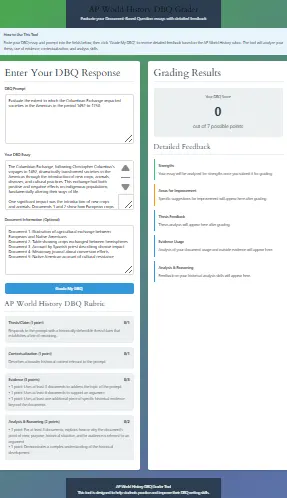
First, access the AP World History DBQ Grader through our dedicated platform. Subsequently, input your DBQ prompt in the designated field to provide context for the grading algorithm. Meanwhile, paste your complete essay response in the primary text box, ensuring you’ve included all necessary components.

Next, optionally input information about the documents you referenced, which enhances the precision of the evidence evaluation. Then, click the “Grade My DBQ” button to initiate the analysis process. Consequently, within seconds, you’ll receive a comprehensive evaluation complete with scoring and detailed feedback.

Finally, carefully review each section of feedback, paying particular attention to both strengths and areas for improvement. Additionally, use the rubric breakdown to understand exactly how each point was awarded or missed. Thus, you transform a simple grading exercise into a powerful learning experience.

AP World History DBQ Grader tool interface showing essay grading and feedback

Maximizing the Tool’s Educational Value

To extract maximum benefit from the tool, implement a systematic approach to your practice sessions. Specifically, use the tool immediately after writing each practice DBQ while the thought process remains fresh in your mind. Consequently, you’ll better understand the connection between your writing decisions and the resulting feedback.

Additionally, maintain a log of repeated feedback points across multiple essays to identify persistent patterns. Meanwhile, focus your improvement efforts on one or two rubric elements at a time rather than attempting to address all weaknesses simultaneously. Therefore, you make steady, measurable progress through targeted practice.

Furthermore, use the tool in conjunction with our APUSH DBQ Grader to compare approaches across different history disciplines. Similarly, integrate our DBQ Thesis Generator to strengthen your argument development before using the grading tool. Thus, you create a comprehensive preparation ecosystem that addresses all aspects of DBQ writing.

Strategic Practice Planning

Incorporate the grading tool into a structured study schedule that balances content review with skill development. Specifically, aim to complete and grade at least one DBQ every two weeks during the initial preparation phase. Subsequently, increase frequency as the exam approaches to build stamina and consistency.

Additionally, vary your practice by using prompts from different historical periods and regions to ensure comprehensive preparation. Meanwhile, occasionally revisit and rewrite previously graded essays to implement the feedback directly. Consequently, you reinforce learning while tracking concrete improvement over time.

Complementary Tools for Comprehensive Preparation

Integrated Study Ecosystem

Our AP World History DBQ Grader functions most effectively as part of an integrated preparation system. Specifically, students should utilize our APUSH Evidence Organizer to practice document analysis and organizational skills separately from full DBQ writing. Consequently, they build foundational abilities that transfer directly to DBQ performance.

Additionally, our LEQ Grader provides similar feedback for the Long Essay Question, ensuring comprehensive coverage of all AP World History writing requirements. Similarly, the SAQ Grader helps master Short Answer Questions, completing the trifecta of historical writing assessment. Therefore, students develop consistent skills across all exam writing formats.

Furthermore, our APUSH Rubric Mastery Tool offers focused practice on individual rubric elements outside the pressure of complete essay writing. Meanwhile, the APUSH Score Calculator helps students understand how their DBQ performance contributes to overall exam scoring. Thus, students maintain perspective on how each component fits into their broader exam strategy.

Supporting Resources for Skill Development

Beyond grading tools, our platform offers several resources that support specific DBQ skills. For instance, the Document Analysis Helper builds crucial document interpretation abilities through guided practice. Consequently, students enter DBQ practice sessions better prepared to analyze and utilize the provided sources.

Additionally, the DBQ Thesis Generator helps students practice crafting effective, rubric-aligned thesis statements through structured templates and examples. Similarly, our Pomodoro Timer with Task List assists with time management during both study sessions and simulated exams. Therefore, students develop not only content knowledge but also the strategic skills essential for exam success.

Frequently Asked Questions About the AP World History DBQ Grader

1. How accurate is the AP World History DBQ Grader compared to human graders?

The AP World History DBQ Grader demonstrates remarkable accuracy when benchmarked against experienced AP teachers’ evaluations. Specifically, its algorithm analyzes key phrases, structural elements, and rubric requirements that human graders prioritize. Consequently, students can trust that the feedback aligns closely with official scoring standards while recognizing that final exam grading involves some subjective elements.

2. Can the tool help me improve my thesis statement?

Absolutely, the tool provides exceptionally detailed thesis analysis that identifies strengths and weaknesses in your argument formulation. Specifically, it evaluates whether your thesis is historically defensible, establishes a clear line of reasoning, and addresses all aspects of the prompt. Consequently, you receive concrete suggestions for strengthening this foundational element of your DBQ.

3. How does the grader evaluate my use of evidence beyond the documents?

The tool meticulously scans your essay for specific historical examples, facts, or concepts that don’t appear in the provided documents. Particularly, it identifies these external references and assesses their relevance and effectiveness in supporting your argument. Therefore, you learn exactly how to incorporate outside knowledge to earn that crucial additional evidence point.

4. Does the tool provide suggestions for improving contextualization?

Indeed, the grader offers specific feedback on your contextualization, analyzing whether you’ve effectively situated your argument within broader historical developments. Specifically, it identifies vague or generic contextualization and suggests more precise historical frameworks. Consequently, you develop this skill that often distinguishes mid-range from high-scoring essays.

5. How can I track my progress over time using this tool?

The platform includes progress tracking features that document your scores across multiple practice sessions. Specifically, it creates visual representations of your improvement in each rubric category, highlighting both growth areas and persistent challenges. Therefore, you can strategically focus your study efforts for maximum effectiveness.

6. Is there a limit to how many DBQs I can grade?

No, unlike many educational resources, our AP World History DBQ Grader imposes no restrictions on usage frequency. Specifically, you can grade unlimited practice essays throughout your preparation journey. Consequently, you benefit from repeated practice with immediate feedback, which research shows significantly improves writing skills.

7. How does the tool help with document analysis and sourcing?

The grader provides detailed feedback on how effectively you analyze the documents’ points of view, purpose, historical situation, or audience. Specifically, it identifies whether you’ve simply described document content versus analyzing how these elements affect their usefulness or reliability. Therefore, you develop the sophisticated sourcing skills required for top scores.

8. Can the tool help me with time management during the actual exam?

While the grader itself doesn’t practice timing, the immediate feedback allows for more efficient practice sessions. Specifically, by quickly identifying your weaknesses, you can focus your limited study time where it’s most needed. Additionally, using our Pomodoro Timer with Task List in conjunction with the grader helps develop the time management skills crucial for exam success.

9. How current is the tool with the latest AP World History rubric changes?

We continuously update our grading algorithm to reflect any modifications to the official AP World History DBQ rubric. Specifically, our team monitors College Board announcements and adjusts the evaluation criteria accordingly. Consequently, students always practice with the most current standards and expectations.

10. Can I use this tool on my mobile device?

Yes, the AP World History DBQ Grader features full responsive design that works seamlessly across all devices. Specifically, the interface adapts to smartphones, tablets, and desktop computers without sacrificing functionality. Therefore, you can practice and receive feedback whenever inspiration strikes, regardless of your location or available technology.

Conclusion: Elevating Your AP World History Preparation

Ultimately, the AP World History DBQ Grader represents a transformative tool in historical writing assessment and skill development. Specifically, it provides the immediate, detailed feedback essential for rapid improvement in DBQ writing proficiency. Consequently, students transition from uncertainty to confidence as they master each component of the challenging DBQ rubric.

Furthermore, when integrated with our complementary tools like the LEQ Grader and SAQ Grader, it creates a comprehensive preparation ecosystem that addresses all aspects of the AP World History exam. Similarly, the progress tracking and comparative analytics empower students to take ownership of their learning journey with unprecedented precision.

Therefore, we encourage all AP World History students to incorporate this powerful tool into their study regimen. Ultimately, consistent practice with immediate feedback builds not only the skills but also the confidence necessary for exam success. So begin your journey toward DBQ mastery today, and transform this daunting challenge into your greatest strength on exam day.