📜 AP DBQ Scoring Sheet 2026
Grade any APUSH Document-Based Question essay against the official College Board rubric in under two minutes — instant total out of 7.
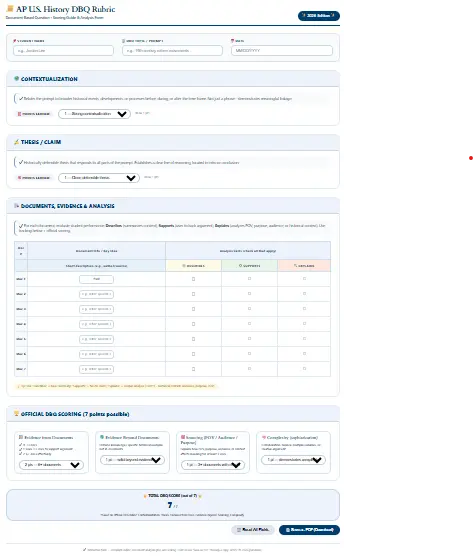
📜 AP U.S. History DBQ Rubric
Document-Based Question • Scoring Guide & Analysis Form
| Doc # | Document Info / Key Idea | Analysis Skills (check all that apply) | ||
|---|---|---|---|---|
| Short description (e.g., author/source) | 📄 DESCRIBES | ⚙️ SUPPORTS | 🔍 EXPLAINS | |
📚 Evidence from Documents
✔️ 0: <3 docs
✔️ 1: uses 3-5 docs to support argument
✔️ 2: 6+ docs effectively
🌎 Evidence Beyond Documents
Outside knowledge / specific historical example not in documents
🎯 Sourcing (POV / Audience / Purpose)
Explains how POV, purpose, audience, or context affects meaning for at least 3 docs.
🧠 Complexity (sophistication)
Corroboration, nuance, multiple variables, or creative argument
0 / 7
What the APUSH DBQ Rubric Scores
The DBQ rubric measures six historical reasoning skills, worth 7 points total:
How to Use This DBQ Scoring Sheet
- Read the essay once for the thesis and overall argument.
- Score each rubric category using the dropdowns above.
- Check the document tracker to confirm which documents were described, used as support, or fully explained.
- Review the total score and identify the weakest category to target in revision.
Common Mistakes That Cost DBQ Points
- Restating the prompt instead of writing a defensible thesis
- Contextualization that names an event but doesn’t explain its connection to the prompt
- Citing documents without sourcing at least three of them
- Skipping outside evidence not found in the provided documents
- Missing complexity — no nuance, counterargument, or corroboration across documents
Related APUSH Tools
Pair this scoring sheet with these tools for full DBQ prep:
- Thesis Statement Generator & Grader
- APUSH Contextualization Builder
- APUSH Evidence Organizer
- DBQ Complexity Analyzer
- APUSH DBQ Grader Feedback Tool
- APUSH Score Calculator
For the official rubric language, see College Board AP Central.
Frequently Asked Questions (FAQs)
It’s an interactive rubric that mirrors the College Board’s official APUSH DBQ scoring guidelines, letting students and teachers score an essay across all six rubric categories and see an instant total out of 7.
The DBQ is scored out of 7 points: 1 for thesis, 1 for contextualization, up to 2 for evidence from documents, 1 for outside evidence, 1 for sourcing, and 1 for complexity.
Write a historically defensible claim that responds to every part of the prompt and sets up a clear line of reasoning — not just a restatement of the question.
Explaining a broader historical event, trend, or process connected to the prompt’s time period — before, during, or after — and showing how it relates, not just naming it.
A specific historical fact, event, or example relevant to the argument that doesn’t appear in any of the provided documents.
Show nuanced reasoning: corroborate documents against each other, explain change and continuity, or acknowledge a counterargument or exception.
Yes, it reflects the current College Board DBQ rubric format.
Editorial and Tool Information
This page provides practical guidance for scoring AP U.S. History Document-Based Question essays against the official College Board rubric.
The tool was developed around a simple workflow: read essay → score each category → track document analysis → review total.
The page and tool information are reviewed periodically to improve clarity and reflect changes to the tool. When discussing AP exam requirements or scoring criteria, students should use current official College Board materials as the authoritative source.
Last reviewed: September 2026
Keep Practicing Your DBQ Skills
Consistent rubric-based grading is the fastest way to improve DBQ scores — use this sheet to catch weak points early, then pair it with the contextualization and evidence tools above for focused revision.
When you’re ready, try the DBQ Grader Feedback Tool, Thesis Generator, or explore the AP History Study Tools hub for more resources.