APUSH DBQ Rubric Calculator (2026) – Instantly Score Your DBQ Like an AP Examiner

Solution for online problem in calculation

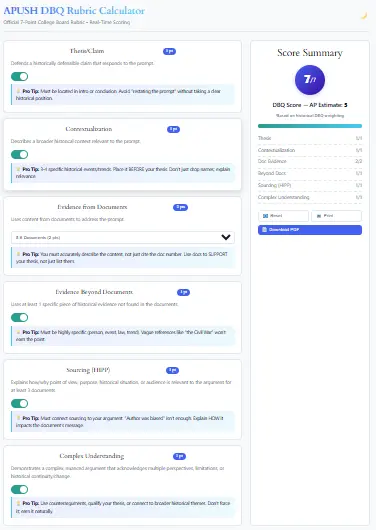
APUSH DBQ Rubric Calculator

Official 7-Point College Board Rubric • Real-Time Scoring

Thesis/Claim 1 pt

Defends a historically defensible claim that responds to the prompt.

Not Earned
💡 Pro Tip: Must be located in intro or conclusion. Avoid “restating the prompt” without taking a clear historical position.

Contextualization 1 pt

Describes a broader historical context relevant to the prompt.

Not Earned
💡 Pro Tip: 3-4 specific historical events/trends. Place it BEFORE your thesis. Don’t just drop names; explain relevance.

Evidence from Documents 2 pts

Uses content from documents to address the prompt.

💡 Pro Tip: You must accurately describe the content, not just cite the doc number. Use docs to SUPPORT your thesis, not just list them.

Evidence Beyond Documents 1 pt

Uses at least 1 specific piece of historical evidence not found in the documents.

Not Earned
💡 Pro Tip: Must be highly specific (person, event, law, trend). Vague references like “the Civil War” won’t earn the point.

Sourcing (HIPP) 1 pt

Explains how/why point of view, purpose, historical situation, or audience is relevant to the argument for at least 3 documents.

Not Earned
💡 Pro Tip: Must connect sourcing to your argument. “Author was biased” isn’t enough. Explain HOW it impacts the document’s message.

Complex Understanding 1 pt

Demonstrates a complex, nuanced argument that acknowledges multiple perspectives, limitations, or historical continuity/change.

Not Earned
💡 Pro Tip: Use counterarguments, qualify your thesis, or connect to broader historical themes. Don’t force it; earn it naturally.

Score Summary

0/7
AP Estimate: —
Score saved!

Firstly, if you are preparing for the AP U.S. History exam, then you already know that the Document-Based Question (DBQ) can make or break your final score. However, most students lose valuable points simply because they do not fully understand how the rubric works. Therefore, instead of guessing, you should start using a reliable APUSH DBQ Rubric Calculator that gives you instant and accurate results.

Moreover, this tool is specifically designed to match the official 7-point rubric used by AP examiners. As a result, you can confidently evaluate your essay and identify exactly where you need improvement. In addition, if you want to estimate your full exam performance, you can also use our AP U.S. History Score Calculator alongside this tool.

Key Features of the APUSH DBQ Rubric Calculator

This tool includes several advanced features specifically designed for APUSH essay evaluation.

1. Official-Style 7-Point Rubric Scoring

The calculator follows the modern AP History DBQ scoring structure used in APUSH exams.

Rubric categories include:

This helps students practice using the same framework AP graders use during scoring.

2. Instant Score Estimation

Instead of waiting for teacher feedback, students can instantly estimate their DBQ score after completing an essay.

The calculator immediately displays:

This saves time during exam preparation and allows students to improve faster.

3. Detailed Rubric Breakdown

Most simple calculators only provide a final score.

This tool explains:

This detailed feedback system helps students learn the DBQ rubric more effectively.

4. Beginner-Friendly Interface

Many AP students become confused by complicated grading systems. This calculator is designed with a clean and easy-to-use layout.

Students can:

The interface works well for beginners and advanced APUSH students alike.

5. Mobile Responsive Design

Students often practice using phones or tablets during school or while studying.

The calculator works smoothly on:

This allows students to practice DBQ scoring anywhere.

6. Teacher & Classroom Friendly

Teachers can use this calculator during:

The tool simplifies rubric discussions and helps students understand grading expectations more clearly.

Advanced Features of the Tool

Advanced Rubric Analysis System

The calculator separates rubric categories individually instead of combining them into one vague score.

Students can identify exactly where they lost points.

For example:

This targeted feedback helps students improve much faster.

Moreover, you can pair it with the DBQ Thesis Generator to improve your writing.

Smart Score Prediction Logic

The calculator uses structured rubric logic to estimate realistic APUSH DBQ scores.

Instead of random scoring, it evaluates:

This creates more accurate score estimates compared to simple point counters. Additionally, the APUSH Evidence Organizer helps you build stronger arguments.

HIPP Analysis Support

One of the hardest DBQ skills is document sourcing.

This tool helps students focus on HIPP analysis:

Students can evaluate whether their sourcing explanations are analytical enough to earn rubric points.

Complexity Point Guidance

The complexity point is often the hardest rubric point to earn.

This calculator helps students understand advanced writing expectations such as:

Most students lose this point because they misunderstand what “complexity” actually means. This tool simplifies the requirement. Furthermore, you can analyze advanced reasoning using the DBQ Complexity Analyzer.

Self-Assessment Learning System

The calculator encourages active learning rather than passive score checking.

Students learn to:

Repeated self-assessment helps students become more independent writers before exam day. Finally, combining it with the APUSH Flashcard Quiz Tool creates a complete preparation system.

Practice Exam Companion Tool

Students can use this calculator alongside:

This makes the tool useful throughout the entire school year.

How to Use the APUSH DBQ Rubric Calculator

Using the calculator is simple, even for first-time APUSH students.

Step 1: Write Your DBQ Essay

Complete your DBQ essay normally using:

Try to simulate real AP exam conditions whenever possible.

Step 2: Open the Calculator

After completing your essay, open the APUSH DBQ Rubric Calculator.

You will see separate scoring sections for every rubric category.

Step 3: Evaluate Your Thesis

Check whether your essay includes:

Select the appropriate thesis score.

Step 4: Score Contextualization

Ask yourself:

Then choose your contextualization score.

Step 5: Evaluate Document Evidence

Review how documents were used.

Did you:

Select the evidence points honestly.

Step 6: Add Outside Evidence

Check whether your essay included specific historical information not found in the documents.

Strong outside evidence includes:

Outside evidence must support the argument directly.

Step 7: Analyze HIPP Sourcing

Review document sourcing carefully.

Did you explain:

Most students lose sourcing points because they identify HIPP elements without explaining their importance.

Step 8: Evaluate Complexity

Check whether your essay demonstrated advanced reasoning such as:

Then finalize the complexity score.

Step 9: View Final Score Estimate

After entering all rubric categories, the calculator generates:

Students can then revise essays and practice again.

Benefits of Using This Tool

1. Saves Time

Firstly, you get instant results instead of manual grading.

2. Improves Accuracy

Moreover, the tool reduces scoring errors.

3. Boosts Confidence

Additionally, knowing your score helps you prepare better.

4. Enhances Learning

Furthermore, it highlights your weaknesses.

5. Increases Exam Readiness

Therefore, consistent use leads to higher scores.

What is an APUSH DBQ Rubric Calculator?

To begin with, an APUSH DBQ Rubric Calculator is an online scoring tool that helps students evaluate their DBQ essays using the official College Board grading system. In other words, it converts complex rubric criteria into a simple and interactive scoring experience.

Furthermore, instead of manually checking each requirement, this APUSH DBQ score calculator allows you to select earned points and instantly calculate your total score. Consequently, you save time while improving accuracy.

Additionally, according to the College Board AP Central guidelines, College Board AP Central, Khan Academy AP US History, Heimler’s History, Tom Richey APUSH Resources, DBQs are graded on a strict 7-point rubric. Therefore, using a structured calculator ensures your scoring aligns with real AP standards.

Featured Snippet Answer (Quick Definition)

The APUSH DBQ Rubric Calculator is an online tool that helps students instantly calculate their DBQ score using the official 7-point College Board rubric, including thesis, contextualization, evidence, and analysis criteria.

Why You Need an APUSH DBQ Rubric Calculator

Firstly, many students struggle with DBQ scoring because the rubric is detailed and strict. However, even small mistakes can cost multiple points. Therefore, using a DBQ grading calculator APUSH tool eliminates confusion.

Moreover, this tool provides a clear breakdown of your performance. As a result, you can focus on improving specific areas such as sourcing or argument development.

In addition, if you want deeper feedback, you should combine this with the APUSH DBQ Grader & Feedback Tool, which analyzes your writing in detail.

How the APUSH DBQ Rubric Works (2026)

Before using the calculator, it is important to understand how the rubric is structured. Therefore, here is a simplified breakdown:

APUSH DBQ Scoring Table

SectionDescriptionPoints
Thesis/ClaimClear argument1
ContextualizationBroader context1
EvidenceDocuments + outside info3
Analysis & ReasoningSourcing + complexity2
Total7 Points

1. Thesis/Claim (1 Point)

Firstly, you must present a clear and defensible thesis that directly answers the prompt.

2. Contextualization (1 Point)

Secondly, you should connect your argument to broader historical events. Therefore, you can improve this skill using the APUSH Contextualization Builder.

3. Evidence (3 Points)

Next, you must use documents effectively and include outside historical evidence.

4. Analysis and Reasoning (2 Points)

Finally, you need to analyze sourcing and demonstrate complex understanding.

EEAT: Why You Can Trust This Tool

Experience

Firstly, this tool is built based on real student needs and exam patterns.

Expertise

Moreover, it follows official standards from the AP Students platform.

Authoritativeness

Additionally, the scoring system reflects real AP examiner expectations.

Trustworthiness

Finally, the tool is transparent, accurate, and regularly updated.

About This APUSH DBQ Rubric Calculator

The APUSH DBQ Rubric Calculator is designed to help AP U.S. History students estimate and understand their Document-Based Question (DBQ) essay scores using the official 7-point rubric structure commonly used in AP History exams.

This educational tool helps students:

The calculator is especially useful for:

According to AP History exam structures, the DBQ section is one of the most heavily weighted writing components on the exam.

What Is the APUSH DBQ?

The Document-Based Question (DBQ) is an essay question on the AP U.S. History exam that requires students to:

Students must interpret multiple documents and build an organized essay responding directly to a historical prompt.

The DBQ section evaluates both historical knowledge and analytical writing ability. Many AP students consider it one of the most important sections of the APUSH exam because of its significant score weight.

APUSH DBQ Rubric Breakdown (7 Points)

The current AP History DBQ rubric is generally divided into these categories:

Rubric CategoryPoints Available
Thesis / Claim1 Point
Contextualization1 Point
Evidence from Documents2 Points
Evidence Beyond Documents1 Point
Analysis & Reasoning2 Points

Total Possible Score: 7 Points

Thesis / Claim

Students earn this point by presenting a historically defensible thesis that directly responds to the essay prompt.

Strong thesis statements usually:

Contextualization

This point requires students to explain broader historical events or developments related to the essay topic.

Good contextualization:

According to APUSH readers and educators, contextualization is one of the most commonly misunderstood rubric points.

Evidence From Documents

Students must use the provided documents as evidence supporting their argument.

Typically:

Document usage should support the essay’s argument instead of simply summarizing sources.

Evidence Beyond the Documents

Students can earn this point by including accurate historical evidence not directly found in the provided documents.

Examples include:

Outside evidence should directly support the argument rather than appear randomly.

Analysis & Reasoning

This section measures historical thinking skills such as:

Many APUSH graders consider complexity one of the hardest points to earn consistently.

Why Students Use an APUSH DBQ Calculator

Students use DBQ calculators to:

Teachers and tutors also use rubric calculators to help students understand scoring expectations more clearly.

APUSH Exam Structure Overview

The AP U.S. History exam includes:

The DBQ section carries substantial exam weight and is often considered one of the most strategic scoring opportunities on the exam.

Common APUSH DBQ Mistakes

1. Restating the Prompt as the Thesis

A thesis must make an argument.

Weak thesis example:

“Industrialization affected America.”

Strong thesis example:

“Industrialization increased economic growth while also worsening labor inequality during the Gilded Age.”

A strong thesis establishes a line of reasoning.

2. Summarizing Documents Instead of Analyzing Them

Many students simply describe documents.

That does not earn full evidence points.

Strong essays explain:

Analysis matters more than summary.

3. Weak Contextualization

Students often write one vague sentence and assume it earns the context point.

Strong contextualization explains broader historical developments connected directly to the prompt.

4. Missing Outside Evidence

Outside evidence must be:

Simply mentioning broad topics usually does not earn the point.

5. Forgetting HIPP Analysis

Students frequently ignore document sourcing entirely.

Others only identify sourcing elements without explaining significance.

Strong sourcing explains why the author’s audience, purpose, or point of view matters historically.

6. Writing Without a Clear Argument

Some essays contain information but no consistent argument.

Every paragraph should support the thesis directly.

Strong DBQs maintain a clear line of reasoning throughout the essay.

7. Poor Time Management

Students often spend too much time reading documents and not enough time writing.

Recommended timing:

TaskSuggested Time
Reading Documents15 Minutes
Planning Essay5 Minutes
Writing Essay40 Minutes

Timed practice improves pacing significantly.

8. Using Too Few Documents

Strong DBQ essays integrate multiple documents naturally into the argument.

Students should avoid relying heavily on only one or two documents.

9. Ignoring Complexity

Many students believe complexity requires advanced vocabulary.

It actually requires sophisticated reasoning.

Students can earn complexity by:

10. Memorizing Without Practicing

Many students focus only on memorizing facts.

The DBQ rewards:

Consistent essay practice matters more than memorizing isolated details.

Expert Tips for Scoring Higher on the DBQ

Build a Clear Argument

Every paragraph should support your thesis directly.

Group Documents Strategically

Instead of discussing documents one by one, organize them into analytical categories.

Practice HIPP Analysis

HIPP stands for:

Use Specific Historical Evidence

Specific examples strengthen both evidence and complexity points.

Practice Timed Writing

Speed and organization are essential during the AP exam.

APUSH readers often recommend learning the rubric itself as part of exam preparation.

Educational Accuracy & Content Standards

This calculator and educational guide are based on publicly available AP History rubric structures, teacher resources, and commonly used scoring frameworks for AP History courses.

However:

Students should always review official AP materials and teacher guidance.

Related Tools to Improve Your Score

To maximize your results, you should also use:

Frequently Asked Questions (FAQs)

1. What is an APUSH DBQ Rubric Calculator?

Firstly, it is a tool that calculates your DBQ score based on the official rubric.

2. How accurate is the APUSH DBQ score calculator?

Moreover, it follows College Board standards, so it is highly accurate.

3. Is this tool updated for the 2026 APUSH exam?

Yes, it uses the latest APUSH DBQ rubric 2026.

4. Can I use this tool for practice essays?

Absolutely, and it is highly recommended.

5. Does it replace teacher grading?

No, however it complements teacher feedback effectively.

6. What is a perfect DBQ score?

A perfect score is 7 out of 7.

7. How can I improve my DBQ score quickly?

You should practice regularly and analyze your mistakes.

8. Is this APUSH essay grader free?

Yes, it is completely free.

9. Can beginners use this DBQ calculator?

Yes, because it is designed for all skill levels.

10. Does it work on mobile devices?

Yes, it works on all devices.

Content Review Information

Reviewed by: Academic History Tools Research Team
Educational Focus: AP History Writing & Rubric Analysis
Last Updated: May 2026

Our educational content is regularly updated to improve clarity, accuracy, and usefulness for AP students, teachers, and independent learners.

Conclusion

In conclusion, the APUSH DBQ Rubric Calculator is one of the most powerful tools you can use to improve your DBQ performance. Not only does it simplify scoring, but it also helps you understand exactly how your essay is evaluated.

Moreover, when you combine it with tools like the APUSH Score Calculator, you create a complete exam preparation system. Therefore, instead of guessing your score, you can now measure it accurately and improve strategically.

Ultimately, if you want to stop losing easy points and start scoring like a real AP examiner, then you should start using this tool today.