Written by an APUSH educator and reviewed for accuracy against the current College Board rubric. Last updated August 2026 for the current exam cycle.
Introduction
Every APUSH student eventually hits the same wall: you know the history, but the essay still doesn’t come together. You can recite the causes of the American Revolution or explain the shift from the Articles of Confederation to the Constitution, yet when you sit down to write, the paragraphs feel disconnected and the argument never quite lands.
That gap is normal, and it’s not really about knowledge. AP US History essays test something different from a regular history quiz. They ask you to build an argument, defend it with evidence, and explain why that evidence matters. Most students have never been taught to write that way before taking this course.
This guide is for anyone working through the DBQ, LEQ, or SAQ format — whether you’re writing your first practice essay in September or reviewing strategy the week before the exam. You’ll learn how each response type is scored, how to build a thesis that actually earns points, and how to avoid the mistakes that quietly cost students credit even when their history knowledge is solid.
Quick summary: A strong APUSH essay needs four things — a defensible thesis, relevant contextualization, specific evidence, and analysis that explains why that evidence matters. The DBQ requires using at least 6 of 7 provided documents plus outside evidence; the LEQ relies entirely on your own historical knowledge; the SAQ rewards short, precise answers rather than a full argument. Most lost points come from restating the prompt instead of arguing a position, or listing evidence without explaining its significance.
Try It: Analyze Your Own Essay
Reading about good essays only gets you so far. The fastest way to improve is to see where your own writing is falling short against the actual rubric criteria.
Use the tool below to analyze your APUSH essay and identify strengths, missing rubric elements, and areas for improvement.
This tool checks for common rubric signals using pattern matching, not full AI grading. Use it to catch obvious gaps before you submit for review.
What Is APUSH Essay Writing?
APUSH essays exist to test whether you can think like a historian, not just remember one. The exam wants to see if you can take a body of evidence — documents, outside knowledge, or both — and use it to support a claim about the past.
That’s a different skill than memorization. A student who has memorized the causes of the Industrial Revolution might list them accurately: railroads, immigration, natural resources, new technology. A student who understands historical reasoning does something more — they might argue that railroad expansion was the most significant cause because it created the transportation network that made large-scale manufacturing and distribution possible, and then back that claim up with specific evidence.
The difference matters because AP readers aren’t grading you on how much you know. They’re grading you on how well you argue. A shorter essay with a sharp, well-supported argument will consistently outscore a longer essay that just narrates events in chronological order.
Types of APUSH Written Responses
APUSH includes three writing formats, and each one asks you to demonstrate a slightly different skill set.
| Format | Purpose | Evidence Requirements | Main Skills Tested |
|---|---|---|---|
| DBQ (Document-Based Question) | Build an argument using provided historical documents plus outside knowledge | Must use at least 6 of 7 documents; requires outside evidence beyond the documents | Sourcing, contextualization, argumentation, synthesis of evidence |
| LEQ (Long Essay Question) | Build an argument using your own historical knowledge, no documents provided | Must include specific, relevant historical evidence you recall independently | Historical reasoning (causation, comparison, or CCOT), argumentation |
| SAQ (Short Answer Question) | Answer three focused sub-questions in a few sentences each | Requires brief, specific evidence rather than a full argument | Precision, factual recall, quick analysis |
The DBQ and LEQ both require a defensible thesis and a real argument, which is why tools like a DBQ Thesis Generator or an LEQ Grader tend to help most — they target the exact skills these two formats reward. SAQs reward something different: precision and efficiency rather than argument-building, so practice there looks more like rapid-fire evidence recall.
How to Write a Strong APUSH Essay
Every strong APUSH essay follows a similar sequence. Skipping a step — even one you think is minor — tends to show up as lost points later.
1. Understand the prompt. Identify what it’s actually asking before you write a word — extent of change, comparison, or causes. Misreading the prompt is one of the most common ways students lose points on an otherwise well-written essay.
2. Identify the historical reasoning skill. Every LEQ and DBQ prompt is built around causation, comparison, or continuity and change over time. Naming this skill first shapes your thesis, evidence choices, and analysis.
3. Create a thesis statement. Your thesis is your argument in miniature. It should take a clear position that could reasonably be argued against, not just restate the prompt.
4. Add contextualization. This situates your argument in the broader historical moment, showing you understand what was happening around the events you’re discussing.
5. Select evidence. Choose evidence that’s specific and directly relevant to your thesis — not just any fact you remember from that unit.
6. Explain the evidence. This is where most points are actually earned or lost. Stating a fact isn’t enough; you have to explain how it supports your argument.
7. Connect your argument. Strong final paragraphs tie the evidence back to the broader argument, showing how the pieces fit together rather than leaving them as a list of disconnected facts.
Each step matters because AP readers are trained to look for them specifically. A thesis without contextualization, or evidence without explanation, leaves rubric points unclaimed even when the underlying history is accurate.
APUSH Thesis Statement Guide
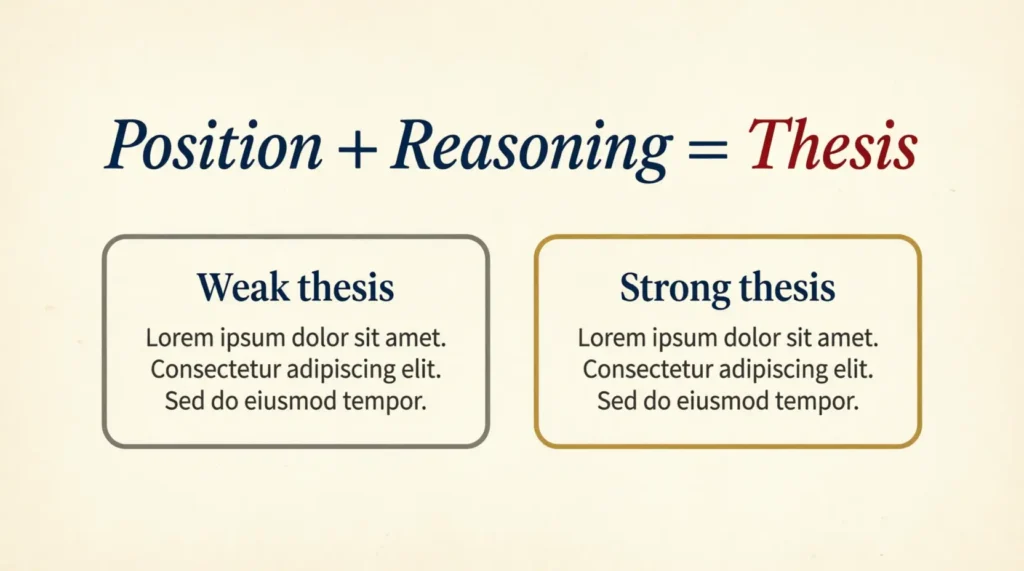
A weak thesis restates the prompt. A strong thesis takes a position.
Weak example: “There were many causes of the Civil War, including slavery, states’ rights, and economic differences.”
This just lists topics. It doesn’t argue anything, so a reader can’t disagree with it — which means it isn’t really a thesis.
Strong example: “While states’ rights and economic differences contributed to sectional tension, slavery was the central cause of the Civil War because it shaped both the economic conflict between North and South and the political battles over westward expansion.”
This version takes a defensible position and previews the reasoning that will follow.
A simple formula that works for most prompts:
Position + Reasoning = Thesis
State what you’re arguing, then briefly explain why, using language tied to the historical reasoning skill in the prompt (causation, comparison, or continuity and change). The DBQ Thesis Generator can be a useful way to practice this pattern until it becomes automatic.
APUSH Contextualization Explained
Contextualization means describing the broader historical situation surrounding your topic — not summarizing the whole unit, but giving the reader enough background to understand why your argument matters.
Common mistake: Students often write several sentences of general history that never connect back to the prompt. This earns nothing, even if it’s accurate, because contextualization has to be relevant.
Weak example: A paragraph describing colonial life in general when the prompt is about the causes of the American Revolution.
Strong example: A few sentences explaining how decades of British salutary neglect shaped colonial expectations of self-governance, directly setting up why new taxation policies after 1763 felt like a violation of established norms.
The strong version works because it’s specific to the argument you’re about to make, not just background noise. The APUSH Contextualization Builder can help you practice narrowing broad historical background down to what’s actually relevant to a given prompt.
Using Evidence in APUSH Essays
Strong evidence in an APUSH essay is specific, relevant, and analyzed — not just mentioned.
Specific evidence names an actual event, policy, person, or document rather than referring vaguely to “the government” or “people at the time.” Naming the Homestead Act is specific; saying “the government helped settlers” is not.
Relevant evidence directly supports your thesis. A true historical fact that doesn’t connect to your argument doesn’t help your score, no matter how accurate it is.
Evidence analysis is the explanation of how that evidence supports your argument. Citing the Homestead Act is a start, but explaining how it accelerated westward migration and intensified conflict with Native nations is what actually earns credit.
Students often assume more facts automatically means a higher score. In practice, two well-explained pieces of evidence usually outscore five that are simply listed. The APUSH Evidence Organizer can help you sort which pieces of evidence are strong enough to build a full analysis around before you start writing.
Historical Thinking Skills in APUSH Essays
Almost every APUSH prompt is built around one of these four skills, so recognizing them quickly helps you know what your essay needs to do.
Cause and effect asks you to explain how one development led to another. Look for prompts using words like “causes,” “effects,” or “led to.”
Comparison asks you to identify similarities and differences between two events, policies, or periods, and to explain their significance — not just list them side by side.
Continuity and change over time (CCOT) asks you to trace how something evolved, or stayed the same, across a given period, and to explain what that pattern reveals.
Historical significance asks you to argue why a particular event or development mattered, often in comparison to other possible turning points.
Recognizing which skill a prompt is testing before you start writing keeps your thesis and evidence aligned with what the rubric is actually rewarding.
APUSH Essay Example
Prompt: Evaluate the extent to which the Progressive Era reforms of the early 20th century changed the relationship between the federal government and the economy.
Planning: This is a CCOT-style prompt about government and economic power. Reasonable evidence: the Sherman Antitrust Act, the Federal Reserve Act, Theodore Roosevelt’s trust-busting, and the persistence of limited regulation in certain industries.
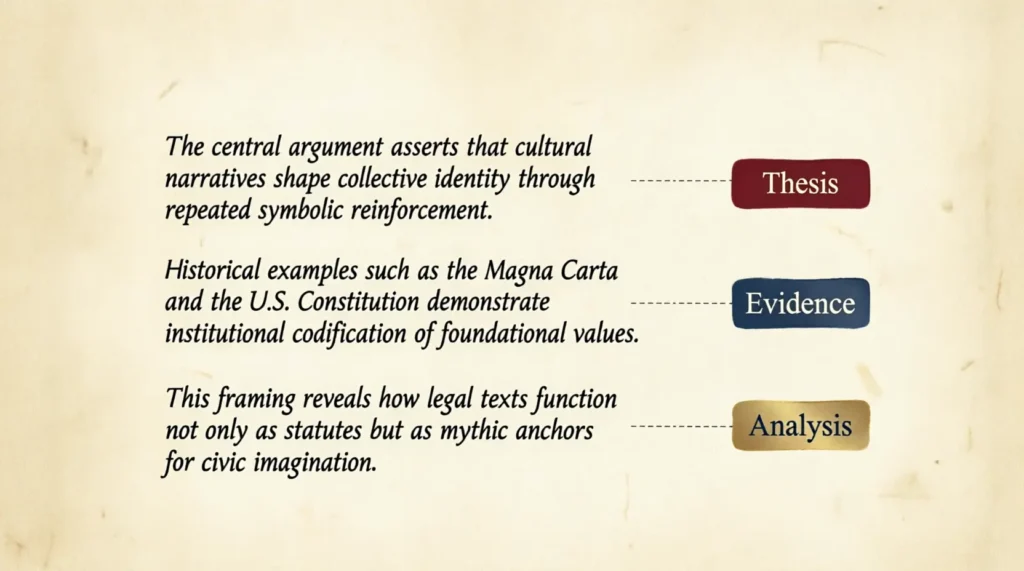
Thesis: “Progressive Era reforms significantly expanded the federal government’s role in regulating the economy, though the change was incomplete, as many industries continued to operate with minimal oversight through the 1910s.”
Evidence: The Federal Reserve Act of 1913 created centralized control over the banking system for the first time. The Sherman Antitrust Act, though passed earlier, was more aggressively enforced under Roosevelt against companies like Standard Oil.
Analysis: The Federal Reserve Act shows a structural shift, not just a policy change — it created a permanent institution for federal economic oversight rather than a one-time intervention. Pairing this with the acknowledgment that many sectors avoided regulation keeps the argument honest about the extent of change, which is exactly what this prompt requires.
Why it works: The thesis takes a clear, arguable position rather than just describing reforms. The evidence is specific and tied directly to the claim. The analysis explains significance instead of simply restating facts, and the essay acknowledges limits to the argument, which strengthens rather than weakens it.
Common APUSH Essay Mistakes
| Mistake | Why It Hurts Your Score | Better Approach |
|---|---|---|
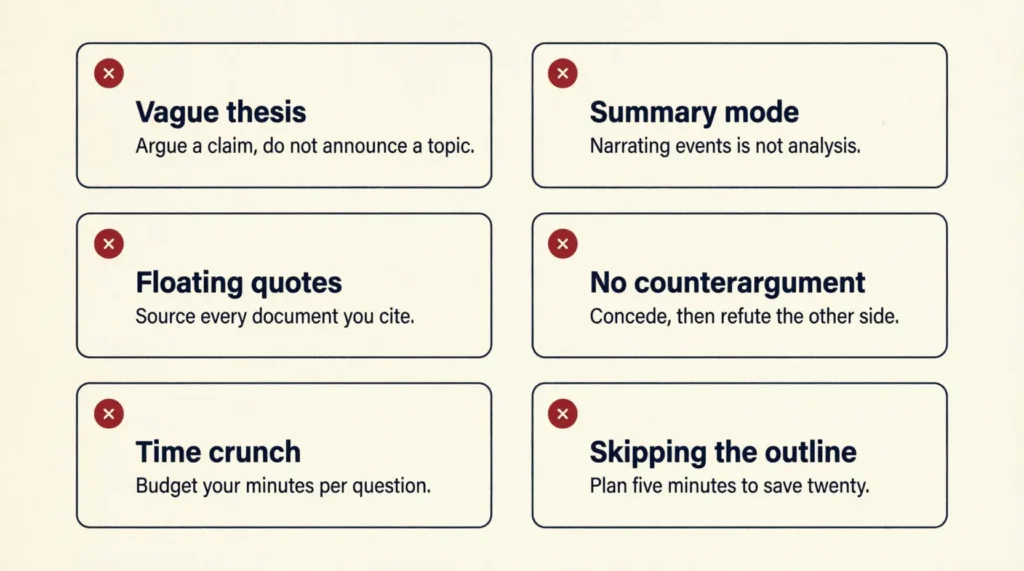
| Writing a descriptive essay instead of an argument | Readers can’t award argumentation points to a narrative that never takes a position | State a clear, defensible claim in your thesis and keep returning to it |
| Weak or restated thesis | A thesis that just repeats the prompt earns no thesis credit | Add a “because” clause that explains your reasoning |
| Vague evidence | Generic references to “society” or “the economy” don’t demonstrate specific knowledge | Name actual events, laws, people, or documents |
| Evidence with no analysis | Listing facts without explanation leaves earned points unclaimed | Explain how each piece of evidence supports your thesis |
| Contextualization that’s too broad | Unrelated background information doesn’t earn contextualization credit | Keep context tied directly to your specific argument |
| Ignoring part of the prompt | Missing a key term (like “to what extent”) often means missing the actual task | Underline key verbs and reread the prompt before writing |
APUSH Essay Checklist
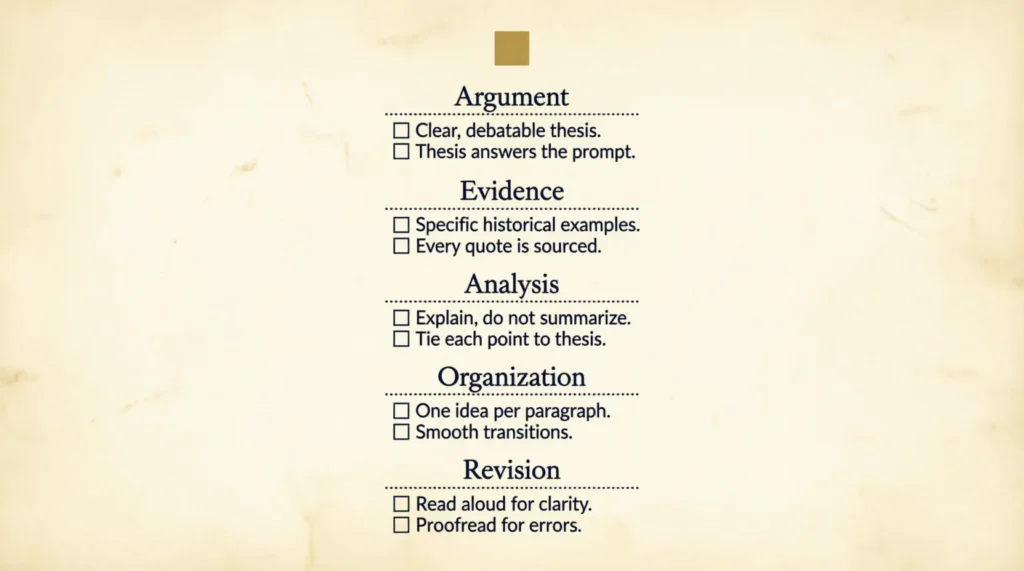
Use this before submitting any practice essay or exam response.
Best Practices From Strong APUSH Students
Students who consistently score well share a few habits. They practice in short, focused sessions — drilling just the thesis or just contextualization for ten minutes — rather than always writing a full essay under time pressure.
They also review mistakes against the actual rubric language rather than just a grade, since understanding why a paragraph lost points is more useful than knowing that it did. Many organize their evidence by historical reasoning skill while studying, not just by chronology, which makes essay planning much faster on exam day. And they track patterns over time: a student who consistently loses contextualization points can target that one skill directly instead of rewriting entire essays from scratch.
Frequently Asked Questions
There’s no required length. A DBQ or LEQ is typically four to six paragraphs, and quality of argument matters far more than word count.
State a clear, defensible position and briefly explain your reasoning, using language tied to the prompt’s historical reasoning skill (causation, comparison, or CCOT).
It’s a few sentences describing the broader historical situation surrounding your topic, used to set up why your argument matters — not a general summary of the time period.
The DBQ requires you to use provided historical documents plus outside knowledge. The LEQ requires you to build an argument entirely from your own historical knowledge, with no documents provided.
Focus on one rubric category at a time — thesis, contextualization, or evidence analysis — rather than trying to fix everything in a single essay.
Most strong essays use four to six paragraphs: an introduction with your thesis and contextualization, two or three body paragraphs, and a brief conclusion.
Accurate facts alone don’t earn full credit. Points come from using that evidence to support a clear argument, which is why analysis matters as much as accuracy.
Related APUSH Resources
If you want to keep building these skills, a few tools are worth working through alongside this guide.
The APUSH Contextualization Builder helps you practice narrowing broad historical background into contextualization that’s actually relevant to your specific thesis.
The APUSH Evidence Organizer is useful for sorting facts by historical reasoning skill before you write, so you’re not scrambling to find relevant evidence mid-essay.
The DBQ Thesis Generator and DBQ Complexity Analyzer both target the thesis and argument-complexity requirements that make up a large share of the DBQ rubric.
The APUSH DBQ Rubric Calculator and APUSH Rubric Mastery Tool are helpful for understanding exactly how points are distributed, so you know where to focus your practice time.
For direct feedback, the APUSH DBQ Grader + Feedback, APUSH SAQ Grader, and LEQ Grader each provide format-specific scoring so you can see how a full response holds up against the rubric.
The APUSH Timeline Generator is a good companion when you’re studying CCOT or causation prompts, since seeing events laid out chronologically makes patterns easier to spot.
For broader review, the APUSH Study Guide, APUSH Study Tool (Flashcards & Quiz), and Free APUSH Textbook support the content knowledge that every strong essay depends on.
External References
For official exam details and sample questions, the College Board’s AP United States History resources are the most reliable source, since they publish the actual rubrics and released exam questions each year.
For primary source research, the Library of Congress’s historical collections offer digitized documents that make strong, specific outside evidence for both DBQs and LEQs.
The National Archives’ primary source collection is another strong option, particularly for government documents and records tied to major policy shifts covered throughout the APUSH curriculum.
Conclusion
Strong APUSH essays come down to three things working together: a clear argument, evidence that’s specific and relevant, and analysis that explains why that evidence matters. None of these require you to know more history than you already do — they require you to use what you know more deliberately.
Like any writing skill, this improves with practice and honest feedback. Work through a few practice prompts, compare your essays against the rubric criteria, and use the tools linked throughout this guide to target the specific areas where you’re losing points. Small, consistent practice on thesis writing, contextualization, and evidence analysis adds up to real score improvement well before exam day.
Leave a Reply