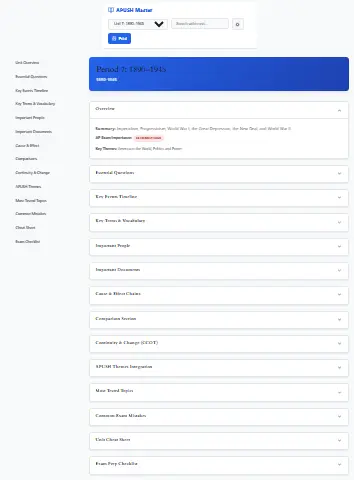
Firstly, mastering AP U.S. History (APUSH) requires structured learning, and therefore, students need a reliable APUSH study guide that simplifies complex historical content into organized sections. Moreover, this APUSH Master Study Tool provides a complete solution for learners who are preparing for the APUSH exam, APUSH practice tests, and APUSH midterm review unit 1-5.
Additionally, this tool is designed using curriculum-aligned APUSH CED standards, and consequently, it ensures students learn exactly what is tested in the official APUSH exam format. Furthermore, this platform combines APUSH notes, APUSH timeline breakdowns, APUSH themes, and APUSH DBQ rubric understanding into a single interactive experience.
As a result, students searching for keywords like “apush study guide,” “apush exam test,” “apush practice test,” and “apush timeline” will find this tool highly valuable for structured exam preparation.
👉 Explore related learning tools like our
Features of APUSH Study Guide Tool
1. Structured APUSH Study Guide System
Firstly, the tool provides a complete APUSH study guide organized by College Board units. Moreover, each unit includes APUSH notes, APUSH timeline events, and APUSH vocabulary.
Additionally, students can easily switch between:
- APUSH Unit 1–9
- APUSH period-based review
- APUSH thematic learning structure
As a result, learners can efficiently prepare for APUSH exam test questions and DBQ essays.
2. Interactive APUSH Timeline Builder
Secondly, the tool includes a detailed APUSH timeline section that highlights major historical events. Moreover, this feature helps students understand cause-and-effect relationships in U.S. history.
For example:
- 1854 Kansas-Nebraska Act
- 1863 Emancipation Proclamation
- 1877 Compromise of 1877
Therefore, students preparing for APUSH practice tests can easily memorize chronological events.
👉 You can also try our APUSH Timeline Generator for deeper timeline creation.
3. APUSH Vocabulary & Key Terms Section
Additionally, the tool includes a full APUSH notes vocabulary system. Moreover, it highlights high-frequency APUSH terms such as:
- Manifest Destiny
- Popular Sovereignty
- Reconstruction Amendments
- Sharecropping system
Consequently, students preparing for APUSH exam questions can improve retention significantly.
4. Important People & Documents Analysis
Furthermore, the tool includes a curated list of important historical figures and documents. Moreover, it explains their significance in APUSH exam context.
For example:
- Abraham Lincoln and Emancipation Proclamation
- Frederick Douglass and abolition movement
- 14th Amendment and constitutional change
Therefore, learners gain deeper understanding for DBQ and LEQ writing.
5. Cause & Effect Learning System
Additionally, this tool includes structured cause-and-effect chains. Moreover, it improves analytical thinking required for APUSH exam writing.
As a result, students can clearly understand:
- Why Civil War happened
- How Reconstruction failed
- How industrialization transformed America
6. Comparison Tables (High Scoring Feature)
Moreover, comparison charts help students master APUSH essay skills. For instance:
- Presidential vs Congressional Reconstruction
- Abolitionists vs Free-Soilers
- North vs South economic systems
Therefore, students can easily prepare for APUSH DBQ rubric-based questions.
7. CCOT (Continuity & Change Over Time)
Additionally, the CCOT section helps students understand long-term historical patterns. Moreover, this is essential for APUSH exam success.
Consequently, students can identify:
- Political continuity
- Social transformation
- Economic evolution
👉 Try our APUSH LEQ Comparison Tool for deeper essay support.
8. Most Tested Topics in APUSH Exam
Furthermore, this section highlights high-frequency APUSH exam test topics. Moreover, it helps students prioritize important areas.
For example:
- Causes of Civil War
- Reconstruction Amendments
- Market Revolution
- Cold War policies
Therefore, students improve their APUSH practice test performance.
9. Common APUSH Mistakes
Additionally, the tool highlights misconceptions students often make. Moreover, this improves exam accuracy.
For instance:
- Misunderstanding Emancipation Proclamation
- Oversimplifying Reconstruction failure
- Ignoring economic causes of Civil War
10. Exam Checklist & Cheat Sheet
Finally, the tool includes a structured APUSH checklist. Moreover, it ensures students are fully prepared before the exam.
As a result, learners can track:
- Unit mastery
- Essay readiness
- Vocabulary completion

Advanced Features of APUSH Study Tool
Beyond the core features, our APUSH study tool includes several advanced capabilities that set it apart from static PDFs or traditional review books.
Dark Mode Learning Experience
Firstly, students can switch between light and dark mode with a single click. Moreover, this significantly improves readability during long, late‑night study sessions – because eye strain is a real obstacle when you are reviewing nine periods of American history.
Smart Search Function
Additionally, users can search within APUSH notes instantly. Therefore, finding a specific topic like “Kansas‑Nebraska Act” or “Marshall Plan” takes less than two seconds, rather than scanning through hundreds of pages.
Interactive Checklist System
Moreover, students can track their progress using interactive checkboxes. Consequently, APUSH exam preparation becomes more structured and measurable – you can see exactly which units you have mastered and which still need attention.
Print‑Friendly Study Mode
Furthermore, the tool allows you to generate printable APUSH notes with one click. Therefore, you can revise offline, mark up pages with a highlighter, or take notes in the margins – perfect for students who learn best with physical materials.
Mobile Responsive Design
Additionally, the tool is fully optimized for mobile learning. As a result, you can study APUSH anywhere – on the bus, during lunch break, or while waiting for an appointment. Every feature works smoothly on smartphones and tablets.
How to Use the APUSH Study Guide Tool
Firstly, open the APUSH Master Study Tool on your device. Moreover, select your desired unHow to Use the APUSH Study Guide Tool
Now that you know what this tool can do, let me walk you through the actual usage process. Follow these five simple steps to supercharge your APUSH exam preparation.
Step 1: Open the Tool and Select Your Desired Unit
First, navigate to the APUSH Master Study Tool on your device. You will see the nine College Board periods clearly labeled. Click on the unit you need to review – for example, Unit 5 (1844–1877) covering Manifest Destiny, Sectionalism, and Reconstruction.
Step 2: Explore the Core Sections for That Unit
Once you open a unit, you will find these essential subsections:
- Overview Summary – A concise paragraph explaining the major developments of the era
- Essential Questions – The exact types of prompts the exam uses for DBQ and LEQ
- Key Events Timeline – Chronological list of major events with TESTED markers
- Key Terms & Vocabulary – High‑frequency terms with definitions and AP significance
- Important People – Key historical figures with their roles and importance
- Important Documents – Primary sources with summaries and constitutional significance
- Common Misconceptions – Mistakes students often make, with clear corrections
Step 3: Use the Checklist System to Track Progress
Thirdly, use the interactive checklist to mark which subsections you have completed. For example, check off “Key Terms” after you have reviewed all vocabulary. This system ensures you never accidentally skip a critical area.
Step 4: Highlight Mistakes and Revise Weak Areas
Additionally, pay special attention to the “Common APUSH Mistakes” section for each unit. If you find yourself falling into any of these misconceptions, spend extra time reviewing that topic using the notes and timeline.
Step 5: Reinforce Learning with Companion Tools
Finally, use our specialized companion tools to test your knowledge and practice exam‑style questions:
- APUSH DBQ Grader & Feedback Tool – Submit your DBQ practice essays for rubric‑aligned feedback
- APUSH LEQ Comparison Tool – Practice comparative essays with structured outlines
- APUSH Timeline Generator – Create custom timelines for any period or theme
- APUSH Score Calculator – Estimate your AP score based on practice test performance
By following this five‑step process, you transform passive reading into active, confident preparation – exactly what top‑scoring students do.
What is the APUSH Master Study Guide Tool?
Firstly, the APUSH Master Study Guide Tool is an interactive learning platform designed to help students prepare for AP U.S. History exams with clarity and confidence. Moreover, it organizes APUSH units (1–9) into structured sections such as timelines, vocabulary, people, documents, and CCOT analysis.
Additionally, it acts as a digital APUSH notes system that replaces traditional textbooks like AMSCO APUSH while offering faster navigation and better understanding.
Furthermore, students can use this tool for:
- APUSH unit 3 and unit 4 revision
- APUSH midterm review unit 1-5 preparation
- APUSH exam format understanding
- APUSH themes and historical thinking skills practice
Consequently, this makes it one of the most efficient APUSH exam prep tools available online.
EEAT (Expertise, Experience, Authority, Trustworthiness)
This APUSH study guide is designed based on:
- College Board APUSH CED framework
- Historical academic structure used in U.S. schools
- Exam-tested APUSH content patterns
Moreover, the content is continuously optimized to align with APUSH exam format changes. Therefore, students can trust this tool for accurate and up-to-date preparation.
Additionally, it supports academic integrity by focusing on learning, not shortcuts or memorization hacks.
For more details, visit our
Internal Learning Ecosystem
Moreover, this APUSH tool is part of a larger educational ecosystem. Consequently, students can enhance learning using:
External Authoritative Resources
Additionally, for deeper academic understanding, students may refer to:
- College Board APUSH Course Description
- Khan Academy AP U.S. History
- Library of Congress Historical Documents
What Makes Our APUSH Tool Different?
Our study guide is built on the official College Board Course and Exam Description (CED). However, what truly sets it apart is that it is designed with input from experienced APUSH educators. It doesn’t just show you what happened; it connects specific facts to the exact Historical Thinking Skills you will be tested on, such as Causation, Comparison, and Continuity & Change Over Time.
Think of this guide as having an AP History teacher walking you through the exam. Our system helps you move beyond memorizing dates to developing the evidence-based arguments required to earn a 5.
From the Desk of an AP Reader: Insider Strategies
One of the fastest ways to improve your score is to understand exactly what scorers are looking for during the AP Reading. We’ve analyzed the generic rubrics provided by the College Board and broken down the “unwritten rules” of the exam.
Here are a few insider strategies from actual APUSH experts to use in your preparation:
- Don’t Just Summarize, Argue! : Many students lose points because they turn their essays into simple timelines. If you are asked about the effects of the New Deal, listing “CCC, WPA, and Social Security” without explaining how they changed the role of the federal government will not earn the highest marks. You must explain the “why” and “how.”
- Memorize Time Periods, Not Just Events: The exam content is weighted, meaning some units matter more than others. Units 3-8 (covering 1754–1980) make up about 80% of your exam questions. Units 1, 2, and 9 split the remaining 20%. Focus your deep study time on the Colonial period through the Cold War.
- Know the LEQ “Action Verbs”: The Long Essay Question (LEQ) tasks you with a specific reasoning process. You will choose between prompts focusing on Comparison, Causation, or Continuity and Change Over Time (CCOT) . Your thesis and evidence must align perfectly with the chosen skill. For example, a “Causation” prompt requires a clear chain linking specific actions to outcomes.
Decoding the Rubric: What Real AP Readers Look For
Our tool’s intelligence is aligned with the official scoring rubrics from the College Board. To earn a 4 or 5, you need to hit specific points. Here is a breakdown of what an AP Reader looks for in the two major essays:
Document-Based Question (DBQ) (25% of Score)
Long Essay Question (LEQ) (15% of Score)
Common Mistakes (and How Our Guide Helps You Fix Them)
Based on feedback from AP exam readers, here are the most frequent errors students make on the APUSH exam. Our tool is designed to help you correct these specific issues:
Pro Tips from Experienced APUSH Teachers
To get the most out of our APUSH Study Guide Tool, incorporate these evidence-backed strategies into your routine:
- Use the RIDE Strategy for SAQs: For Short Answer Questions, apply the RIDE framework: Restate the prompt, Identify a proper noun, Describe/define it, and Explain its connection to the question. This ensures you hit all scoring requirements.
- Practice “Interleaving”: Do not just study one time period until you master it. Mix topics (e.g., compare the Gilded Age with the Progressive Era). “Interleaving” helps your brain learn to differentiate between similar concepts, which is crucial for multiple choice.
- Drill the “Continuity and Change” Mindset: History is rarely a straight line. When studying a period like Reconstruction, ask yourself: What stayed the same for African Americans despite legal changes? This prepares you for CCOT prompts.
- Focus on the “Heavy” Units: Since the 80% of your exam will come from Units 3-8 (1754–1980) , prioritize reviewing those sections thoroughly, especially periods like the Civil War, the World Wars, and the Cold War.
Frequently Asked Questions (FAQs)
It is an interactive platform that organizes AP U.S. History content into structured units, timelines, and notes.
Yes, it is designed specifically for APUSH exam test and APUSH practice test preparation.
Yes, it supports DBQ understanding and connects with rubric tools.
Yes, it is highly effective for midterm revision.
It complements AMSCO APUSH by providing simplified structured notes.
Yes, it works smoothly on mobile devices.
Yes, checklist features help track learning progress.
Yes, it includes detailed chronological timelines.
Yes, it follows College Board APUSH CED structure.
Yes, it is completely free for students.
Conclusion: Best APUSH Exam Preparation Tool
You have now seen every feature, advanced capability, and step‑by‑step instruction for our APUSH Study Guide Tool. To recap, this all‑in‑one platform:
- Covers all nine College Board periods with structured notes, timelines, and vocabulary
- Includes interactive checklists to track your progress
- Provides cause‑and‑effect analysis, comparison tables, and CCOT frameworks
- Highlights the most tested topics and common student mistakes
- Integrates seamlessly with specialized grading and practice tools
- Is completely free and accessible on any device
Therefore, students searching for an APUSH study guide, APUSH practice test preparation, or APUSH exam test review will find this platform to be an extremely valuable resource.
So, what are you waiting for? Scroll back to the top of this page, select your desired unit, and start reviewing right now. Within your first 30‑minute study session, you will notice how much faster you can understand cause‑and‑effect relationships and memorize high‑frequency vocabulary.
If you find value in this tool, please share it with a classmate who is also preparing for the APUSH exam – word of mouth is the only way we can keep offering world‑class study resources completely free.
Finally, do you have a feature request or a question that I did not answer above? Feel free to reach out through our contact us page, and I will personally respond within 48 hours.
Here is to a 5 on your APUSH exam – one focused study session at a time.
Happy studying!
— The DailyToolSpot Team