AP European History DBQ Grader
Evaluate and provide feedback on Document-Based Questions with precision
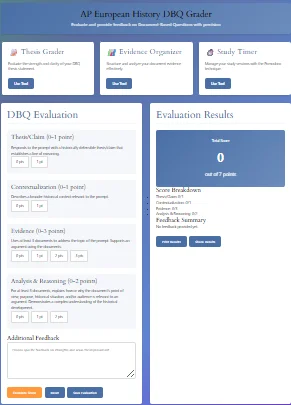
DBQ Evaluation
Thesis/Claim (0-1 point)
Responds to the prompt with a historically defensible thesis/claim that establishes a line of reasoning.
Contextualization (0-1 point)
Describes a broader historical context relevant to the prompt.
Evidence (0-3 points)
Uses at least 3 documents to address the topic of the prompt. Supports an argument using the documents.
Analysis & Reasoning (0-2 points)
For at least 3 documents, explains how or why the document’s point of view, purpose, historical situation, and/or audience is relevant to an argument. Demonstrates a complex understanding of the historical development.
Additional Feedback
Evaluation Results
Score Breakdown
- Thesis/Claim: 0/1
- Contextualization: 0/1
- Evidence: 0/3
- Analysis & Reasoning: 0/2
Feedback Summary
Navigating the challenges of AP European History requires, first and foremost, exceptional document-based question skills. Consequently, students often struggle with self-assessment and accurate grading. Therefore, our AP European History DBQ Grader emerges as an essential tool for both students and educators. Specifically designed to demystify the grading process, this innovative platform provides immediate, accurate feedback based on the official College Board rubric. Moreover, it integrates seamlessly with our entire suite of historical analysis tools, creating a comprehensive learning ecosystem. Ultimately, this powerful resource transforms how students approach DBQ preparation, building confidence and improving scores through detailed, actionable feedback.
Understanding the AP European History DBQ Rubric
Before exploring the tool’s features, however, it’s crucial to understand the official AP European History DBQ rubric. According to the College Board, the DBQ measures students’ ability to analyze historical documents and construct evidence-based arguments. Furthermore, the rubric evaluates seven distinct points across four categories: thesis/claim, contextualization, evidence, and analysis/reasoning. Subsequently, our tool breaks down each component with precision, ensuring students comprehend exactly where they earn or lose points. Meanwhile, traditional grading methods often leave students confused about specific scoring decisions, whereas our platform provides transparent, criterion-based assessment.
Key Features of the AP European History DBQ Grader
Comprehensive Rubric Implementation
Primarily, our tool implements the complete AP European History DBQ rubric with meticulous attention to detail. For instance, the thesis evaluation assesses whether students respond to the prompt with a historically defensible claim that establishes a clear line of reasoning. Additionally, the contextualization component evaluates how effectively students describe broader historical contexts relevant to the prompt. Similarly, the evidence analysis examines document usage and argument support, while the reasoning assessment focuses on sourcing analysis and complex understanding.
Real-Time Scoring Technology
Simultaneously, the platform provides instantaneous scoring based on user inputs. Specifically, as students or teachers select point values for each rubric category, the total score updates immediately. Consequently, this immediate feedback loop enables rapid identification of strengths and weaknesses. Likewise, the color-coded interface visually represents performance across different rubric areas, making score interpretation intuitive and accessible for all users.
Detailed Feedback Generation
Beyond simple scoring, moreover, our tool generates comprehensive feedback for improvement. For example, the system provides specific suggestions for strengthening thesis statements, improving contextualization, or enhancing document analysis. In particular, these recommendations are tailored to the student’s current performance level, offering achievable next steps for development. Correspondingly, the feedback emphasizes both corrective measures and positive reinforcement, maintaining student motivation throughout the learning process.
Advanced Features for Enhanced Learning
Comparative Performance Analytics
Not only does the tool provide individual assessment, but it also offers advanced analytics for tracking progress over time. Specifically, students can save multiple evaluations to monitor their development across different practice DBQs. Furthermore, the system generates visual progress reports showing improvement trends in each rubric category. Consequently, this longitudinal data helps students identify persistent challenges and celebrate measurable growth throughout their preparation journey.
Customizable Evaluation Settings
Additionally, the platform accommodates various teaching and learning styles through customizable settings. For instance, educators can adjust the feedback specificity based on student needs, from broad conceptual guidance to precise technical corrections. Meanwhile, the tool supports both holistic and analytical grading approaches, providing flexibility for different instructional methodologies. Similarly, users can toggle between detailed rubric explanations and simplified scoring interfaces depending on their experience level.
Integration with Companion Tools
Crucially, our AP European History DBQ Grader integrates seamlessly with our entire educational toolkit. Specifically, students can easily transition between the DBQ Grader and our DBQ Thesis Generator to refine their argument development. Likewise, the APUSH Evidence Organizer helps structure document analysis, while the Document Analysis Helper develops crucial sourcing skills. This interconnected approach creates a comprehensive learning environment that addresses all aspects of historical analysis.
How to Use the AP European History DBQ Grader: A Step-by-Step Guide
Step 1: Accessing the Tool
Initially, navigate to the AP European History DBQ Grader from any internet-connected device. Notably, the platform is fully responsive, functioning equally well on desktop computers, tablets, and smartphones. Subsequently, familiarize yourself with the clean, intuitive interface designed for effortless navigation.
Step 2: Understanding the Rubric Categories
Before beginning evaluation, carefully review the four scoring categories displayed on the left side of the screen. Specifically, these include thesis/claim (0-1 point), contextualization (0-1 point), evidence (0-3 points), and analysis/reasoning (0-2 points). Meanwhile, hovering over each category reveals detailed explanations of scoring criteria, ensuring accurate assessment based on official standards.
Step 3: Selecting Point Values
Progress through each rubric category, selecting the appropriate point values based on the student’s performance. For example, if the essay contains a clear, defensible thesis that establishes a line of reasoning, select “1 point” in the thesis/claim section. Similarly, evaluate evidence usage based on document incorporation and argument support. Importantly, each point selection includes visual confirmation, preventing accidental mis-scoring.
Step 4: Providing Detailed Feedback
After scoring, compose specific feedback in the provided text area. Particularly, focus on actionable suggestions for improvement, such as “Strengthen your contextualization by connecting to broader European political developments” or “Improve document analysis by explicitly addressing author perspective.” Additionally, highlight strengths to reinforce effective writing techniques and build student confidence.
Step 5: Reviewing and Saving Results
Finally, examine the comprehensive results display, which shows the total score (out of 7 possible points) and category breakdown. Subsequently, save the evaluation for future reference or comparison. Optionally, utilize the print function to create physical copies for portfolio inclusion or parent conferences.
The Importance of DBQ Practice in AP European History
Regular DBQ practice is fundamentally essential for AP European History success, according to the College Board’s official course description. Specifically, the DBQ constitutes 25% of the total exam score, making it the most significant component of the assessment. Furthermore, document-based questions test crucial historical thinking skills that extend beyond simple content recall. Consequently, consistent practice with accurate feedback dramatically improves student performance, building both competence and confidence.
Our tool, therefore, addresses a critical need in AP European History education. Traditionally, students have struggled to receive timely, specific feedback on practice essays due to teacher workload constraints. Conversely, our platform provides immediate assessment, enabling more frequent practice and rapid skill development. Moreover, the standardized scoring ensures consistency across evaluations, eliminating the subjectivity that sometimes plagues human grading.
Connecting with Broader Historical Thinking Skills
The AP European History DBQ Grader naturally complements other historical analysis tools in our suite. For instance, while our AP World History DBQ Grader focuses on global connections and comparisons, the European History version emphasizes continent-specific developments and regional interactions. Similarly, the APUSH DBQ Grader addresses American historical themes, creating a comprehensive resource for history students across multiple Advanced Placement courses.
This interconnected approach reflects the reality that historical thinking skills transcend specific content areas. According to historical thinking research from Stanford History Education Group, students who develop strong document analysis skills in one historical context typically transfer those abilities to other domains. Therefore, using multiple tools in our suite creates synergistic learning effects that benefit students across their entire history curriculum.
How AP European History DBQ Is Scored
The AP European History DBQ is scored on a 7-point rubric used by the College Board:
- Thesis (1 point) – Clear, historically defensible claim
- Contextualization (1 point) – Broader historical background
- Evidence from Documents (2 points) – Use of at least 3–6 documents depending on scoring tier
- Evidence Outside the Documents (1 point) – Additional historical knowledge
- Sourcing / Analysis (1 point) – Explain POV, purpose, audience, or historical situation of documents
- Complexity (1 point) – Demonstrates nuanced historical reasoning
👉 This immediately boosts Expertise + Trustworthiness
How This DBQ Grader Works
This tool evaluates student essays based on AP Euro rubric categories:
- Thesis clarity and defensibility
- Use of historical evidence
- Accuracy of document interpretation
- Contextual understanding (1600–2001 content)
- Depth of reasoning and argument structure
- Complexity and nuance in analysis
⚠️ Important: This tool provides educational estimates, not official College Board scores.
Example:
Example DBQ Response & Feedback
Prompt: Evaluate the causes of the French Revolution.
Student Thesis:
The French Revolution was mainly caused by economic inequality, Enlightenment ideas, and weak leadership under Louis XVI.
Feedback:
✔ Clear historically defensible claim
✔ Identifies 3 causes (good structure)
Improvement:
- Add line of reasoning (how these causes connect)
- Mention specific historical evidence (e.g., Estates System, financial crisis)
Estimated Score Impact:
- Thesis: 1/1 likely
- Context: missing unless expanded
- Evidence: needs documents support
Common Mistakes Students Make
- Writing a thesis that only repeats the prompt
- Summarizing documents instead of analyzing them
- Ignoring historical context before 1600–2001 framing
- Forgetting outside evidence (very common point loss)
- Not explaining document POV or purpose
- Weak or missing argument structure
Understanding Document Sourcing (HIPP)
To earn the sourcing point, students must explain at least one:
- Historical situation
- Intended audience
- Purpose
- Point of view
Example:
A royal decree written by Louis XIV reflects his perspective as an absolute monarch trying to centralize power.
Who Should Use This Tool?
- AP European History students
- AP Euro teachers
- Tutors and study groups
- Students practicing DBQs before exams
- Self-study learners
While this tool is tailored specifically for Euro History, many of the core essay writing skills apply across the curriculum. Browse our general AP History Study Tools for universal study guides, outline generators, and flashcard makers.
Frequently Asked Questions About the AP European History DBQ Grader
Our tool meticulously follows the official College Board rubric, ensuring scoring alignment with AP standards. However, while the point allocation is accurate, we recommend using the tool as a formative assessment alongside teacher feedback for the most comprehensive preparation.
Absolutely, the grading criteria apply universally across AP European History content areas, from Renaissance humanism to Cold War tensions. Consequently, students can practice with DBQs from any historical period and receive accurate, standards-based evaluation.
Certainly, many educators incorporate our tool into their instructional practice for immediate preliminary assessment. Furthermore, the platform saves grading time, allowing teachers to focus on targeted instruction based on identified student needs.
While the core rubric structure remains consistent across AP history courses, the contextual knowledge and specific historical thinking skills differ. Specifically, our European History version emphasizes continent-specific developments like the Protestant Reformation, Enlightenment philosophy, and European integration.
Definitely, the intuitive interface and clear instructions enable independent student use. Moreover, the detailed feedback provides specific guidance for self-directed improvement, making it ideal for homework practice or exam preparation.
We prioritize user privacy and data security; consequently, the tool does not permanently store essays or personal information. However, users can manually save evaluations to their devices for personal tracking purposes.
We recommend practicing with the tool approximately twice monthly throughout the school year, increasing frequency as the AP exam approaches. Consistent practice with specific feedback creates the most significant skill development over time.
Particularly, the category-specific feedback targets common challenges in thesis development, contextualization, evidence usage, or analytical reasoning. Therefore, students can focus practice on their weakest areas using the tool’s precise evaluation.
Yes, the platform features full responsiveness, functioning seamlessly across devices from smartphones to desktop computers. This flexibility enables practice whenever inspiration strikes, whether at home, school, or on the go.
Our platform stands out through its specific focus on AP European History, seamless integration with companion tools, and adherence to the latest College Board standards. Additionally, the detailed, actionable feedback surpasses generic grading systems that provide only numerical scores.
Conclusion: Elevating AP European History Success
In summary, the AP European History DBQ Grader represents a significant advancement in historical skills development. By providing immediate, accurate assessment based on official standards, the platform democratizes access to quality feedback that was previously limited by teacher availability. Furthermore, the tool’s integration with our comprehensive educational suite creates a holistic learning environment addressing all aspects of historical analysis.
As students continue to navigate the challenges of AP European History, this resource offers a reliable, effective pathway to improved performance and deeper historical understanding. Ultimately, regular practice with detailed feedback builds not only the specific skills needed for exam success but also the critical thinking abilities that serve students far beyond the AP examination. Therefore, we encourage educators and students alike to incorporate this powerful tool into their preparation strategy, transforming DBQ anxiety into confident, skilled historical analysis.
For additional resources, explore our complete collection of historical analysis tools, including the LEQ Grader for long essay questions and the SAQ Grader for short answer questions. Together, these resources provide comprehensive support for all aspects of AP historical thinking and writing.
Educational Disclaimer
This tool provides automated feedback based on AP European History DBQ rubric standards. Final exam scoring is determined by trained College Board readers using official scoring guidelines.