🏛️ AP Government Argument Essay Grader
Practice your AP U.S. Government and Politics argument essay with instant rubric-based analysis. Get feedback on thesis, evidence, reasoning, and counterargument — all in your browser.
AP Government Argument Essay Grader
Practice your AP U.S. Government and Politics argument essay with an instant rubric-based analysis.
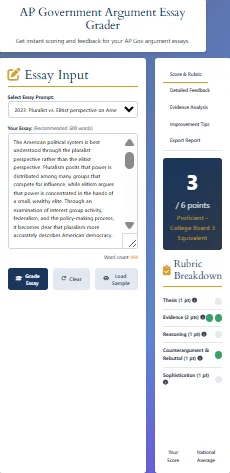
Rubric Breakdown
Score Comparison
Strengths
Weaknesses
Suggestions
Required Supreme Court Cases
Foundational Documents
Major Legislation / Policies
Text Report
Download the grading report as a TXT file.
PDF Report
Generate a PDF report using jsPDF.
Print Report
Open a clean printable version of the report.
How This Grader Actually Works
This tool isn’t AI. It’s a rule-based checker that runs entirely in your browser.
Here’s what it scans for:
Nothing you type is sent to a server.
What it can’t do
- Tell if a case you named was actually explained correctly
- Judge if your thesis answers the specific prompt
- Confirm your reasoning sentence really connects to your claim
Use the score as a checklist, not a verdict.
The Real Rubric (6 Points, 4 Rows)
Most AP Gov prep tools — including earlier versions of this one — misrepresent the rubric. Here’s the actual structure:
| Row | Points | What It Checks |
|---|---|---|
| A — Thesis | 0–1 | Defensible claim, not a restated prompt |
| B — Evidence | 0–3 | Two specific pieces; one must be from the prompt’s listed documents |
| C — Reasoning | 0–1 | Explains how evidence supports the thesis |
| D — Alternate Perspective | 0–1 | Describes AND rebuts an opposing view |
No sophistication point exists on this essay. That’s a DBQ/LEQ and AP Lang thing — not AP Gov.
Where This Tool’s Score Differs From the Real One
- Caps Evidence at 2 points (real max is 3)
- Adds a “sophistication” score the official rubric doesn’t have
- Can’t verify the evidence point actually requires the thesis point (gating rule)
- Can’t check which documents your specific prompt listed
Good for practice reps. Not a substitute for a real score.
Heads Up: The Case & Document Lists Changed
Two things shifted recently — check before you rely on any tool’s list, including this one:
- Foundational documents: Expanded from 9 to 13. New additions: Federalist No. 39, the Emancipation Proclamation, the Gettysburg Address, and a Wealth of Nations excerpt.
- Required Supreme Court cases: Most current sources say Roe v. Wade was dropped after Dobbs overturned it, putting the list at 14 instead of 15. Some prep sites haven’t updated yet.
This tool’s evidence detector still runs on the older 9-document, 15-case list. Verify against this year’s official Course and Exam Description.
Naming a Case ≠ Using It as Evidence
This is the #1 point-killer.
Doesn’t earn credit:
“The Constitution gives Congress power.”
Earns credit:
“In United States v. Lopez, the Court struck down a federal law for exceeding the Commerce Clause — showing Congress’s power over policy has real constitutional limits.”
The tool will flag “Lopez” as detected either way. Only the second version would earn a real reader’s point.
Mistakes That Cost Real Points
- Thesis that restates the prompt instead of taking a position
- Naming evidence without explaining why it matters
- Two pieces of evidence crammed into one sentence (readers can’t credit them separately)
- Acknowledging an opposing view but never rebutting it
What to Do With Your Score
Low counterargument score? Make sure you both describe the opposing view and answer it.
Low reasoning score? Add one sentence after each piece of evidence explaining why it supports your claim.
Find your weakest rubric row, then rewrite just that paragraph.
Related Tools
- APUSH DBQ Grader & Feedback Tool — get feedback on a practice DBQ essay
- LEQ Grader — practice scoring against the 6-point AP History rubric
- DBQ Thesis Generator — build a defensible thesis from evidence
- APUSH Evidence Organizer — organize specific evidence before writing
- APUSH Score Calculator — estimate your AP score from practice test results
- APUSH Study Guide Tool — structured notes for all nine units
For the official rubric language, see College Board AP Central.
Frequently Asked Questions (FAQs)
No. It’s a practice heuristic, not a predictor of your exam score.
Its lists predate College Board’s recent expansion to 13 documents. A correctly-used case it doesn’t have on file is a gap in the tool, not your essay.
Usually a spelling/phrasing mismatch. Note: a match also doesn’t mean a real reader would credit it — naming isn’t explaining.
No — those use a different rubric with contextualization and sophistication points that don’t apply here.
Editorial and Tool Information
This page provides a browser-based practice grader for AP U.S. Government and Politics argument essays. It is designed for self-review and revision practice, not for official scoring.
The tool was developed around a simple workflow: paste your essay → run the analysis → review rubric scores and feedback → export or print the report.
The page and tool information are reviewed periodically to improve clarity and reflect changes to the tool. When discussing AP exam requirements or scoring criteria, students should use current official College Board materials as the authoritative source.
Last reviewed: September 2026
Keep Practicing Your Argument Essay
Consistent practice with rubric-based feedback is the fastest way to improve your AP Government argument essay — use this grader to find weak spots, then pair it with the thesis and evidence tools above for focused revision.
When you’re ready, try the DBQ Thesis Generator, the Evidence Organizer, or explore the AP History Study Tools hub for more resources.