Navigating personal finance can often feel overwhelming; consequently, having a simple yet powerful framework is absolutely essential for success. Fortunately, the 50/30/20 rule provides exactly that—a straightforward blueprint for budgeting your after-tax income. Furthermore, as we step into 2026, financial clarity becomes more crucial than ever. This definitive guide will not only explain the rule in depth but will also introduce you to our sophisticated 50/30/20 rule calculator, a dynamic tool designed to automate and optimize your financial planning. Therefore, whether you are a budgeting novice or a seasoned finance enthusiast, you will discover actionable strategies to take control of your monetary destiny.
Additionally, we will clearly show you how our free 2026 Budget Planner Tool does all the hard work for you automatically.
Features of Our 50/30/20 Rule Calculator
Our 50/30/20 Rule Calculator is designed to help you create a balanced budget quickly and accurately. Instead of calculating percentages manually, you can simply enter your income and receive an instant breakdown of your finances.
Instant Budget Allocation
As soon as you enter your monthly income, the calculator automatically divides it into the recommended categories of needs, wants, and savings.
Accurate Percentage Calculations
Because manual calculations can lead to mistakes, the tool performs all calculations automatically and provides precise results.
User-Friendly Interface
The calculator is simple, clean, and easy to use. Therefore, even beginners can create a budget without financial expertise.
Works for Any Income Level
Whether you earn a small salary, freelance income, or a high monthly income, the calculator adjusts the results instantly.
Mobile-Friendly Design
Since many users manage finances on smartphones, the tool works smoothly across mobile devices, tablets, and desktops.
Budget Planning Support
In addition to showing percentages, the calculator helps users understand how much they can realistically spend and save each month.
Financial Goal Tracking
By following the recommended savings allocation, users can work toward emergency funds, investments, debt repayment, and long-term financial goals.
Free and Accessible
Unlike many budgeting apps that require subscriptions, this calculator is completely free and available anytime.
Quick 50-30-20 Calculator
Enter your monthly income:
Advanced Features of This 50/30/20 Budget Calculator
Beyond basic calculations, our advanced budgeting calculator offers valuable insights that help users make smarter financial decisions.
Real-Time Results
Whenever you change your income amount, the calculator updates the budget breakdown instantly. As a result, you can compare different income scenarios without refreshing the page.
Flexible Budget Analysis
Although the traditional 50/30/20 rule is a popular guideline, every financial situation is different. Therefore, users can use the results as a starting point and adjust categories according to their needs.
Savings and Investment Planning
The calculator highlights the recommended savings amount, which can be used for emergency funds, retirement planning, investments, or debt reduction.
Better Spending Awareness
By clearly separating needs and wants, the tool helps users identify unnecessary expenses and improve spending habits over time.
Financial Discipline Support
Because budgeting requires consistency, the calculator encourages a structured approach to managing money each month.
Quick Scenario Testing
Users can experiment with different income levels and instantly see how changes in earnings affect their budget distribution.
Cost-of-Living Adaptability
Since housing, transportation, and utility costs vary by location, the calculator can be used as a flexible framework rather than a strict rule.
Beginner-Friendly Financial Education
Besides calculations, the tool helps users learn the fundamentals of budgeting, money management, and personal finance.
How to Use This 50/30/20 Rule Calculator
Using the calculator is simple and only takes a few seconds. Follow the steps below to create your personalized budget plan.
Step 1: Enter Your Monthly Income
First, enter your total monthly after-tax income into the calculator. This amount should represent the money you actually receive each month.
Step 2: Start the Calculation
Next, click the calculate button to generate your personalized budget breakdown instantly.
Step 3: Review Your Budget Categories
After the calculation is complete, you will see three spending categories:
- 50% for essential needs such as rent, groceries, transportation, utilities, and insurance.
- 30% for personal wants such as entertainment, shopping, dining out, and hobbies.
- 20% for savings, investments, emergency funds, or debt repayment.
Step 4: Compare With Your Current Spending
Then, compare the suggested budget allocation with your actual expenses. This comparison can help you identify areas where adjustments may be needed.
Step 5: Make Financial Improvements
If your spending exceeds the recommended amounts, gradually reduce unnecessary expenses. Meanwhile, try to increase your savings whenever possible.
Step 6: Track Your Progress Monthly
Finally, use the calculator regularly to monitor your budget and stay aligned with your financial goals throughout the year.
Pro Tip
While the 50/30/20 rule provides an excellent budgeting framework, you can customize the percentages based on your lifestyle, income level, and local cost of living. The goal is not perfection but consistent financial improvement.
What Exactly is the 50/30/20 Rule?
Essentially, the 50/30/20 rule 2026 rule is a straightforward framework for managing your money. Historically, it was popularized by Senator Elizabeth Warren in her book All Your Worth. Specifically, the rule wisely suggests you divide your after-tax income into three simple categories:
- 50% for Needs: These are your essential expenses you must pay to live.
- 30% for Wants: Conversely, these are your non-essential luxuries and lifestyle choices.
- 20% for Savings & Debt Repayment: Most importantly, this secures your financial future.
Consequently, this balanced approach strategically ensures you cover your essentials, enjoy your life, and build a secure future—all without feeling deprived and divides consequently your after-tax income into three categories:
- First, 50% Needs: Essential expenses you can’t avoid.
- Next 30% Wants: Non-essential lifestyle choices.
- Finally, 20% Savings/Debt: Future-focused goals and financial security.
The 50/30/20 rule in particular divides your income into three key categories. For instance first it is, 50% goes to essential needs like rent and groceries. Next, 30% is allocated to non-essential wants, such as dining out or hobbies. Finally, 20% is reserved for savings or debt repayment. However, on the other hand, you can adjust these percentages if your financial situation requires flexibility.
Step 1: Calculate Your After-Tax Income
Nevertheless as we approach 2026, start by determining your monthly take-home pay which includes:
- Salary/wages (after taxes and deductions).
- Side hustle or freelance income.
- Rental income or dividends.
Example: If your monthly income is $4,500, here is how the 50/30/20 breakdown looks:
- Needs: $2,250
- Wants: $1,350
- Savings/Debt: $900
To begin, calculate your after-tax income. Then, list your needs, such as rent and utilities. Afterward, track your wants, including non-essentials like entertainment. Most importantly, save 20% for the future to ensure financial security.
Step 2: Categorize Your 2026 Expenses
Given rising costs in 2026 needs: Essentials for Survival
- Rent/mortgage, utilities, groceries.
- Minimum debt payments (e.g., student loans, credit cards).
- Health insurance, childcare, basic transportation.
2026 Tip: Anticipate inflation adjustments. If rent or utilities rise, adjust your needs category first.
30% Wants: Lifestyle Choices
- Dining out, streaming services, vacations.
- Hobbies, gym memberships, luxury purchases.
- Upgraded gadgets or fashion.
2026 Focus: To future-proof your budget, prioritize experiences or goals that matter most to you (e.g., a 2026 travel bucket list).
20% Savings/Debt: Secure Your Future
- Emergency fund contributions.
- Retirement accounts (401(k), IRA).
- Extra debt payments (beyond minimums).
- Investments or education savings.
2026 Goal: Aim to boost retirement savings if employer matches increase, or tackle high-interest debt.
Step 3: Adapt the Rule for 2026
Unlike traditional methods, while the 50/30/20 rule for the 2026 framework is flexible, 2026 may require tweaks:
- Adjust percentages if your needs exceed 50% (e.g., high-cost city living). Then try 55/25/20 temporarily.
- Automate savings using apps or direct deposits to stay disciplined.
- Plan for unknowns: Rising healthcare costs, tax changes, or career shifts.
Example: A 2026 Budget Using 50/30/20
Monthly Income: $5,000
| Category | Allocation | Expenses |
|---|---|---|
| Needs (50%) | $2,500 | Rent (1,200),groceries(1,200),groceries(400), utilities (300),carpayment(300),carpayment(600) |
| Wants (30%) | $1,500 | Dining (300),travelfund(300),travelfund(500), Netflix (15),hobbies(15),hobbies(685) |
| Savings/Debt (20%) | $1,000 | Emergency fund (400),RothIRA(400),RothIRA(300), extra student loan payment ($300) |
50/30/20 Budget Calculator Form
50/30/20 Budget Calculator (2026)
Understanding the 50/30/20 Rule: A Timeless Framework for Financial Health
The 50/30/20 rule, popularized by Senator Elizabeth Warren in her book All Your Worth: The Ultimate Lifetime Money Plan, offers a beautifully simple method for allocating your income. Specifically, it divides your take-home pay into three distinct categories:
- 50% for Needs: Essentially, this category covers essential, non-negotiable expenses you must pay to live and work. For instance, these include rent or mortgage payments, utilities, groceries, healthcare, minimum debt payments, and basic transportation costs.
- 30% for Wants: Conversely, this segment is for the lifestyle choices that enhance your life but are not strictly necessary. Typically, these encompass dining out, entertainment, hobbies, shopping for non-essential items, vacations, and subscription services.
- 20% for Savings & Debt Repayment: Ultimately, this is the segment that builds your future financial security. Importantly, it includes contributions to your emergency fund, retirement accounts (like a 401(k) or IRA), investments, and any extra payments toward debt principal beyond the minimums.
This framework, therefore, creates a balanced financial ecosystem where your present needs, current happiness, and future stability are all addressed simultaneously.
Introducing Your Personal Financial Co-Pilot: The 50/30/20 Rule Calculator
Manually calculating these percentages for every paycheck can be tedious and prone to error. As a result, we developed our 50/30/20 rule calculator to eliminate the guesswork and provide instant, personalized insights.
Our tool is more than just a simple percentage calculator; it is a comprehensive financial analysis engine. Firstly, you simply input your monthly after-tax income. Then, the calculator instantly generates your personalized spending allocations: the exact dollar amounts you should ideally target for Needs, Wants, and Savings/Debt. Consequently, you receive a clear and immediate financial target to aim for each month.
Tips to Master the 50/30/20 Rule in 2026
- First, use a Digital Tool because manually tracking is a chore.
- Second, review your budget monthly; therefore, you can adjust it regularly.
- Another key point is to be realistic with your spending categories.
- Finally, start small if necessary; for example, begin with 5% savings and gradually increase.
Ready to Take Control? Use Our Free 2026 Budget Planner!
In conclusion, understanding the rule is one thing; however, implementing it is another. Why struggle with spreadsheets when you can have a tool built specifically for this purpose?
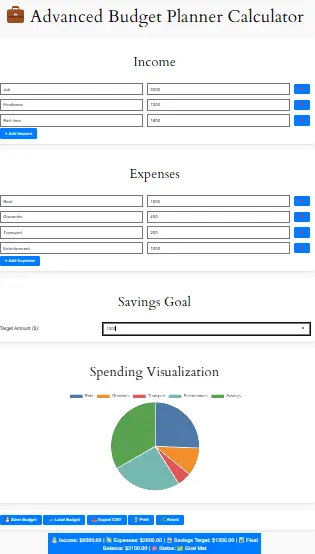
Our 2026 Budget Planner Tool is consequently designed to make the 50/30/20 rule effortless. It features instant calculations and a visual dashboard. Therefore, you will see instantly if you are on track.
So, stop stressing about money and start building the financial future you deserve.
[Click Here to Launch Your Free 2026 Budget Planner Now!]
Ultimately, take the first step towards financial peace today. It only takes a few minutes, and as a result, the payoff will last all year long.
Common Mistakes to Avoid
In order to make the budget avoid mistakes like:
- Misclassifying wants as needs: That daily latte is a want.
- Ignoring inflation: Factor in 2026 price hikes for groceries or fuel.
- Skipping emergency savings: Even $50/month adds up.
Budget Breakdown Analysis
| Category | Percentage | Examples |
|---|---|---|
| Needs | 50% | Rent, Utilities, Insurance |
| Wants | 30% | Dining, Travel, Hobbies |
| Savings/Debt | 20% | Emergency Fund, Loans |
| Category | Amount | Percentage |
|---|---|---|
| Needs | $1,500 | |
| Wants | $900 | |
| Savings/Debt | $600 |
How Our 2026 Budget Planner Simplifies the Process
Using our tool is straightforward and designed for a seamless user experience. Here is a simple walkthrough:
- Locate the Tool: Firstly, navigate to our 50/30/20 rule calculator on the main page. (Internal Link: You can also find it on our financial calculators hub).
- Enter Your Income: In the designated field, input your monthly after-tax income. This is your net pay, not your gross salary. If your income is irregular, use an average from the last 3-6 months.
- Review Default Allocations: The calculator will automatically display the recommended allocations based on the 50/30/20 rule. Take a moment to review these figures.
- (Optional) Adjust Percentages: If your situation demands it, use the sliders or input fields to adjust the percentages for Needs, Wants, and Savings. Observe how the dollar amounts change in real-time.
- Input Your Actual Expenses: For the most accurate picture, proceed to the detailed breakdown section. Here, enter your actual spending in as many sub-categories as possible. This is where the most valuable insights are revealed.
- Analyze Your Results: Finally, examine the visual report generated by the calculator. The color-coded feedback will immediately show you which categories are aligned with your goals and which need attention. Use this analysis to make informed adjustments to your spending for the following month.
Try Our Free 2026 Budget Planner – Automate the 50/30/20 Rule!
Why the 50/30/20 Rule is Perfect for Your 2026 Budget
As we look ahead, financial flexibility in 2026 will be absolutely key. Thankfully, the 50/30/20 rule is not rigid; instead, it is a flexible guideline that easily adapts to your life. For this reason, it is perfectly suited for navigating unpredictable expenses while still making consistent progress toward your goals, whether that is saving for a vacation, paying down student loans, or building a robust emergency fund.
The rule divides your take-home pay into three categories:
- 50% for essential needs
- 30% for discretionary wants
- 20% for savings, investing, or extra debt payments
The method was popularized by Elizabeth Warren and her daughter in the book All Your Worth: The Ultimate Lifetime Money Plan.
50% Needs
Needs are expenses you must pay to live and work. These usually include:
- Rent or mortgage
- Utilities
- Groceries
- Transportation
- Insurance
- Minimum debt payments
In 2026, many people find that housing alone can take 30–40% of their income, making the traditional 50% limit harder to follow.
30% Wants
Wants are the things that make life more enjoyable but are not absolutely necessary:
- Dining out
- Streaming services
- Shopping
- Vacations
- Hobbies
- Entertainment
These expenses are usually the easiest to reduce when your budget becomes tight.
20% Savings and Debt
The final 20% should go toward:
- Emergency savings
- Retirement accounts
- Investments
- Extra student loan or credit card payments
- Saving for a house or future goal
Financial experts still recommend trying to save at least 15–20% of your income whenever possible.
Example of a 50/30/20 Budget
If your monthly take-home pay is $5,000:
- Needs: $2,500
- Wants: $1,500
- Savings: $1,000
The core budgeting formula is:
Needs=0.50I,Wants=0.30I,Savings=0.20I
where I is your after-tax monthly income.
Does the 50/30/20 Rule Still Work in 2026?
For some people, yes. It works especially well for:
- People with moderate or higher incomes
- Beginners who want a simple budgeting method
- People living in lower-cost areas
- Households without large debt payments
However, many people in 2026 need to adjust the rule because necessities have become more expensive. High rent, inflation, child care, commuting, and debt often push “needs” well above 50%.
Reddit users frequently mention that the rule is useful as a starting point, but most people eventually customize it to fit their real expenses. One common suggestion is to “save first, then adjust the rest.”
Popular Alternatives in 2026
Because of higher living costs, many people now use modified versions such as:
- 60/30/10
- 65/20/15
- 70/20/10
- 15/65/20
The 60/30/10 method gives 60% to necessities, 30% to wants, and 10% to savings. This may work better for people in expensive cities or with higher housing costs.
The newer 15/65/20 approach puts 15% into savings first, allows up to 65% for essentials, and keeps 20% for discretionary spending. This can feel more realistic without abandoning budgeting discipline.
How to Make the Rule Work Better
To adapt the 50/30/20 rule for modern life:
- Track your current spending first
- See which category is too high
- Reduce wants before cutting savings
- Automate your savings
- Adjust the percentages if needed
Many people find that even saving 10–15% consistently is better than giving up because 20% feels impossible.
Why This Budgeting Method Is Still Popular
The biggest strength of the 50/30/20 rule is its simplicity. You do not need complicated spreadsheets or dozens of categories. It gives you a quick way to understand where your money is going and whether you are spending too much on one area.
Even if you do not follow the percentages exactly, the rule is still a helpful starting point for building a realistic budget in 2026.
Author: Personal Finance Tools Team
Experience: 5+ years creating budgeting and money-management tools
Expertise: Personal finance, budgeting, saving strategies, debt management
Last Updated: April 2026
Frequently Asked Questions (FAQs)
If essentials like rent or healthcare consume more than 50%, adjust the rule temporarily. Try a 55/25/20 split (55% needs, 25% wants, 20% savings). Also prioritize your reducing high-cost needs over time, like refinancing debt or downsizing housing.
Yes! In particular, calculate your average monthly income over the past 6-12 months. Use our 2026 Budget Planner to set baseline allocations and adjust monthly as income fluctuates.
Needs: Rent, utilities, groceries, minimum debt payments, healthcare.
Wants: Dining out, streaming services, vacations, hobbies.
Pro Tip: Use our tool’s pre-built categories to avoid confusion.
No absolutely not! The 20% covers:
Emergency funds
Retirement accounts
Debt payoff (beyond minimums)
Education or vacation savings
Prioritize debt repayment in the 20% savings category. For example:
Allocate 15% to debt and 5% to savings until balances are paid off.
Absolutely! Our tool automates the 50/30/20 split which is based on your income. You just input your numbers, and this tool calculate allocations for needs, wants, and savings. Try it here.
While review expenses quarterly and adjust allocations.
Use our tool’s scenario planner to test inflation-driven “what-if” changes.
Borrow from next month’s “wants” budget.
Track spending daily with our tool’s real-time balance alerts.
Yes! Use the “Share Preview” feature in our planner to collaborate without sharing login details.
Yes! Freelancers should:
Calculate after-tax income (average monthly earnings).
Allocate 20% to savings for taxes and emergencies.
Use our tool’s freelancer template for irregular income.
Conclusion
In conclusion, the 50/30/20 rule remains a profoundly effective and resilient strategy for managing personal finances, even as we face the economic realities of 2026. Its true power lies not in rigid adherence to specific percentages, but in the fundamental mindset it promotes: a conscious and balanced allocation of your resources towards necessities, lifestyle, and future security.
Ultimately, our advanced 50/30/20 rule calculator is designed to be the bridge between understanding this powerful principle and implementing it effortlessly in your daily life. By leveraging its dynamic calculation, deep-dive analysis, and scenario-planning features, you transform a static budget into a living, adaptable financial plan. Therefore, we encourage you to not just read about this rule, but to actively engage with it. Input your numbers, explore the scenarios, and let the data guide you toward smarter financial decisions.
Remember, the journey to financial wellness is a marathon, not a sprint. Start by using our calculator today to establish your baseline; subsequently, make small, consistent adjustments each month. Finally, by committing to this process, you are not just budgeting your money—you are actively designing a more secure, prosperous, and financially free future for yourself.
2026 is your year to thrive financially. Start planning today!
Disclaimer: This article and the associated 50/30/20 rule calculator are for educational purposes only and should not be considered as professional financial advice. It is always recommended to consult with a qualified financial advisor for personalized guidance tailored to your specific circumstances. Data and calculations from the tool are estimates based on the information you provide.
Leave a Reply