Are you tired of complex formulas and time-consuming manual calculations for finding the volume of shapes? Whether you’re a student tackling geometry homework, a DIY enthusiast planning a project, or a professional needing quick measurements, our free online volume calculator at OnlineTool.Free.nf is here to make your life easier!
A free online volume calculator helps users quickly calculate the amount of three-dimensional space inside an object or shape. Instead of memorizing formulas or doing manual calculations, users can enter measurements such as length, width, height, or radius and get an instant result. This volume converter calculators are commonly used in geometry, construction, engineering, manufacturing, cooking, and everyday planning.
Volume Calculator – Calculate the Volume of a Cube, Sphere, Cylinder, and More!
Volume is a critical measurement in countless scenarios:
- Students use it for math, physics, and engineering problems.
- Builders need it to estimate materials like concrete or paint.
- Home cooks rely on it for recipes and portioning ingredients.
- Hobbyists calculate volumes for crafts, aquariums, or gardening.
But let’s face it—memorizing formulas for cubes, cylinders, spheres, and cones can be tedious. Even a small error in manual calculations can lead to wasted time, resources, or costly mistakes. That’s where our tool steps in!
Understanding Volume: The Essential Principles
First and foremost, volume quantifies the three-dimensional space an object occupies. It is universally expressed in cubic units, such as cubic centimeters (cm³), cubic meters (m³), or cubic feet (ft³). Understanding this concept is absolutely critical across countless scenarios. For instance, it is essential in baking for measuring ingredients, in construction for ordering concrete, and in science for conducting experiments. Thus, utilizing an accurate volume calculator online is far more than a mere convenience; indeed, it is a necessity for achieving precision and efficiency. Our tool, developed by the experienced team at OnlineTool.Free.nf, seamlessly translates intricate geometric formulas into simple, error-free outcomes. For example, just as you might use our comprehensive GPA Calculator to track academic performance, this volume tool empowers you to master the practical mathematics that underpin real-world applications.
What Is Volume?
Volume is the amount of space occupied by a three-dimensional object. It is measured in cubic units such as cubic centimeters (cm³), cubic meters (m³), cubic inches (in³), or cubic feet (ft³).
Understanding volume is essential in mathematics, science, engineering, and everyday tasks like measuring containers, calculating storage capacity, or estimating materials.
Core Features of Our Free Volume Calculator
Our online volume calculator distinguishes itself through an exceptional blend of simplicity, robust functionality, and unwavering reliability. Subsequently, here are the definitive features that make it an indispensable resource:
- Comprehensive Multi-Shape Support: Effortlessly calculate the volume of a vast array of geometric shapes. Our tool expertly handles cubes, rectangular prisms (cuboids), cylinders, spheres, cones, and square pyramids all within a single, unified interface.
- Instant and Mathematically Accurate Results: Immediately after you input the required dimensions, the calculator applies the correct volume formula to generate a result. Consequently, you receive a precise answer completely free from the common errors associated with manual calculation.
- Intuitively Designed User Interface: The platform boasts a clean, logical, and user-friendly interface. As a result, individuals of all skill levels—from middle school students to professional engineers—can navigate and operate it with absolute confidence and ease.
- Completely Free and Universally Accessible: This tool is offered 100% free without any hidden fees, required subscriptions, or mandatory sign-ups. Moreover, it is fully responsive and performs flawlessly across all devices, including desktops, tablets, and smartphones.
- Uncompromising Privacy Protection: In strict accordance with our clearly stated Privacy Policy, we adhere to a zero data-tracking policy. This means we do not collect, store, or share your personal information or any calculation inputs, ensuring your complete confidentiality.
Advanced Functionality for Complex Requirements
Beyond performing basic computations, our calculator incorporates sophisticated functionalities designed for more complex needs and deeper analytical understanding:
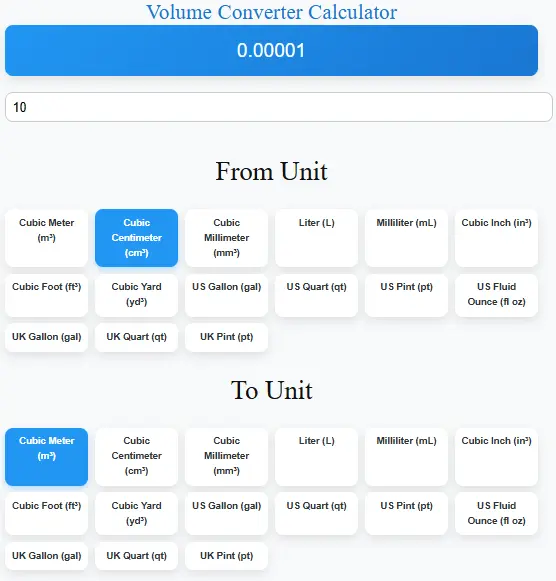
- Integrated Unit Conversion: Calculate a volume in one unit (e.g., cubic inches) and instantly convert it to another (e.g., liters or gallons) within the same workflow. This feature is particularly invaluable for international projects, scientific research, or everyday unit translation.
- Educational Step-by-Step Solutions: To enhance learning, the tool can optionally display the exact mathematical formula used and a detailed breakdown of the calculation steps. Therefore, it functions not just as an answer generator but as a powerful educational aid for students.
- Dynamic 3D Shape Visualization: For key shapes, an interactive diagram updates in real-time based on your inputs. This visualization helps you confirm that you have entered the correct parameters, such as distinguishing between radius and diameter.
- Result Export and Sharing: You can easily copy your calculation results to the clipboard or generate a shareable link. This functionality is perfect for collaborating on team projects, submitting work to an instructor, or simply keeping records.
For other specialized measurement conversions, we invite you to explore our suite of dedicated tools, such as the Temperature Conversion Calculator or the Length Conversion Calculator.
About This Tool
This volume calculator is designed to help students, engineers, and professionals perform accurate geometric calculations بسهولة. It is based on standard mathematical formulas and aims to provide fast, reliable, and easy-to-use solutions for everyday calculations.
How to Use the Volume Calculator
Using our volume calculator online is a remarkably straightforward, three-step process engineered for maximum efficiency and clarity.
Step 1: Select Your Geometric Shape
Begin by navigating to the clearly marked shape selector dropdown menu. Then, choose the specific geometric shape for which you need to calculate the volume—options include “Cylinder,” “Sphere,” “Cube,” “Cone,” and more.
Step 2: Input the Required Dimensions
Next, enter the necessary measurements into the corresponding, clearly labeled input fields. For example:
- For a Cylinder, you would input the radius and height.
- For a Rectangular Prism, you would input the length, width, and height.
- For a Sphere, you would only need the radius.
Step 3: Calculate and Review Your Results
Finally, click the prominent “Calculate” button. Instantly, the precise volume will be displayed in your preferred cubic units. Additionally, you can utilize the integrated unit converter to view the equivalent result in a different measurement system, enhancing its flexibility.
Practical Real-World Example:
Imagine you need to determine the capacity of a cylindrical water tank.
- First, select “Cylinder” from the menu.
- Then, enter a radius of 2 meters and a height of 5 meters.
- Consequently, the tool automatically applies the formula V = πr²h and displays the result: approximately 62.83 cubic meters.
How This Volume Calculator Works
The calculator follows a simple process:
- Select the shape (cube, sphere, cylinder, etc.)
- Enter the required measurements (radius, height, length, etc.)
- Click calculate
- Get instant results in cubic units
These tools rely on well-established mathematical formulas, making calculations fast and accurate without manual errors.
Why Use a Volume Calculator?
This tool is useful when you need to know how much space a 3D object occupies or how much material, liquid, or storage capacity it can hold. A good volume calculator supports multiple shapes and provides accurate results instantly.
Typical uses include:
- Calculating the capacity of tanks, containers, and boxes
- Solving school and college geometry problems
- Estimating concrete, soil, water, or building materials
- Measuring storage space or room size
- Engineering and design calculations
Most modern volume calculators support common shapes such as cubes, spheres, cylinders, cones, pyramids, prisms, capsules, and ellipsoids.
How to Use This Volume Calculator Effectively
- Double-check your measurements
- Use consistent units (cm, m, etc.)
- Choose the correct shape
- Recalculate if needed
- Use results for practical applications
What Is Volume?
Volume is the measurement of the space inside a three-dimensional object. It is usually written in cubic units such as:
- Cubic centimeters (cm³)
- Cubic meters (m³)
- Cubic inches (in³)
- Cubic feet (ft³)
- Liters or gallons for liquid capacity
For example, a box with a volume of 1 cubic meter can hold the same amount of space as a cube that measures 1 meter on each side.
What This Volume Calculator Does
This free online volume calculator helps you quickly calculate the volume of common 3D shapes such as:
- Cube
- Cylinder
- Sphere
- Cone
- Rectangular prism
Simply enter the required dimensions, and the tool instantly calculates the volume using standard geometric formulas.
Real-World Calculation Example
For example, imagine you need to find the volume of a cylindrical water tank. Here is the simple process:
- First, select “Cylinder” from the shape menu.
- Then, enter the radius (e.g., 2 meters) and the height (e.g., 5 meters).
- Consequently, the tool immediately provides the result: ≈ 62.83 m³.
Therefore, you can see how the formula V = πr²h is applied automatically, giving you an accurate and reliable result without any manual calculation. Ultimately, this efficient process saves you time and eliminates potential.
Common Volume Formulas
Here are some standard formulas used:
- Cube → V = a³
- Rectangular Prism → V = length × width × height
- Cylinder → V = π × r² × h
- Sphere → V = (4/3) × π × r³
- Cone → V = (1/3) × π × r² × h
These formulas are widely used in geometry and scientific calculations.
Volume Formula Table
| Shape | Formula | Variables | Units |
|---|---|---|---|
| Cuboid | Length × Width × Height | l, w, h | cm³, m³, in³ |
| Cube | Side³ | a | cm³, m³ |
| Cylinder | π × r² × h | r, h | cm³, m³ |
| Sphere | (4/3) × π × r³ | r | cm³, m³ |
| Cone | (1/3) × π × r² × h | r, h | cm³, m³ |
Volume Comparison Chart (Sample Values)
Real-World Applications
Our volume calculator is a truly versatile tool designed to provide immediate solutions across a wide range of situations. Consequently, it is an invaluable resource for students, homeowners, and professionals alike.
Firstly, it is engineered to boost academic success and understanding. For instance, students can reliably use it to double-check homework answers or to prepare effectively for crucial exams, thereby reinforcing their learning of complex geometric concepts.
Secondly, the calculator streamlines a variety of home and DIY projects. As a result, you can accurately determine the amount of paint needed for walls, calculate the volume of soil for a garden bed, or figure out the water capacity for a new swimming pool, ensuring you purchase the correct amounts of materials.
Furthermore, for professional use in fields like construction or logistics, this tool is essential. Specifically, it allows you to quickly estimate construction materials like concrete or gravel, and precisely determine the storage capacities of containers and warehouses, which improves project planning and cost-efficiency.
Finally, it even simplifies daily life tasks. For example, you can use it to measure bulk ingredients for baking recipes or to understand the portion sizes of different food containers, promoting both culinary accuracy and better household organization. Ultimately, this demonstrates how a simple calculator can solve everyday problems with precision and ease.
Volume calculations are used in many real-world scenarios:
- Construction → estimating material requirements
- Engineering → designing tanks and containers
- Science → measuring liquids and gases
- Shipping → calculating package size and capacity
- Daily life → filling containers or storage planning
Accurate volume measurement helps avoid waste and improves efficiency in practical tasks.
Quick Demo: Calculate Cube Volume
See how it works! Enter the side length of a cube below.
Why Choose Our Tool?
While countless online calculators exist, our tool is deliberately engineered to offer a fundamentally better user experience. Consequently, it stands out by prioritizing your focus, privacy, and convenience.
Firstly, our platform is committed to a completely distraction-free, ad-free experience. Therefore, you can focus entirely on your calculations without any annoying pop-ups, banners, or interruptions, ensuring maximum productivity.
Secondly, we guarantee absolute privacy and security. Specifically, we have a strict zero data tracking policy, meaning we do not collect, store, or share any of your personal information or calculation inputs.
Finally, our calculator is always available and reliably accessible. As a result, you can simply bookmark the page for instant, one-click access anytime you need it—no downloads, updates, or service interruptions to worry about. Ultimately, this combination of features provides a seamless and trustworthy tool you can count on.
Why Use This Online Volume Calculator
- Saves time compared to manual calculations
- Reduces calculation errors
- Supports multiple shapes and units
- Easy to use for students and professionals
- Instant and accurate results
Online calculators simplify complex calculations by combining multiple formulas into one tool.
What Is Volume in Mathematics?
Volume is the amount of three-dimensional space occupied by an object or solid shape. It is measured in cubic units such as:
- Cubic centimeters (cm³)
- Cubic meters (m³)
- Cubic inches (in³)
- Cubic feet (ft³)
In geometry, volume helps determine:
- Capacity
- Storage space
- Material quantity
- Liquid measurement
- Spatial dimensions
Volume calculations are an essential part of mathematics, engineering, architecture, and physics education.
Common Volume Formulas
Below are some of the most widely used volume formulas for geometric solids.
Cube Volume Formula
V=a3
s
V=s3≈27.00s = 3
Where:
- a = side length
A cube has equal sides on all dimensions.
Rectangular Prism Volume Formula
V=l×w×h
Where:
- l = length
- w = width
- h = height
This formula is commonly used for boxes, rooms, tanks, and containers.
Cylinder Volume Formula
V=πr2h
r
h
Abase=πr2≈28.27
V=πr2h≈226.19r = 3.0h = 8.0
Where:
- r = radius
- h = height
Cylinder volume calculations are widely used in engineering, piping, and fluid storage systems.
Sphere Volume Formula
V=34πr3
r
V=34πr3≈113.10r = 3.0
Where:
- r = radius
Sphere volume formulas are used in physics, astronomy, manufacturing, and mathematics education.
Cone Volume Formula
V=31πr2h
r
h
Abase=πr2≈28.27
V=31πr2h≈75.40r = 3.0h = 8.0
Where:
- r = radius
- h = height
Cones are common in geometry assignments and real-world engineering calculations.
Pyramid Volume Formula
V=31Bh
Where:
- B = base area
- h = height
Pyramid calculations are often used in architecture and advanced geometry problems.
Why Use an Online Volume Calculator?
Online calculators simplify complex geometry calculations by:
- Reducing manual errors
- Saving time
- Providing instant results
- Supporting multiple shapes
- Helping students learn formulas visually
- Working on desktop and mobile devices
Many modern geometry tools also include:
- Unit conversion
- Step-by-step explanations
- Formula references
- Educational examples
Educational geometry platforms increasingly use interactive calculators to improve understanding of mathematical concepts.
Real-World Applications of Volume Calculations
Volume formulas are used in many industries and daily activities.
Education
Students use volume calculations in:
- Geometry
- Algebra
- Physics
- Engineering courses
- AP mathematics
Construction & Architecture
Builders and architects calculate:
- Concrete quantities
- Room space
- Material estimates
- Storage capacity
Manufacturing
Factories use volume calculations for:
- Product design
- Packaging
- Liquid containers
- Industrial tanks
Shipping & Logistics
Volume helps estimate:
- Cargo capacity
- Packaging dimensions
- Freight requirements
Science & Engineering
Scientists and engineers use volume calculations in:
- Fluid mechanics
- Structural engineering
- Mechanical systems
- Material science
Common Mistakes in Volume Calculations
Mixing Measurement Units
Using centimeters and meters together can produce incorrect answers.
Using Diameter Instead of Radius
Many sphere and cylinder formulas require radius, not diameter.
Forgetting Cubic Units
Volume should always be expressed in cubic measurements.
Incorrect Formula Selection
Different shapes require different formulas.
Online calculators help minimize these errors by automatically applying the correct formula.
Educational Accuracy & Formula Standards
This calculator uses standard mathematical formulas commonly taught in:
- School geometry courses
- College mathematics
- Engineering education
- STEM learning programs
The formulas are based on accepted geometry principles used internationally in mathematics and science education.
Tips for Students Learning Volume
Understand the Shape First
Identify whether the object is a prism, cylinder, cone, sphere, or composite shape.
Keep Units Consistent
Always use the same measurement unit throughout the calculation.
Practice Formula Recognition
Memorizing common formulas improves speed during exams.
Break Complex Shapes Into Smaller Parts
Irregular objects can often be divided into simpler geometric solids.
Students and educators on online math communities frequently recommend decomposing complex figures into basic shapes for easier calculations.
Content Review & Educational Information
Reviewed by: Mathematics & Geometry Educational Tools Team
Educational Category: Geometry & Measurement Calculators
Last Updated: May 2026
Our educational content is regularly updated to improve clarity, accuracy, and usefulness for students, teachers, professionals, and general users.
Frequently Asked Questions (FAQs)
Area is 2D (like the floor space of a room), Volume is 3D (the entire space in the room).
The cubic meter (m³) is the standard SI unit, but liters are also very common.
Yes, certainly. The calculator features a fully responsive design and operates perfectly on all mobile devices. This allows you to perform calculations anywhere, similar to the convenience of our Time Zone Converter Tool.
The calculations are derived from mathematically precise and proven geometric formulas, such as those published by authoritative educational sources like Khan Academy. We ensure computational reliability, a standard we also uphold in tools like our Percentage Calculator.
Yes, definitively. Simply model the tank’s interior as a standard geometric shape (e.g., a cylinder for a round tank, a rectangular prism for a box-shaped one). Then, input its internal dimensions into the calculator.
It is expertly designed for standard geometric shapes. However, for highly irregular objects, the water displacement method is traditionally used. For related analytical tasks, you might find utilities like our Text to Graph generator helpful for data visualization.
Our calculator can provide volume in cubic centimeters (cm³). Since 1 liter is exactly equal to 1000 cm³, conversion is simple. Alternatively, you can use the tool’s built-in unit converter for an automatic and accurate transformation.
Study Tips for Students
Many math students find volume difficult because they try to memorize too many formulas at once. A simpler approach is to group shapes by type:
- Prisms and cylinders use “base area × height”
- Cones and pyramids are usually one-third of the matching prism or cylinder
- Spheres use a special radius-based formula
A popular explanation from math communities is that a cylinder behaves like many circles stacked together, while a cone contains only one-third as much space as a cylinder with the same base and height.
Why You Can Trust This Tool
This volume calculator is based on standard geometry formulas used in schools, engineering, architecture, and mathematics. The formulas are the same ones used in textbooks, classrooms, and professional design software. Reliable online tools also provide step-by-step explanations, unit support, and multiple shapes to ensure accurate results.
Author: Geometry & Math Tools Team
Expertise:
- Geometry and mathematics
- Engineering calculations
- Educational tools
- Construction and measurement formulas
Editorial Policy:
Every formula and explanation is reviewed regularly for mathematical accuracy, clarity, and practical usefulness.
Important Note
While this calculator provides accurate results:
- Ensure correct input values
- Results depend on proper measurements
- Complex or irregular shapes may require advanced methods
For highly complex shapes, calculations may involve breaking objects into smaller parts or using advanced mathematical techniques.
Conclusion:
Stop letting complex calculations slow you down! Whether you are solving challenging equations for a class, meticulously planning a home renovation project, or are simply curious about the volume of your favorite coffee mug, free online volume calculator delivers the fast, accurate results you need.
You can also deepen your understanding of geometry by exploring the excellent resources on Khan Academy Geometry, Math is Fun Geometry, Wolfram MathWorld, OpenStax Mathematics.
.
Ultimately, we encourage you to try our volume calculator for your next academic assignment, DIY project, or professional task. Experience firsthand the ease, speed, and accuracy it brings to your workflow. Furthermore, discover our other complimentary utilities, such as the BMI Calculator for health assessments or the Random Password Generator for enhancing your digital security. Finally, we are dedicated to continuous improvement. If you have any feedback, suggestions, or questions, please do not hesitate to reach out through our Contact Us page.
Disclaimer: While we rigorously apply standard geometric formulas to ensure the highest possible accuracy, this tool is designed primarily for educational, planning, and estimation purposes. For mission-critical applications in fields like engineering, construction, or formal scientific research, results should be verified and certified by qualified professionals.
Leave a Reply