Master 500+ essential GRE words with definitions, examples, and synonyms
Your Learning Progress
Loading vocabulary…
Please wait while we load the GRE words
Preparing for the GRE, consequently, can feel like a monumental task, especially when facing the daunting Verbal Reasoning section. Therefore, a robust vocabulary is not just helpful; it is absolutely fundamental for a high score. Specifically, understanding high-frequency GRE words allows you to swiftly comprehend complex texts, precisely discern nuanced meanings, and confidently tackle sentence equivalence and text completion questions. Fortunately, with a structured approach and the right tools, learning these words is entirely achievable. Ultimately, this comprehensive guide, paired with our interactive GRE Vocabulary Master tool, will provide you with the strategy, resources, and practice needed to transform your verbal score dramatically. For students balancing multiple exams, our comprehensive Free SAT Vocabulary Practice Tool offers a similar structured approach for another critical test.
Features of the Vocabulary Tool
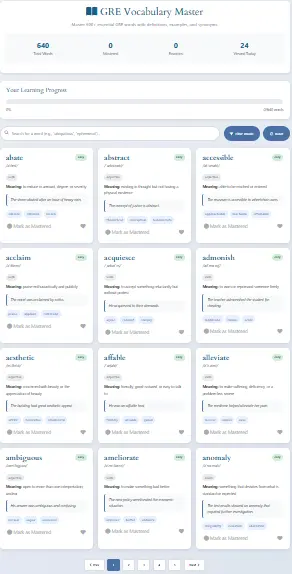
- Curated High-Frequency Word List: To maximize your study efficiency, we have firstly compiled a list of 640 words that most frequently appear on the GRE, which focuses on high-yield vocabulary. Instead of overwhelming you with thousands of obscure terms, we focus on the vocabulary that gives you the highest return on your study investment.
- Complete Word Definitions: For every term, the tool provides a clear, concise definition designed for quick understanding.
- Contextual Example Sentences: Vocabulary entry is presented in a clear, practical sentence to reinforce understanding. Aiding in comprehensive understanding, this feature is crucial for contextual application and long-term retention of vocabulary.
- Key Synonyms: You will also find a shortlist of the most relevant synonyms is also provided. For abate, these include subside, diminish, and lessen. This practice is invaluable for Sentence Equivalence questions.
- Pronunciation Guide: A phonetic spelling is included to ensure correct pronunciation.
Advanced Features for Effective Learning
Beyond the basics, our tool incorporates advanced features grounded in cognitive science to optimize your study sessions. For a broader look at tools designed to enhance your workflow, visit our Productivity Focus Hub.
- Personalized Learning Progress Tracker: The tool automatically tracks the total number of words you have mastered. Consequently, you get a visual percentage of your overall progress (e.g., 0% 0/640 words), which provides powerful motivation and helps you plan your study timeline.
- Favorites List for Difficult Words: As you study, you will inevitably find certain words more challenging. Therefore, you can mark words like ameliorate or anomaly as “Favorites.” This allows you to create a custom list for targeted review and repetition.
- Daily Engagement Metrics: The tool displays metrics like “Viewed Today,” encouraging consistent, daily practice—a habit far more effective than sporadic cramming. To build this daily habit, our Daily Routine Planner can be an excellent companion.
- Interactive Learning Model: Ultimately, the tool transforms passive memorization into an active learning experience. By engaging with definitions, examples, and synonyms, you build stronger neural connections for each term.
How to Use the GRE Vocabulary Master Tool: A 4-Step Strategy
To maximize the effectiveness of this tool, follow this structured study plan. Managing your time across all subjects is crucial; our Time Management Tools hub can help you create a balanced schedule.
1: Diagnostic Assessment.
Begin by quickly browsing through the first 50-100 words. Specifically, mark as “Mastered” only the words you can confidently define and use. This initial step will give you a realistic baseline of your current vocabulary strength.
2: Thematic or Alphabetical Study.
Next, commit to learning a manageable set of words each day (e.g., 20-30 words). You can proceed alphabetically or, for better associative learning, group words by theme. For example, you could study a set of words related to criticism (admonish, reproach, censure) or improvement (ameliorate, enhance, refine).
3: Active Recall and Application.
After reviewing a word’s details, close your eyes and try to recall its definition, synonym, and craft your own example sentence. This practice of active recall is scientifically proven to strengthen memory far more than passive re-reading.
4: Spaced Repetition and Review.
Finally, and most importantly, regularly review your “Favorites” list and words you marked as mastered earlier in the week. The tool’s progress tracker facilitates this spaced repetition, which is essential for moving words from your short-term to your long-term memory. For more structured practice in other areas, consider using our Online Scientific Calculator for quantitative section prep.
Understanding the GRE Verbal Challenge
The GRE Verbal Reasoning section rigorously tests your ability to analyze and evaluate written material. Primarily, it assesses your skills in three key areas: understanding the meaning of words, sentences, and entire texts; recognizing relationships among words and concepts; and analyzing the components of sentences and passages. Significantly, a large portion of the questions—especially Text Completion and Sentence Equivalence—directly depend on your knowledge of advanced vocabulary. This is why a tool dedicated to mastery, like our GRE Vocabulary Master, is indispensable.
For instance, you might encounter a sentence with one, two, or three blanks, and you must select the correct word from a list of sophisticated choices. Similarly, Sentence Equivalence questions require you to choose two words that both complete the sentence with the same meaning. Without a doubt, a weak vocabulary will make these questions nearly impossible. Conversely, a strong vocabulary allows you to eliminate incorrect choices quickly and accurately, saving precious time for the reading comprehension passages. To manage that precious time effectively, consider using our Pomodoro Timer with Task List to structure your study sessions for maximum focus.
Why Use a GRE Vocabulary Master Tool?
Most students struggle with GRE vocabulary because they try to memorize long word lists all at once. Unfortunately, cramming usually leads to forgetting most words within a few days.
This tool is designed to help users:
- Learn high-frequency GRE words
- Practice synonyms and antonyms
- Review words with spaced repetition
- Track difficult words separately
- Study with example sentences and mnemonics
- Improve retention over time
The most effective GRE vocabulary tools focus on the 800–1,000 words that appear most often on the exam rather than trying to memorize thousands of rare words.
Built Around Proven Learning Methods
The best GRE vocabulary systems are based on two research-backed techniques:
- Active recall
- Spaced repetition
Active recall means testing yourself instead of simply rereading a list. For example, instead of looking at the definition of “laconic,” you should try to remember its meaning, a synonym, and an example sentence before checking the answer. Students who actively recall words remember them much better than students who only reread notes.
Spaced repetition means reviewing words at increasing intervals—such as after 1 day, 3 days, 1 week, and 1 month. Words you forget appear more often, while words you know appear less often. This helps you spend more time on the vocabulary you actually need to improve.
Research on spaced repetition shows that memory improves significantly when learners review information just before they are likely to forget it.
Built on Proven Vocabulary Learning Methods
Research and modern GRE study platforms show that students remember new words more effectively when they use:
- Repetition over time
- Flashcards and quizzes
- Synonyms and antonyms
- Example sentences
- Progress tracking
- Structured study levels
This GRE Vocabulary Master Tool uses these same principles to help you retain difficult words and review them when you are most likely to forget them.
What Makes This Tool Different?
Unlike a simple GRE word list, this tool is designed to give you a complete learning experience. It helps users:
- Learn the meaning of each GRE word
- Understand pronunciation and usage
- Practice with example sentences
- Review synonyms and antonyms
- Organize words by difficulty level
- Track learning progress
- Build confidence before the GRE exam
The tool is useful for beginners who are just starting GRE preparation as well as advanced students aiming for a high Verbal score.
Carefully Selected GRE Vocabulary Words
The words included in this tool are chosen from commonly tested GRE vocabulary sources and academic English usage. Instead of showing uncommon or outdated words, we focus on vocabulary that appears more often in GRE-style reading passages, sentence equivalence, and text completion questions.
Examples of commonly tested GRE words include:
- Aberrant
- Alacrity
- Ambiguous
- Cogent
- Ephemeral
- Laconic
- Pragmatic
- Tenacious
- Ubiquitous
- Zealous
Learning these high-frequency words can help students improve both vocabulary knowledge and reading speed.
Designed for Better Retention
Many students struggle because they memorize a word once and forget it after a few days. This tool is designed to solve that problem.
By reviewing words repeatedly, testing yourself regularly, and studying in smaller groups, you can improve long-term memory and reduce the time needed to prepare for the GRE.
We recommend studying 15 to 20 new words each day and reviewing previously learned words before moving to the next level.
Who Should Use This Tool?
This GRE Vocabulary Master Tool is ideal for:
- GRE students preparing for the Verbal section
- College students improving academic vocabulary
- GMAT, SAT, TOEFL, and IELTS students
- English learners building advanced vocabulary
- Teachers and tutors helping students prepare for exams
Even if you are not taking the GRE, this tool can help improve your academic writing, reading comprehension, and English communication skills.
Our Commitment to Accuracy and Trust
We are committed to providing educational content that is accurate, practical, and easy to understand. Our vocabulary lists and study methods are based on trusted GRE preparation resources and commonly accepted academic vocabulary standards.
However, vocabulary learning is personal, and different students may prefer different study styles. We encourage users to combine this tool with reading practice, GRE mock tests, and official study materials for the best results.
Study Tips for Better GRE Vocabulary Scores
To get the best results from this tool:
- Study consistently every day
- Review old words before learning new ones
- Use each word in your own sentence
- Learn groups of related words together
- Focus on synonyms, antonyms, and context
- Practice with GRE-style quizzes regularly
Students who follow a daily study plan often see faster improvement in their GRE Verbal performance.
Author & Editorial Policy
This page is reviewed and updated regularly by our academic tools team to ensure the content remains useful and relevant for current GRE preparation.
Author: Academic Vocabulary Tools Team
Areas of Expertise:
- GRE and standardized test preparation
- English vocabulary learning
- Academic writing and study tools
- Educational content development
Editorial Process: Every vocabulary list, definition, and study recommendation is checked for clarity, accuracy, and usefulness before being published.
Complementary Tools for GRE and Graduate School Success
While vocabulary is paramount for the verbal section, a holistic GRE preparation strategy involves multiple skills. Therefore, we offer a suite of complementary free tools to support your entire graduate school journey.
- Quantitative Practice: The GRE Quantitative section demands precision. Our Online Scientific Calculator is perfect for practice, and the Percentage Calculator helps master a common question type.
- For Writing & Research Skills: Strong academic writing is essential for graduate school. Our MLA Citation Generator, APA Citation Generator, and Chicago Citation Generator will become invaluable for your future research papers and the analytical writing section.
- Planning & Organization: Staying organized is key to effective studying. Use our 2025 Budget Planner to manage application costs and our Student Project Proposal Builder to hone skills you’ll need in grad school.
Our Commitment to Your Success
This tool is based on widely used GRE study strategies, official high-frequency vocabulary lists, and cognitive science research on memory and language learning. We regularly review and update the word lists, examples, and learning methods to ensure they remain useful and aligned with current GRE preparation practices.
Author: GRE Study Tools Team
Expertise:
- GRE Verbal preparation
- Vocabulary learning
- Spaced repetition systems
- Academic test preparation
Editorial Policy:
Every word list, mnemonic, and study recommendation is reviewed for accuracy, clarity, and usefulness before publication.
Frequently Asked Questions (FAQs)
You do not need to know every word in the English language. Typically, Knowing 800-1,000 high-frequency words is sufficient for an excellent score. Our list of 640 provides a core foundation that covers a significant portion of what you will encounter.
No, it is not. While definitions are critical, you must also understand nuance, connotation, and usage. That is why our tool emphasizes example sentences and synonyms, preparing you for how words are tested in context.
With consistent daily practice of 20-30 words, you can comfortably work through the entire list in about a month. However, true mastery requires ongoing review, so budget 6-8 weeks for integration. Use our Custom Workday Calculator to plan your study blocks.
Yes, the tool is accessible via web browser on any device, allowing you to study during short breaks throughout your day.
For abstract words like aesthetic or ambiguous, pay extra attention to the example sentence and think of personal examples. Associating the word with a concrete mental image or scenario greatly improves recall.
Incorporate review into your daily routine. Briefly revisit the words from the previous day and the previous week. This spaced repetition is the single most effective technique for long-term memorization. Tools like our Flow State Assistant can help you create an environment conducive to deep review sessions.
Mnemonics Help Difficult Words Stick
One of the fastest ways to remember difficult GRE words is to create a mental association or mnemonic.
For example:
- “Obdurate” means stubborn
- Mnemonic: “An old door won’t move because it is stubborn.”
The brain remembers unusual or visual associations much more easily than plain definitions. Many GRE students report that mnemonic-based vocabulary study helps them learn words 2–3 times faster.
Research shows that combining mnemonics with spaced repetition is one of the most effective methods for long-term memory.
Grouping Words by Theme Improves Memory
Instead of learning words alphabetically, many successful GRE students group them by tone, category, or word root.
Examples:
- Positive words: benevolent, magnanimous, altruistic
- Negative words: malevolent, spiteful, vindictive
- Uncertainty words: equivocal, ambiguous, dubious
You can also group words by roots:
- “bene-” = good
- “mal-” = bad
- “cred-” = believe
- “dict-” = speak
Learning related words together makes it easier to understand and remember new vocabulary on test day.
Daily Study Strategy
Most GRE experts recommend studying vocabulary in short sessions rather than long, exhausting study marathons.
A common routine is:
- Learn 10–20 new words each day
- Review older words for 10–15 minutes
- Use flashcards during breaks or travel
- Take a quiz every few days
- Create a separate list of words you keep forgetting
Many students find that reviewing vocabulary 2–3 times per day for a few minutes works better than studying for several hours once a week.
Who Should Use This Tool?
This GRE Vocabulary Master Tool is useful for:
- GRE students preparing for Verbal Reasoning
- Students studying for GMAT, TOEFL, SAT, or IELTS
- Anyone improving advanced English vocabulary
- Tutors and teachers creating custom word lists
Many GRE vocabulary words also appear on other standardized tests, so this tool can help beyond the GRE itself.
Conclusion: Your Path to Verbal Mastery
In conclusion, conquering the vocabulary portion of the GRE is a systematic process that requires the right resources and a disciplined strategy. Our GRE Vocabulary Master tool, with its 640+ essential words, detailed definitions, contextual examples, and progress-tracking features, provides a completely free yet professional-grade platform to build the lexical foundation you need. Remember, consistency is far more important than intensity. By engaging with this tool daily, applying active recall, and leveraging spaced repetition, you will steadily see unfamiliar words like acquiesce and anomaly become a natural part of your test-taking arsenal. Ultimately, this mastery will not only boost your GRE score but also enhance your academic and professional communication for years to come. For all our tools and policies, please see our Privacy Policy.
Start your journey to a higher verbal score today. Visit the GRE Vocabulary Master tool and take control of your prep!
Disclaimer
This tool is intended for educational purposes only. While we strive to provide accurate vocabulary definitions and GRE study guidance, users should also verify important information with official GRE and ETS preparation materials.