Systematically analyze historical documents for APUSH and other history courses
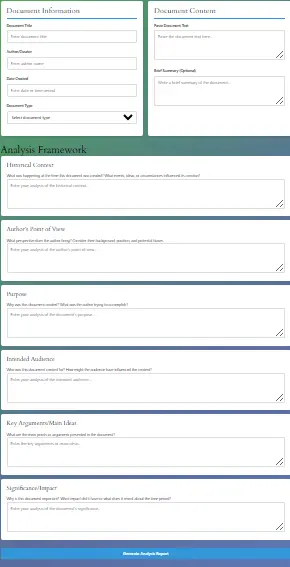
Document Information
Document Content
Analysis Framework
Historical Context
What was happening at the time this document was created? What events, ideas, or circumstances influenced its creation?
Author’s Point of View
What perspective does the author bring? Consider their background, position, and potential biases.
Purpose
Why was this document created? What was the author trying to accomplish?
Intended Audience
Who was this document created for? How might the audience have influenced the content?
Key Arguments/Main Ideas
What are the main points or arguments presented in the document?
Significance/Impact
Why is this document important? What impact did it have or what does it reveal about the time period?
In historical scholarship and academic writing, every word carries significant weight; moreover, every character contributes to your analytical framework. Whether you’re crafting a meticulous DBQ, structuring a comprehensive LEQ, or organizing compelling historical evidence, the precision of your writing fundamentally shapes your argument’s impact. Consequently, having immediate access to detailed text analysis isn’t just convenient—it’s academically essential. Therefore, our document analysis tool serves as the foundational tool within our specialized suite of historical writing utilities, designed specifically to support students and educators in mastering document-based questioning and historical analysis. Ultimately, this integrated approach ensures that your writing meets exacting standards before you even begin the grading process with our specialized tools like the DBQ Grader or LEQ Grader.
The Critical Role of document analysis tool in Historical Writing
Why Word and Character Limits Matter in Academic Settings
Firstly, in academic environments, adherence to specific word counts and character limits demonstrates discipline and precision—two hallmarks of excellent historical writing. For instance, when preparing a DBQ Thesis, every word must contribute directly to your argument, as space is typically limited. Similarly, when organizing evidence for your Evidence Organizer, understanding the length and density of your textual excerpts helps in creating balanced and persuasive arguments. Furthermore, many standardized exams and academic assignments enforce strict length requirements; thus, our document analysis tool becomes your first line of defense against unnecessary point deductions.
Beyond Basic Counting: Writing with Historical Precision
Additionally, effective historical writing requires more than just meeting length requirements; it demands linguistic precision. A well-crafted historical argument uses specific terminology consistently, maintains varied sentence structures for readability, and develops paragraphs that fully explore each aspect of the thesis. Fortunately, our Document Analysis Helper provides the metrics needed to achieve this level of sophistication. By monitoring your sentence count and paragraph count, you can ensure your writing has appropriate rhythm and flow. Meanwhile, the keyword density feature helps you maintain focus on your core historical concepts and terminology.
Features of the Document Analysis Helper
Core Text Analysis Metrics for Academic Writing
Our document analysis tool provides essential metrics that form the foundation of strong academic writing:
- Academic Word Count: Primarily, our precise word counter ensures you meet specific assignment requirements, whether you’re drafting a concise SAQ or a more expansive LEQ.
- Character Count (with spaces): Subsequently, this metric is crucial when preparing abstracts, proposals, or any text with strict spatial limitations in academic publishing.
- Character Count (without spaces): Alternatively, this count is particularly valuable when crafting thesis statements or brief analytical comments where conciseness is paramount.
- Sentence Count: Moreover, tracking your sentences helps maintain readability and argumentative flow throughout longer historical essays.
- Paragraph Count: Finally, this feature allows you to verify your essay’s structural integrity, ensuring each paragraph develops a distinct aspect of your overall argument.
Advanced Analysis for Historical Writing Excellence
Beyond basic metrics, our tool offers specialized features that directly support historical analysis and writing:
- Thesis Keyword Density: Specifically, this advanced keyword density checker helps you maintain focus on your core argument by tracking the frequency of your central historical concepts and terms. Please check out our Free Essay Writing Tool.
- Reading Time Estimation: Particularly useful for teachers, this feature helps estimate how long student essays might take to review using tools like our DBQ Grader or SAQ Grader.
- Speaking Time Estimation: Additionally, this assists students in preparing for presentations or oral examinations based on their written materials.
- Evidence Concentration Analysis: Furthermore, this unique feature identifies how frequently specific dates, names, or document references appear, helping balance your historical evidence.
How the Document Analysis Helper Integrates with Your Historical Workflow
The Complete Historical Analysis Ecosystem
Our Document Analysis Helper isn’t a standalone tool; rather, it’s the entry point to a comprehensive historical writing ecosystem. Consider this integrated workflow:
- Research Phase: Begin by using our Pomodoro Timer to maintain focus during your research sessions, ensuring productive, structured study periods.
- Organization Phase: As you gather sources, employ our Evidence Organizer to categorize and track your historical evidence systematically.
- Writing Phase: During composition, use the Document Analysis Helper to refine your text, then craft your central argument with the DBQ Thesis Generator.
- Review Phase: Finally, evaluate your work using our specialized Rubric Mastery tools or automated grading systems like the DBQ Grader and LEQ Grader.
Step-by-Step Guide to Using the Document Analysis Helper
Using our tool within this academic context is straightforward:
- Prepare Your Historical Text: Initially, copy your DBQ thesis, LEQ paragraph, or evidence analysis from your document. Notably, our tool works perfectly with excerpts of any length.
- Paste for Analysis: Then, paste your text into the main input box of the Document Analysis Helper. Alternatively, you can type directly while formulating your ideas.
- Review Academic Metrics: Immediately, the results panel displays all relevant metrics. Pay particular attention to word count for assignment compliance and keyword density for argument focus.
- Refine and Progress: Based on the insights, refine your writing. For example, if your DBQ Thesis is too long, condense it using the character count metrics. Then, proceed to develop your full essay using our Evidence Organizer or prepare it for assessment with our LEQ Grader.
The Academic Benefits of Regular Document Analysis
For Students: Building Stronger Historical Arguments
Integrating regular text analysis into your writing process offers multiple academic advantages. First, it cultivates writing discipline by making you conscious of your word choices and sentence structures. For example, when preparing a DBQ Thesis, the tool helps you eliminate fluff and strengthen your argument’s clarity. Second, it serves as an early warning system for common academic writing issues before you submit work for grading with our SAQ Grader or DBQ Grader. Third, it develops metacognitive awareness of your writing patterns, making you a more intentional and effective historical writer over time.
For Educators: Streamlining the Teaching Process
For teachers, the Document Analysis Helper provides valuable efficiencies. By encouraging students to use the tool before submission, you reduce time spent on basic editing issues. Additionally, when using our Rubric Mastery system, you can reference specific metrics from the analysis tool in your feedback. Furthermore, the reading time estimates help in planning grading sessions, while the keyword density analysis quickly reveals whether students have maintained focus on the prompt’s central requirements.
Frequently Asked Questions (FAQs)
Our tool is exceptionally valuable for DBQ writing because it helps maintain conciseness in your thesis statement—a common challenge. By using the character count without spaces and word counter, you can refine your argument to be both comprehensive and succinct before developing your full response.
Absolutely. The Document Analysis Helper provides precise word count online tracking, essential for AP history assignments where guidelines often suggest specific ranges. This ensures your practice essays closely mimic exam conditions before formal evaluation with our LEQ Grader or DBQ Grader.
While they operate as separate specialized tools, they’re designed as a complementary system. Typically, students use the Document Analysis Helper during the writing process, then teachers assess the final product using our Rubric Mastery system or automated graders like the SAQ Grader.
For thesis statements, character count without spaces and word count are both critical due to space limitations in DBQ and LEQ responses. Additionally, the keyword density feature helps ensure your central argument terms appear with appropriate frequency.
Teachers can project the Document Analysis Helper during writing workshops to demonstrate revision techniques. Similarly, they can require students to include analysis metrics with draft submissions, creating concrete discussion points for writing conferences. This approach works beautifully with our Evidence Organizer for teaching document analysis skills.
No. We prioritize academic integrity and privacy. Your documents are processed entirely in your browser and never transmitted to our servers. This is particularly important for student work and original historical analysis.
Definitely. When used alongside our Pomodoro Timer for focused writing sessions, this tool provides immediate feedback that speeds up the revision process. Consequently, you spend less time guessing about length and focus issues and more time developing sophisticated historical arguments.
Unlike basic counters, our tool provides academic-specific metrics like keyword density focused on historical argumentation. Furthermore, it’s part of an integrated system that includes specialized tools like the DBQ Thesis Generator and Evidence Organizer, creating a cohesive historical writing environment.
Keyword density ensures your central historical concepts—whether “industrialization,” “revolution,” or “colonialism”—receive appropriate emphasis throughout your essay. This helps maintain analytical focus, which is particularly valuable when writing document-based responses.
Certainly. The Document Analysis Helper adapts to various educational levels. Middle school students can focus on basic word and sentence counts, while AP and college students can utilize the advanced features for sophisticated thesis development and argument analysis in preparation for assessment with our DBQ Grader or LEQ Grader.
Our Complete Historical Writing Toolkit
The Document Analysis Helper represents just one component of our specialized educational technology ecosystem. Each tool addresses a specific need in the historical writing process:
- Pomodoro Timer: Maintain focus and productivity during research and writing sessions
- Evidence Organizer: Systematically categorize and track historical evidence from documents
- DBQ Thesis Generator: Develop strong, argumentative thesis statements for document-based questions
- SAQ Grader: Automatically evaluate short-answer questions with instant feedback
- LEQ Grader: Assess long essay questions using sophisticated grading criteria
- DBQ Grader: Evaluate document-based questions with detailed analytical feedback
- Rubric Mastery: Create, apply, and master grading rubrics for consistent assessment
Together, these tools form a comprehensive system that supports both learning and teaching in history education.
Conclusion: Elevating Historical Writing Through Precision and Integration
In conclusion, the path to excellence in historical writing begins with attention to textual detail and culminates in sophisticated argumentation. The Document Analysis Helper provides that essential foundation of precision, offering the metrics and insights needed to refine your writing at its most fundamental level. When integrated with our specialized tools for thesis generation, evidence organization, and automated grading, it becomes part of a powerful educational ecosystem that supports both students and educators. Therefore, we invite you to make the Document Analysis Helper your starting point for all historical writing endeavors, then explore how our complete toolkit—from Pomodoro Timer to DBQ Grader—can transform your approach to history education. Begin with precise analysis today, and build toward masterful historical scholarship.