AP US History Score Calculator
Section I: Multiple Choice (55 Questions)
Section I: Short Answer Questions (3 of 4)
Section II: Document-Based Question (DBQ)
Section II: Long Essay Question
Understanding your potential AP U.S. History score is a key part of exam prep. This calculator takes your performance estimates for each section and generates a composite score and predicted AP rating, so you can see your strengths and weak spots before exam day.
The AP U.S. History exam has two sections: Section I covers Multiple Choice and Short Answer Questions, and Section II covers the DBQ and Long Essay Question. This calculator estimates your composite score based on past scoring curves — the actual curve can shift slightly each year.
How Is The AP US History Exam Structured?
AP US History Exam table you provided shows historical score distributions (what % of students got each score).
AP Score Thresholds vs. Historical Distribution
| Your Composite Score | Predicted AP Score | 2023 Student Distribution |
|---|---|---|
| 86-130 | 5 | 12.8% |
| 70-85 | 4 | 33.3% |
| 55-69 | 3 | 26.0% |
| 40-54 | 2 | 19.4% |
| 0-39 | 1 | 8.4% |
* Thresholds align with tool’s calculations | Distribution data: College Board 2023
Official AP US History Exam Scoring Breakdown
The APUSH exam is split into two sections, each weighted differently. Section I covers Multiple-Choice Questions (40%) and Short-Answer Questions (20%). Section II covers the Document-Based Question (25%) and the Long Essay Question (15%). Your raw performance across all four is combined into a composite score, which is then converted to your final 1–5 AP score.
How to Improve Your APUSH Score
A strong study plan combines three things: know the official College Board curriculum framework so nothing catches you off guard, practice writing DBQs and LEQs under timed conditions to build stamina, and keep reviewing key historical concepts and themes. Full-length practice exams are the closest simulation to the real testing experience, and resources like Khan Academy line up well with the APUSH curriculum for content review.
How to Use This APUSH Scoring Tool
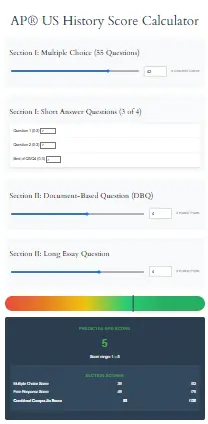
Enter your projected results into the calculator: estimated correct multiple-choice answers, then your short-answer, DBQ, and LEQ scores. The calculator instantly processes these into a composite score and predicted AP value from 1 to 5.
Core Features
- Input Flexibility
- Multiple input methods:
- Sliders + number inputs for MCQs, DBQ, and Long Essay
- Number-only inputs for Short Answer Questions (0-3 scale)
- Real-time synchronization between sliders and number inputs
- Multiple input methods:
- Score Calculation
- Official College Board weighting system:
- Multiple Choice (40% → 52 points)
- Short Answer (20% → 24 points)
- DBQ (25% → 22 points)
- Long Essay (15% → 32 points)
- Automatic composite score (0-130 scale)
- Official College Board weighting system:
- Result Display
- Predicted AP® Score (1-5)
- Section-wise breakdown:
- Multiple Choice Score (/52)
- Free Response Score (/78)
- Combined Composite Score (/130)
- Validation & Safety
- Input restrictions (min/max values enforced)
- Error handling for invalid/non-numeric inputs
Advanced Features
- Interactive Visual Feedback
- Live Score Meter:
- Color-coded gradient (red to green)
- Dynamic pointer showing score position
- Progress bars for slider inputs
- Live Score Meter:
- Two-Way Input Binding
- Sliders and number inputs stay synchronized
- Example: Moving the MCQ slider updates the number input instantly
- Responsive Design
- Works seamlessly on:
- Desktops
- Tablets
- Mobile devices
- Clean grid layout for score breakdowns
- Works seamlessly on:
- User Experience Enhancements
- Instant score updates (no “Calculate” button needed)
- Color-coded AP score display
- Clear section divisions with shadow effects
- Customization Ready
- CSS variables for easy color changes
- Modular code structure for adjustments
Specialized Functionality
- Short Answer Handling
- Auto-selects best score between Q3/Q4
- Limits total SAQ points to 9 (3 questions × 3 points)
- Scoring Algorithm
- Floor rounding for fractional scores
- AP score thresholds based on historical curves:
- 5 = 86+
- 4 = 70-85
- 3 = 55-69
- Educational Components
- Built-in scoring guidelines
- Section time allocations shown
Why Students Use APUSH Score Calculators
Before Exam Day
Students use calculators to:
- Set target scores
- Create study goals
- Understand section weighting
After Practice Tests
Students can estimate potential AP scores based on practice exam performance.
After the Official Exam
Many students use score calculators while waiting for official July score releases.
How Accurate Is an APUSH Score Calculator?
A score calculator provides an estimate, not an official College Board result.
Several factors affect final scoring:
- Annual score conversion curves
- Exam difficulty variations
- Reader scoring differences
- Free-response evaluation standards
Most calculators provide a close approximation when students enter realistic section scores.
APUSH Study Strategies to Improve Your Score
Master Historical Thinking Skills
Focus on:
- Comparison
- Causation
- Continuity and Change Over Time (CCOT)
- Periodization
Practice DBQ Writing
Strong DBQ essays should include:
- Clear thesis statement
- Contextualization
- Document analysis
- Outside evidence
- Complex understanding
Improve LEQ Structure
Successful LEQs typically contain:
- Defensible thesis
- Historical context
- Specific evidence
- Strong analysis
Review Frequently Tested Topics
Common APUSH themes include:
- Colonial America
- American Revolution
- Civil War and Reconstruction
- Industrialization
- Progressive Era
- World Wars
- Cold War
- Civil Rights Movement
Once you know what composite score you’re aiming for, you need a concrete plan to get there. Our comprehensive AP History Study Tools hub can help you build a weekly study schedule tailored to your weakest exam sections.
Understanding Your AP US History Score
Interpreting your results is the next critical step. The College Board, which administers all Advanced Placement examinations, assigns a final score between 1 and 5. Specifically, these numerical ratings communicate your overall proficiency and eligibility for college credit. Typically, a score of 3 is considered “qualified,” while ratings of 4 and 5 demonstrate superior command of the subject matter. Conversely, a 1 or 2 indicates that you are not currently recommended for college credit. In summary, understanding this scoring spectrum is vital for setting realistic and effective goals.
Common APUSH Scoring Mistakes
Students often lose points because they:
- Fail to answer the prompt directly
- Use vague historical evidence
- Ignore document sourcing
- Write weak thesis statements
- Forget contextualization
- Mismanage exam timing
Understanding these mistakes can significantly improve exam performance.
Who Should Use an APUSH Score Calculator?
This tool is useful for:
- High school APUSH students
- Teachers creating score projections
- Tutors evaluating practice exams
- Parents tracking student progress
- Homeschool students preparing for AP exams
APUSH Score Planning Example
Suppose a student scores:
- 42/55 MCQ
- Strong SAQ responses
- 5/7 DBQ
- 4/6 LEQ
Using a score calculator can help estimate whether that performance is likely to earn a 3, 4, or 5 before official results are released.
Why Use Our APUSH Score Calculator?
Our calculator is designed to help students:
- Estimate AP scores instantly
- Understand exam weighting
- Track practice test progress
- Set realistic score goals
- Prepare more effectively for exam day
The tool is free, mobile-friendly, and provides immediate score projections without registration.
FAQs: Answers to the Questions You are Too Embarrassed to Ask
The AP US History Score Calculator estimates your final APUSH exam score based on your performance in the multiple-choice and free-response sections. It helps you predict your AP score out of 5.
Simply enter the number of correct multiple-choice answers and your estimated scores for the short answer, DBQ, and long essay sections. The calculator will display your projected AP score instantly.
A score of 3 or higher is typically considered a passing score. However, many colleges offer credit for a 4 or 5, depending on their policies.
Yes! This calculator helps you set goals and measure your progress. Knowing what scores you need in each section can guide your study efforts.
Yes, the AP US History Score Calculator is fully responsive and works smoothly on mobile, tablet, and desktop devices.
Yes, the calculator is updated to reflect the current structure and scoring system of the AP US History exam.
Absolutely! This AP US History Score Calculator is 100% free with no sign-up required.
Visit our homepage for more free calculators and educational tools.
Conclusion
This AP US History score calculator is an estimation tool created for informational and planning purposes exclusively. The projected score it generates is not an official AP score and should not be treated as such. Official AP scores are determined and released solely by the College Board. This website and its tools are not affiliated with, endorsed by, or connected to the College Board.
We recommend using this tool alongside others like the GPA Calculator and Percentage Calculator for a complete academic toolkit. If you have any suggestions or feedback, feel free to reach out via our Contact Us page.
Content Review & Educational Methodology
This AP US History Score Calculator is based on publicly available APUSH exam structure information, scoring guidelines, and historical exam weighting patterns. Content is reviewed regularly to reflect current AP exam formats and educational standards.
Reviewed by Daily Tool Spot Educational Content Team
Last Updated: August 2026