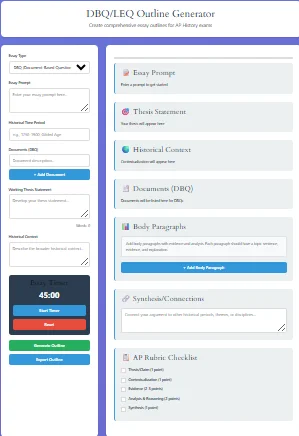
DBQ/LEQ Outline Generator
Create comprehensive essay outlines for AP History exams
💡 Related Tools That Might Help:
Essay Timer
📝 Essay Prompt
🎯 Thesis Statement
🌍 Historical Context
📑 Documents (DBQ)
📊 Body Paragraphs
🔗 Synthesis/Connections
📋 AP Rubric Checklist
Navigating the demanding landscape of AP U.S. History, AP World History, or AP European History can undoubtedly feel overwhelming. Consequently, students often find the Document-Based Question (DBQ) and Long Essay Question (LEQ) to be the most challenging hurdles. These essays require not just historical knowledge, but a structured, analytical approach under intense time pressure. Fortunately, a well-crafted outline is the secret weapon of every high-scoring student. Therefore, our DBQ/LEQ Outline Generator was specifically designed to transform that anxiety into confidence. Moreover, this guide will walk you through every feature of this powerful tool, demonstrating how it can streamline your study process and elevate your writing.
Ultimately, our mission is to provide authoritative, trustworthy resources that genuinely help students. For instance, the College Board, which administers AP exams, emphasizes the critical importance of a “clear, well-organized thesis” and a “coherent essay,” both of which start with a solid outline. Similarly, our tool aligns perfectly with these rigorous standards, ensuring you’re building skills that directly translate to exam success. Once you have your outline, you can test its strength with our precise APUSH DBQ Grader & Feedback Tool.
Key Features of the DBQ/LEQ Outline Generator
Firstly, let’s explore the core functionalities that make this tool an indispensable part of your AP History toolkit.
1. Streamlined Thesis Formulation
Above all, a strong thesis is the foundation of any DBQ or LEQ. Rather than staring at a blank page, our tool provides a structured framework to input your argument, historical context, and line of reasoning. If you need a dedicated tool just for this crucial element, our DBQ Thesis Generator offers focused assistance.
2. Guided Contextualization Section
Additionally, many students struggle with where and how to include context. Our outline generator dedicates a specific section for contextualization, prompting you to describe the broader historical events, processes, or developments relevant to the prompt. For a deeper dive into this skill, use our APUSH Contextualization Builder.
3. Organized Evidence Logging
Furthermore, the tool helps you systematically organize your evidence. Specifically, you can input document summaries for a DBQ or specific historical examples for an LEQ, tagging them to the body paragraphs where they will be used. This process, in turn, ensures your essay is packed with relevant, well-utilized evidence. For organizing facts before you outline, try the APUSH Evidence Organizer.
4. Structured Body Paragraph Builder
Similarly, each body paragraph section is pre-formatted to guide you in presenting a topic sentence, supporting evidence, and analysis. Importantly, this includes a dedicated spot for HIPP analysis (Historical Context, Intended Audience, Purpose, or Point of View) for DBQ documents, which is essential for sourcing points. When you encounter tricky primary sources, our Document Analysis Helper is a perfect companion.
Advanced Features for Top-Tier Scores
Beyond the basics, our generator includes advanced features designed to help you climb into the highest scoring brackets.
1. Rubric-Integrated Checklists
Simultaneously, as you build your outline, the tool provides a sidebar checklist based directly on the official AP History rubrics. Consequently, you can self-assess your work in real-time, ensuring you’re hitting every required point for a top score. For even more detailed feedback, you can later use our dedicated APUSH DBQ Grader & Feedback Tool or our specialized LEQ Grader.
2. Adaptable Templates for DBQ and LEQ
Moreover, the tool intelligently adapts based on your selection. For example, if you’re working on a DBQ, it will include sections for document analysis and sourcing. Conversely, for an LEQ, it focuses on a wider range of specific historical examples and complexity. This flexibility makes it a one-stop-shop for all your AP History essay needs. You can also use our APUSH Rubric Mastery Tool to deepen your understanding of the scoring guidelines.
3. Sample Outlines and Exemplars
To further enhance understanding, the tool provides access to annotated sample outlines for different historical periods and question types. These exemplars, developed by experienced educators, demonstrate how to effectively apply the outline structure to real prompts.
4. Integration with Companion Tools
Most importantly, our outline generator is part of a full suite of AP History resources. For instance, after generating your outline, you can pop your thesis into our DBQ Thesis Generator for a final polish. Alternatively, use the APUSH Evidence Organizer to pre-sort your facts before bringing them into the outline. This interconnected ecosystem is designed to support your entire writing workflow.
How to Use the DBQ/LEQ Outline Generator in 4 Simple Steps
Using the tool is straightforward and intuitive. Here is a step-by-step guide to get you from a prompt to a finished outline in minutes.
Step 1: Input the Essay Prompt
Initially, you will copy and paste your specific DBQ or LEQ prompt into the designated field. Subsequently, select your essay type (DBQ or LEQ) and the relevant AP history course (APUSH, AP World, or AP Euro). This first step ensures the tool customizes the outline template to your exact needs.
Step 2: Build Your Core Argument
Next, you will move to the thesis section. Here, you will be guided to articulate your claim and the line of reasoning you plan to pursue. The tool will prompt you with questions like, “What is your main argument?” and “What are the main points you will use to prove it?” This structured approach, therefore, makes formulating a complex thesis feel manageable.
Step 3: Log Your Evidence and Analysis
After that, you will fill in the body paragraph sections. For a DBQ, you can briefly summarize each document and note its HIPP element. For an LEQ, you will list your specific examples. Meanwhile, the tool encourages you to explicitly state how each piece of evidence supports your topic sentence. This practice is crucial for earning the analysis and reasoning points on the rubric.
Step 4: Finalize and Export Your Outline
Lastly, you will review the completed outline in the tool’s clean, formatted interface. Then, you can export it as a text file or simply use it as a direct guide to start writing your essay. Many students find that using this outline with our Pomodoro Timer with Task List helps them write their first draft efficiently and without burnout. For long-term planning, our Daily Routine Planner can help you stay on track.
Why Use a DBQ and LEQ Outline Before Writing?
Many AP History students lose points because they begin writing before organizing their evidence and arguments. A structured outline helps you:
- Build a stronger thesis statement
- Organize historical evidence logically
- Connect documents to your argument
- Avoid repeating ideas
- Save time during timed exams
This tool was designed to help students create a clear essay structure before drafting the final response.
Example DBQ Outline
Prompt: Evaluate the causes of the American Revolution.
Thesis Example:
“The American Revolution was primarily caused by British taxation policies, growing colonial political resistance, and Enlightenment ideas that encouraged self-government.”
Paragraph 1
- Stamp Act
- Sugar Act
- Colonial protests
Body Paragraph 2
- Sons of Liberty
- Boston Tea Party
- Intolerable Acts
3 Body Paragraph
- John Locke
- Natural rights
- Self-government
Based on Official AP History Rubrics
This DBQ and LEQ Outline Generator is structured based on:
- College Board APUSH DBQ rubric
- College Board AP World / AP Euro DBQ rubric
- LEQ scoring guidelines (thesis, evidence, reasoning)
- AP History writing expectations used by exam graders
AP Exam Writing Tips
Common DBQ Mistakes to Avoid
- Writing a thesis that simply repeats the prompt
- Using documents without analysis
- Ignoring historical context
- Forgetting outside evidence
- Writing paragraphs without topic sentences
A good outline prevents rambling, but you still need the historical facts to fill in those paragraphs. Use our AP History Study Tools directory to find the best evidence organizers and study guides for your specific AP class.
Common LEQ Mistakes to Avoid
- Lack of historical complexity
- Weak evidence
- Poor chronological organization
- Missing contextualization
This gives your page unique educational value instead of looking like a basic tool page.
DBQ vs LEQ (Important Difference)
DBQ
- Uses historical documents
- Requires document analysis (HIPP)
- Evidence is partly provided
LEQ
- No documents provided
- Requires pure historical knowledge
- Focus on argument + evidence recall
How to Use This Outline Generator
- Enter your DBQ or LEQ prompt
- Identify type of essay (causation, comparison, etc.)
- Generate outline structure
- Adjust evidence before writing
- Use outline during timed exam practice
How AP Essays Are Scored
Your outline is designed to help you earn:
- Thesis (1 point)
- Contextualization (1 point)
- Evidence (2–3 points)
- Analysis & reasoning (2 points)
- Complexity (1 point)
Who This Tool Is For
Simple but important:
- APUSH students
- AP World History students
- AP European History students
- Teachers creating practice materials
- Tutors and study groups
Why Teachers Recommend Outlining Before Writing a DBQ or LEQ
Many students think outlining wastes time, but experienced AP History teachers often recommend spending 5–10 minutes creating a structured plan before drafting.
Benefits of outlining include:
- Reduces the chance of forgetting key evidence
- Helps organize documents into logical categories
- Prevents weak or repetitive body paragraphs
- Makes contextualization easier to include
- Improves historical reasoning throughout the essay
- Creates a roadmap for writing under timed conditions
Students who outline first are often able to write more focused essays because they know exactly what evidence supports each argument before drafting begins.
What Makes a Strong AP History Thesis?
A thesis is more than a simple answer to the prompt. According to AP History scoring guidelines, a strong thesis should:
Be Historically Defensible
The claim must be supported by historical evidence.
Weak Thesis:
“The American Revolution happened because colonists were angry.”
Stronger Thesis:
“The American Revolution resulted primarily from British taxation policies, colonial resistance movements, and Enlightenment political ideals that challenged imperial authority.”
Address the Entire Prompt
Students should answer every part of the question.
Establish a Line of Reasoning
The thesis should preview the categories that will appear in body paragraphs.
How to Organize DBQ Documents
One of the biggest challenges in a DBQ is grouping documents effectively.
Instead of discussing documents one by one, successful essays organize documents into categories.
Example
Prompt:
Evaluate the causes of the American Revolution.
Possible document groups:
Economic Causes
- Stamp Act
- Sugar Act
- Townshend Acts
Political Causes
- Colonial protests
- Sons of Liberty
- Intolerable Acts
Ideological Causes
- Enlightenment ideas
- Natural rights
- Social contract theory
Grouping documents creates stronger analytical paragraphs and demonstrates historical reasoning.
Understanding HIPP Analysis
AP History DBQs require students to analyze documents, not simply summarize them.
HIPP stands for:
Historical Situation
What events were occurring when the document was created?
Intended Audience
Who was meant to read or hear the document?
Purpose
Why was the document created?
Point of View
How might the author’s background influence the message?
Example
If a British tax collector writes a document defending taxation policies, their position within the British government may influence their perspective.
Strong DBQ essays connect HIPP analysis directly to the argument.
Historical Reasoning Skills Used in DBQs and LEQs
The College Board evaluates more than factual knowledge.
Students are expected to use historical reasoning skills such as:
Causation
Explaining why historical events occurred.
Comparison
Identifying similarities and differences between developments.
Continuity and Change Over Time (CCOT)
Analyzing what changed and what remained the same.
Periodization
Evaluating whether a historical period represents significant change.
A good outline should identify which reasoning skill the prompt requires before writing begins.
How Long Should an AP History Outline Be?
Students often ask whether a full-page outline is necessary.
A practical DBQ or LEQ outline usually contains:
| Section | Recommended Length |
|---|---|
| Thesis | 1–2 sentences |
| Context | 2–3 bullet points |
| Body Paragraphs | 3–5 evidence bullets each |
| Outside Evidence | 1–2 examples |
| Complexity | 1 planning note |
The goal is organization, not writing the essay in advance.
Common Reasons Students Lose DBQ Points
Many essays lose points because students:
- Fail to answer the prompt directly
- Summarize documents instead of analyzing them
- Forget contextualization
- Use inaccurate historical evidence
- Ignore sourcing analysis
- Write weak topic sentences
- Do not explain how evidence supports the argument
Creating an outline beforehand can reduce these mistakes.
Why This Outline Generator Is Different
Unlike a basic outline template, this tool helps students:
- Structure arguments before writing
- Plan contextualization
- Organize evidence logically
- Prepare for DBQ and LEQ scoring requirements
- Practice historical reasoning skills
- Build confidence during timed AP exams
This approach mirrors the planning process used by many successful APUSH, AP World History, and AP European History students.
Frequently Asked Questions (FAQs)
Yes, absolutely! Consequently, you can use the DBQ/LEQ Outline Generator as many times as you need without any cost or required sign-up.
For privacy reasons, the tool does not automatically save your work. Therefore, it is recommended that you export your outline once you have finished it.
While it is specifically optimized for the AP History DBQ/LEQ format, the underlying structure of thesis, evidence, and analysis is universal.
Our DBQ Thesis Generator is a fantastic, focused tool for building one specific part of your essay. In contrast, the Outline Generator provides a comprehensive framework for your entire essay, from introduction to conclusion, making it a more complete solution.
While no tool can guarantee a specific score, using this generator ensures your essay is well-structured and addresses all aspects of the rubric. You can project your potential score with our APUSH Score Calculator.
The tool includes helpful tips and examples in each section. Additionally, you can cross-reference with our Document Analysis Helper or APUSH Contextualization Builder for more targeted assistance.
Yes, the tool is fully adaptable for AP World History: Modern, AP European History, and AP U.S. History (APUSH). You can even get specific feedback with our AP World History DBQ Grader and AP European History DBQ Grader.
By practicing with the outline generator, you internalize the essay structure. Hence, on exam day, you will be able to create a mental outline much faster. You can practice timed writing sessions using our Custom Workday Calculator to simulate exam conditions. Also, ensure you’re well-rested using our Sleep Cycle Duration Calculator.
Conclusion: Your Pathway to AP History Success
In summary, mastering the DBQ and LEQ is a complex but entirely achievable goal. The journey from a daunting prompt to a polished, high-scoring essay begins with a single, crucial step: creating a powerful outline. Our DBQ/LEQ Outline Generator is more than just a template; it is a guided system that builds the essential skills of historical argumentation and structured analysis.
Therefore, by integrating this tool into your regular study routine, you are not just preparing for a single exam; you are developing critical thinking and writing abilities that will serve you in college and beyond. Furthermore, when combined with our other specialized tools for grading, organization, and time management, you have a complete support system at your fingertips.
So, whether you are just starting your AP History journey or are in the final weeks of cramming, remember that a clear plan is the key to confidence. Finally, we invite you to use this tool, explore its features, and take control of your academic success. Good luck!
About the Author
This educational resource was created by the Daily Tool Spot team to help AP History students organize DBQ and LEQ essays more efficiently. Our goal is to build free study tools that simplify exam preparation and academic writing.
Educational Disclaimer
This tool provides structured outlines based on AP History writing rubrics. Final exam scores are determined by official College Board graders using standardized scoring guidelines.