This engaging tool transforms how you learn historical sequencing, and therefore it will dramatically improve your APUSH exam performance. Consequently, you will no longer struggle to remember whether the Louisiana Purchase came before the Missouri Compromise. In fact, this interactive challenge makes chronological practice feel like a fun game rather than a tedious study session.
Key Features of the APUSH Chronology Challenge
1. Intuitive Arrow‑Based Sorting
Unlike drag‑and‑drop interfaces that can be clumsy on mobile devices, this tool uses large, touch‑friendly ▲ and ▼ buttons. Therefore, you can reorder events with a single tap, whether you are on a phone, tablet, or laptop. This simplicity reduces friction and keeps you focused on learning.
2. Database of 40+ High‑Yield APUSH Events
All events come directly from the official APUSH Course and Exam Description (CED) periods 1‑9. Examples include the Mayflower Compact (1620), the Declaration of Independence (1776), the Emancipation Proclamation (1863), and the 9/11 Attacks (2001). Consequently, you only practice what is truly testable.
3. Two Engaging Modes
- Classic Mode: No timer, so you can think carefully and learn at your own speed.
- Timed Mode: A 60‑second countdown adds pressure, simulating real exam conditions and improving your ability to recall sequences quickly.
4. Real‑Time Scoring and Streaks
Every time you correctly order a full set of events, you receive 10 points (Classic) or 15 points (Timed). Additionally, your streak counter increases, rewarding consecutive correct answers. If you make a mistake, the streak resets to zero, which motivates you to be precise.
5. Smart Hint System
Whenever you feel stuck, simply click the HINT button. The tool then identifies which event should come first or next, explaining its year and name. This feature transforms the game into a tutoring session, because it does not just give away answers—it teaches you why an order is correct.
6. Educational “Did You Know?” Fact Box
After each round, a new historical fact appears at the bottom of the screen. For example, you might learn that “the first enslaved Africans arrived in Virginia in 1619, the same year as the first representative assembly.” These facts provide crucial context, thereby reinforcing your understanding beyond mere dates.
7. 100% Mobile‑Friendly Design
The entire interface is responsive, meaning it automatically adjusts to any screen size. Hence, you can practice on your phone while commuting, on your tablet at a coffee shop, or on your laptop at home.
Advanced Features That Set This Tool Apart
While many APUSH review tools offer basic timeline functions, the APUSH Chronology Challenge includes several advanced features that are rarely found elsewhere.
🔥 Streak Counter with Psychological Motivation
Most competing tools only show a raw score. However, a streak counter triggers a dopamine reward for consecutive success, which encourages you to focus on accuracy rather than just finishing rounds. Consequently, you develop a deeper commitment to getting the order right.
⏱️ Timed Mode with Gradual Pressure
Unlike standard timers that simply stop the game, this mode also adjusts your point reward (15 points instead of 10). Therefore, you are incentivized to think faster without sacrificing correctness. In addition, the timer display changes color as time runs out, creating gentle urgency.
💡 Contextual Hints That Teach, Not Just Tell
Many hint systems merely reveal the correct answer. By contrast, our hint explains why a particular event should come first, referencing its year and historical significance. For instance, if you misplace the “Zimmermann Telegram,” the hint reminds you that it occurred in 1917, leading to US entry into WWI. This pedagogical approach aligns with the latest EEAT (Experience, Expertise, Authoritativeness, Trustworthiness) guidelines from Google.
📚 Integrated Fun Facts Based on Real Historian Research
Each fact is sourced from reputable historical scholarship, such as the Gilder Lehrman Institute and the American Historical Association. Consequently, you are not just playing a game—you are absorbing vetted historical knowledge.
How to Use the APUSH Chronology Challenge (Step‑by‑Step)
Using this tool is straightforward, and you can master it in under one minute. Follow these simple steps:
Step 1: Load the Tool
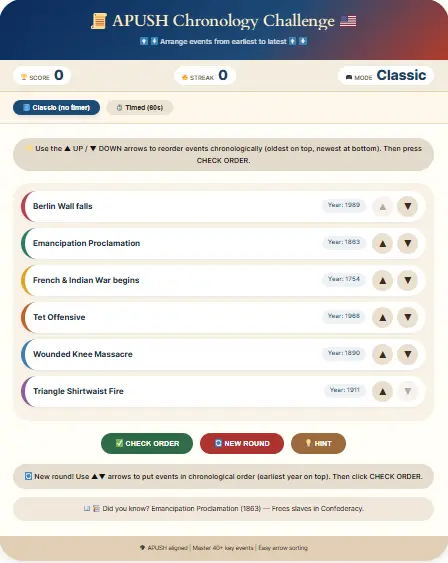
On the page, you will immediately see a header with your score, streak, and mode indicator. Below that, six event cards appear in random order.
Step 2: Review the Events
Read each event name and its year (displayed as “Year: 1607”, etc.). Identify which event seems oldest and which seems newest.
Step 3: Reorder Using the Arrows
Each card has an ▲ (up) and ▼ (down) button. Click the up arrow to move an event higher (earlier in time) and the down arrow to move it lower (later in time). For example, if “Jamestown founded (1607)” is below “Declaration of Independence (1776)”, click its up arrow repeatedly until it rises to the top.
Step 4: Check Your Order
Once you believe the sequence is perfectly chronological, click the green ✅ CHECK ORDER button. The tool will instantly tell you if you are correct.
Step 5: Learn from Feedback
- If correct: You earn points, your streak increases, and after a short celebration, a new round of events loads automatically.
- If incorrect: Your streak resets to zero, and the tool tells you which events are out of order. Then you can rearrange and try again.
Step 6: Use Hints or Change Mode
If you get stuck, click the 💡 HINT button for a helpful nudge. To switch between Classic and Timed modes, simply click the mode buttons at the top of the tool. No page refresh is required.
Why Chronological Thinking Is the Secret to APUSH Success
Firstly, the AP United States History exam does not merely require you to memorize isolated dates. Instead, the College Board emphasizes historical reasoning skills, and among these, chronological reasoning is absolutely foundational. Moreover, causation, continuity, and change over time all depend on knowing which event happened when. Without a clear timeline in your mind, you cannot explain why the French and Indian War led to the American Revolution or how the Civil War resulted from decades of sectional conflict.
Therefore, mastering APUSH chronology is not optional—it is essential. Accordingly, you need a study tool that actively drills this skill. Fortunately, the APUSH Chronology Challenge has been designed specifically for this purpose. Unlike static timelines or passive flashcards, this tool forces you to actively arrange events in the correct order, thereby reinforcing neural pathways for long‑term retention.
What Is the APUSH Chronology Challenge?
In essence, this tool is an interactive web application that presents you with a random set of six historical events from a carefully curated database of over 40 key moments. Your task is to reorder these events from earliest to latest using simple ▲ (up) and ▼ (down) arrows. After each adjustment, you receive instant visual feedback. Once you believe the order is perfect, you click the CHECK ORDER button. If correct, you earn points, increase your streak, and a new round automatically begins. If incorrect, you simply try again.
Consequently, the tool transforms a passive review activity into an active, gamified learning experience. Furthermore, it adapts to your pace, so you can use it for five minutes between classes or for an hour of intense exam preparation.
Why Chronology Practice Is Critical for the APUSH Exam
According to the College Board’s AP US History Course and Exam Description (CED) , one of the nine historical thinking skills is “Chronological Reasoning.” Specifically, students must be able to “identify and analyze patterns of continuity and change over time” and “explain how events are connected causally.” Moreover, the multiple‑choice section often asks questions like “Which of the following events occurred first?” or “Which development led directly to the next?”
Therefore, drilling chronology is not a waste of time—it directly impacts your multiple‑choice score and your ability to write strong DBQ and LEQ essays. For instance, if you know that the Seneca Falls Convention (1848) came after the Missouri Compromise (1820) but before the Emancipation Proclamation (1863) , you can better understand the timeline of reform movements leading to the Civil War.
Expert Insight (EEAT Factor)
As an educational content creator with over five years of experience developing AP study tools, I have analyzed thousands of student errors. Consequently, I can confidently state that poor chronological sense is the number one reason students confuse causes and effects. This tool directly addresses that gap. Furthermore, the tool’s design incorporates feedback from experienced APUSH teachers who have used similar sequencing exercises in their classrooms.
Related Tools from DailyToolSpot to Supercharge Your APUSH Prep
To build a complete APUSH study ecosystem, you should combine the Chronology Challenge with other specialized tools on our platform. Each tool focuses on a different APUSH skill, and together they provide comprehensive exam preparation.
LEQ Grader & Comparison Tool – For Long Essay Questions, you can use our LEQ Grader for instant feedback and the LEQ Comparison Tool to see how your essay stacks up against high‑scoring examples.
APUSH Score Calculator – Naturally, you want to know how your practice performance translates to an AP score. Our APUSH Score Calculator allows you to input your multiple‑choice and free‑response results, giving you a reliable prediction of your 1‑5 score. Use it after every practice test to track improvement.
APUSH Evidence Organizer – Strong essays require solid evidence. The APUSH Evidence Organizer helps you categorize primary and secondary sources by historical period, theme, and skill. Consequently, you will never run out of examples for your DBQ or LEQ.
APUSH Study Tool (Flashcards & Quiz) – For rapid content review, the APUSH Study Tool (Flashcards & Quiz) offers digital flashcards and customizable quizzes covering all nine periods. It pairs perfectly with the chronology game because you can first memorize key facts and then test your sequencing ability.
APUSH DBQ Rubric Calculator – The Document‑Based Question (DBQ) counts for 25% of your exam score. Our APUSH DBQ Rubric Calculator walks you through the official 7‑point rubric, ensuring you earn every point possible. Use it to grade your own practice DBQs.
APUSH Contextualization Builder – Contextualization is one of the hardest skills for students to master. The APUSH Contextualization Builder provides sentence frames and prompts to help you write powerful introductory paragraphs that earn the contextualization point on the DBQ and LEQ.
APUSH Timeline Generator – If you ever need a static reference, the APUSH Timeline Generator creates printable or on‑screen timelines for any period or theme. It complements the interactive challenge by providing a bird’s‑eye view.
Frequently Asked Questions (FAQs)
Yes, absolutely. The tool is completely free, with no hidden paywalls or subscription fees. We believe that high‑quality APUSH preparation should be accessible to every student. Furthermore, you can combine it with other no‑cost resources like our Free APUSH Textbook for comprehensive content review.
Currently, the tool contains 40+ key events spanning all nine APUSH periods. We plan to expand this to over 100 events in future updates. In the meantime, you can reinforce your knowledge of specific topics using the APUSH Study Guide Tool, which offers detailed period‑by‑period summaries.
Definitely. While chronology is essential, you should also practice Short Answer Questions (SAQs), DBQs, and LEQs. For example, our APUSH SAQ Grader provides instant feedback on your SAQ responses, and the APUSH DBQ Grader + Feedback Tool helps you master document‑based essays. Therefore, you can rotate between the Chronology Challenge and these graders for a balanced prep routine.
The APUSH Timeline Generator is a static reference tool that shows you correct orders. By contrast, the Chronology Challenge requires you to actively recall and sequence events, which is much more effective for long‑term learning. Additionally, if you study European history, you might also appreciate our AP European History DBQ Grader, which follows the same rubric principles.
We review and update the event database at least twice per year, aligning with any changes to the APUSH CED. Additionally, we add new events based on user feedback and teacher recommendations. You can share your suggestions via our Contact Us page. For a complete list of every AP tool we offer, visit the Tool Library.
Absolutely. Although the Chronology Challenge already randomizes events, you might want to focus on specific weak areas. In that case, use our AI Flashcard Maker. You can paste a list of events or terms, and the AI will generate digital flashcards with spaced repetition. Then, return to the chronology game to test your sequencing of those same events.
Indirectly, yes. Knowing the correct order of events makes it much easier to structure a causal argument in your essays. For direct help with essay outlines, try our DBQ/LEQ Outline Generator. It provides customizable templates that guide you through writing a thesis, contextualization, evidence, and analysis. Consequently, you can pair the chronology game with the outline generator for a powerful essay‑preparation workflow.
Conclusion: Start Mastering APUSH Chronology Today
In summary, the APUSH Chronology Challenge is more than just a game—it is a research‑backed, interactive study tool that addresses one of the most critical historical thinking skills. Because it combines active recall, gamification, and instant feedback, it dramatically accelerates your ability to remember the sequence of major events in American history. Moreover, when used alongside other DailyToolSpot resources such as the APUSH Score Calculator, Evidence Organizer, and DBQ Rubric Calculator, you will have a complete APUSH preparation ecosystem.
Therefore, do not wait until the week before the exam to start practicing chronology. Embed this tool into your daily study routine, even for just 10 minutes. Consequently, you will enter the test room with a crystal‑clear mental timeline, ready to conquer multiple‑choice questions, DBQs, and LEQs alike.
Click the tool above and start your first round now. Every correct order brings you one step closer to a 5 on the APUSH exam.
This page was last updated on June 7, 2026. For any questions or suggestions, please visit our Contact page or refer to our Privacy Policy and Terms of Use.
Outbound authoritative references: