Professional theory with playable piano, multiple clefs & key signatures
Major Third
E
Welcome to the most comprehensive music interval calculator online available today. Furthermore, understanding the distance between two notes is fundamentally the bedrock of all music theory. Consequently, our free tool provides instant, accurate calculations for musicians of all skill levels.
Whether you are a beginner or a seasoned professional, this music interval calculator music theory resource is essential. Moreover, it eliminates the tedious process of manually counting semitones on a staff. Therefore, you can focus entirely on composing, practicing, and analyzing beautiful music.
Historically, musicians relied solely on their ears and manual calculations to identify these distances. However, modern technology allows us to visualize and hear these relationships instantly. Thus, our platform bridges the gap between ancient theory and modern digital convenience.
Core Features of Our Music Interval Calculator Online
Our platform offers an array of core features designed for maximum efficiency. Initially, users can instantly calculate the exact distance between any two chosen notes. Furthermore, the interface displays the result in semitones, cents, and standard musical nomenclature.
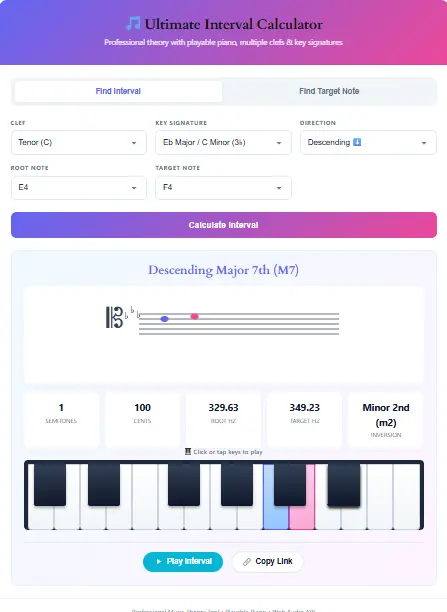
In addition to basic calculations, the tool provides a beautiful visual representation of the results. Consequently, you will see the notes accurately placed on a dynamic SVG staff notation. Meanwhile, an interactive piano keyboard highlights the exact keys being played.
Moreover, the system automatically calculates the exact Hertz frequency for both notes. Specifically, this feature is incredibly useful for audio engineers and electronic music producers. Thus, you can see the exact scientific pitch alongside the traditional music theory name.
Additionally, the tool provides the exact inverted interval for any calculation. For example, if you calculate a major third, it will instantly show you the minor sixth. Hence, this feature is invaluable for students studying counterpoint and harmony.
Advanced Features of the Tool
Beyond the basics, this compound interval calculator supports distances far beyond a single octave. Specifically, it accurately computes 9ths, 10ths, 11ths, 12ths, 13ths, and even 15ths. Therefore, advanced jazz and contemporary classical students will find this functionality absolutely indispensable.
Moreover, the system includes a comprehensive multiple clef selector for diverse instrumentalists. For example, you can seamlessly switch between treble, bass, alto, and tenor clefs. Additionally, a built-in key signature display ensures that enharmonic spellings remain theoretically correct.
Furthermore, the integrated audio engine uses the Web Audio API to generate pristine tones. Consequently, you can hear the exact harmonic relationship without needing external audio files. Meanwhile, the playable piano allows you to click any key to test your ear training.
Specifically, the visual piano features both mouse and touch support for mobile devices. Thus, it functions perfectly as a highly responsive music interval calculator app. Furthermore, the keys visually depress when clicked, providing excellent tactile feedback.
How to Use the Music Interval Calculator App
Operating this music interval calculator free tool is remarkably straightforward for everyone. First, simply select your desired root note from the intuitive dropdown menu. Subsequently, choose your target note or pick a specific interval from the color-coded grid.
Next, adjust the direction to either ascending or descending based on your musical needs. Then, click the primary calculation button to generate your comprehensive results instantly. Finally, use the integrated audio player to hear the exact harmonic relationship.
Alternatively, you can use the visual piano to click your starting note directly. Moreover, the staff notation will update dynamically to reflect your exact key signature choice. Thus, the entire process is completely visual, auditory, and interactive.
Additionally, you can easily share your exact calculation with a teacher or peer. Specifically, the tool generates a unique URL that locks in your specific parameters. Therefore, collaborating on music theory homework has never been easier.
Understanding the Fundamentals of Musical Intervals
To truly master this subject, one must first understand what an interval actually represents. Specifically, an interval measures the pitch difference between two distinct musical notes. Additionally, these distances are categorized by both their numerical size and their exact quality.
For instance, the numerical size simply counts the letter names involved in the span. However, the quality determines the exact number of semitones separating those letters. Thus, a third could be major, minor, augmented, or diminished depending on those half-steps.
Fundamentally, there are three main categories of interval qualities in Western music. Namely, these include perfect intervals, major/minor intervals, and augmented/diminished intervals. Consequently, understanding these categories is the first step toward musical fluency.
According to the foundational principles of acoustics, pitch is determined by the frequency of sound waves. Furthermore, the ratio between two frequencies dictates the consonance or dissonance of the interval. Therefore, music theory is deeply rooted in the physical properties of sound.
The Science and Mathematics Behind Intervals
Historically, the study of intervals is deeply rooted in the rich traditions of Western music. Indeed, the Greek philosopher Pythagoras was the first to document the mathematical ratios of musical pitches. Furthermore, he discovered that simple frequency ratios produce the most consonant sounds.
For example, a perfect octave always represents a precise 2:1 frequency ratio. Similarly, a perfect fifth corresponds to a highly stable 3:2 ratio. Therefore, our brains naturally perceive these specific mathematical relationships as pleasant and harmonious.
Conversely, more complex ratios create dissonance and musical tension. Specifically, the tritone features a highly complex ratio that sounds inherently unstable. Thus, composers have used this mathematical dissonance to drive musical narratives for centuries.
Ultimately, our tool calculates these exact frequencies in Hertz for you. Consequently, you can see the precise mathematical reality behind the musical notation. Moreover, this scientific approach appeals to both audio engineers and traditional theorists.
Perfect Intervals Explained
First, let us examine the perfect intervals, which include the unison, fourth, fifth, and octave. Fundamentally, these intervals are called “perfect” because of their acoustic purity and stability. Moreover, they cannot be major or minor; they are strictly perfect, augmented, or diminished.
For instance, the perfect fifth is arguably the most important interval in all of Western music. Specifically, it forms the backbone of the circle of fifths and standard chord progressions. Consequently, recognizing a perfect fifth by ear is a mandatory skill for all musicians.
However, if you shrink a perfect fifth by one semitone, it becomes a diminished fifth. Alternatively, expanding it by one semitone creates an augmented fifth. Therefore, altering perfect intervals requires extreme care to maintain theoretical correctness.
Major and Minor Intervals
Secondly, we must explore the major and minor intervals, which include seconds, thirds, sixths, and sevenths. Essentially, these intervals dictate the emotional “flavor” or mood of a specific chord. Furthermore, the difference between a major and minor interval is always exactly one semitone.
For example, a major third sounds incredibly bright, happy, and resolved. Conversely, lowering that third by a single half-step creates a minor third, which sounds sad or melancholic. Thus, this single semitone difference is responsible for the entire emotional spectrum of Western harmony.
Additionally, major and minor intervals can be inverted to create their counterparts. Specifically, inverting a major third results in a minor sixth. Hence, understanding interval inversion is crucial for advanced voice leading and counterpoint.
Augmented and Diminished Intervals
Thirdly, we encounter the augmented and diminished intervals, which represent altered distances. Fundamentally, an augmented interval is one semitone larger than a perfect or major interval. On the other hand, a diminished interval is one semitone smaller than a perfect or minor interval.
For instance, an augmented fourth spans six semitones, making it exactly half an octave. Moreover, this specific interval is famously known as the tritone or “diabolus in musica.” Consequently, it demands resolution and creates immense dramatic tension in musical compositions.
Nevertheless, these dissonant intervals are just as important as the consonant ones. Specifically, without tension and dissonance, music would sound incredibly boring and predictable. Therefore, mastering augmented and diminished intervals unlocks the true expressive power of composition.
Common Interval Questions Answered
Many students frequently search for the exact distance of the f to b interval. Indeed, this specific distance spans exactly six semitones across the musical spectrum. Consequently, it is classified as an augmented fourth or a diminished fifth.
Furthermore, this unique distance is famously known in theory as the tritone. Historically, composers avoided it because of its highly dissonant and unstable sound. However, modern musicians utilize it extensively to create tension in jazz and metal genres.
Similarly, learners often ask about the distance of the a to c sharp interval. Specifically, moving from A up to C# covers exactly four semitones. Therefore, this distance is universally recognized as a major third.
Moreover, this major third forms the foundational building block of the A major triad. Additionally, recognizing this interval by ear is crucial for sight-singing and ear training. Thus, our tool helps you internalize this bright, consonant sound perfectly.
Another common query involves the exact measurement of the g to b interval. Unsurprisingly, this distance also spans four semitones, just like the previous example. Hence, it is also classified as a major third.
Furthermore, this specific interval serves as the backbone of the G major chord. Consequently, understanding this relationship is vital for guitarists and pianists alike. Meanwhile, you can use our online metronome to practice playing this interval in time.
The Rule of Nine for Interval Inversion
Fundamentally, understanding how intervals invert is a core requirement for music theory students. Specifically, when you invert an interval, the original top note becomes the bottom note. Consequently, the numerical values of the two intervals will always add up to nine.
For instance, inverting a second results in a seventh, because two plus seven equals nine. Similarly, inverting a third results in a sixth. Therefore, this mathematical rule allows you to instantly calculate inversions without counting semitones again.
Moreover, the quality of the interval also changes upon inversion. Namely, perfect intervals remain perfect, while major intervals become minor. Conversely, augmented intervals become diminished, and vice versa.
Thus, our calculator automatically displays the inverted interval for your convenience. Additionally, this feature helps students verify their manual calculations instantly. Hence, it serves as an excellent self-grading tool for homework assignments.
Enharmonic Equivalents and Correct Spelling
In music theory, the correct spelling of an interval is just as important as the sound. Specifically, an augmented second and a minor third sound identical on a piano. However, they are theoretically completely different and must be spelled differently on a staff.
For example, the distance from C to D# is an augmented second. Conversely, the distance from C to Eb is a minor third. Therefore, our tool respects the diatonic scale to ensure the correct theoretical spelling is always displayed.
Furthermore, this distinction is crucial when analyzing classical scores or writing voice leading. Indeed, writing a diminished fourth instead of a major third can completely change the harmonic analysis. Consequently, our algorithm prioritizes strict theoretical accuracy over simple enharmonic equivalence.
Practical Applications in Music and Production
Mastering intervals directly improves your overall musicality and compositional skills. For instance, recognizing a perfect fifth helps you tune string instruments rapidly. Additionally, understanding minor seconds allows you to compose incredibly tense and dramatic melodies.
To practice these concepts effectively, you should combine interval training with rhythm exercises. Therefore, we highly recommend pairing this with our tap tempo BPM calculator to ensure your practice sessions are perfectly timed. Furthermore, checking your exact tempo with our BPM calculator guarantees absolute precision.
When composing complex pieces, keeping track of time signatures is equally important. Consequently, our time calculator can help you figure out exact practice durations. Moreover, if you are producing electronic music, our DJ beat match calculator is an essential companion.
For those interested in the mathematical side of sound, frequency calculations are fascinating. Specifically, every interval corresponds to a precise mathematical frequency ratio. Thus, you can explore these concepts further using our online scientific calculator.
Additionally, understanding tempo is crucial when practicing these intervals at different speeds. Hence, consulting our tempo marking chart will help you understand historical speed terms. Furthermore, you can convert those speeds using our BPM to milliseconds converter for digital audio workstations.
To maintain peak focus during long study sessions, managing your time is absolutely vital. Therefore, utilizing a Pomodoro timer with task list will keep your practice structured. Additionally, our flow state assistant can help you achieve deep concentration while studying complex compound intervals.
If you are writing a music theory paper, proper formatting is just as important as the analysis itself. Consequently, you can easily format your references using our APA citation generator. Moreover, this ensures your academic work meets the highest scholarly standards.
Ear Training Techniques Using the Calculator
Ultimately, the best way to learn intervals is through consistent ear training. First, use our playable piano to listen to a specific interval repeatedly. Subsequently, try to sing the interval back without looking at the screen.
Moreover, you can use the “Find Target Note” feature to test your predictive hearing. Specifically, select a root note and an interval, then try to sing the target note before clicking calculate. Therefore, this active recall method drastically accelerates your musical memory.
Additionally, practicing interval recognition in the context of famous songs is highly effective. For instance, the first two notes of “Star Wars” form a perfect fifth. Similarly, the first two notes of “Here Comes the Bride” form a perfect fourth.
Consequently, you can use our tool to verify the exact intervals of your favorite melodies. Furthermore, analyzing the sheet music of your favorite songs will reveal how composers use these distances. Thus, theoretical knowledge and practical application merge perfectly.
Frequently Asked Questions (FAQs)
Essentially, it is a digital tool designed to measure the distance between two notes. Furthermore, it instantly provides the exact name, quality, and semitone count. Therefore, it saves musicians from manually counting lines and spaces on a staff.
Indeed, our platform is 100% free to use without any hidden charges. Moreover, you do not even need to create an account to access it. Consequently, you can start calculating intervals immediately upon visiting the page.
Absolutely, this compound interval calculator handles distances well beyond a single octave. Specifically, it accurately computes 9ths, 10ths, 11ths, 12ths, and 13ths. Thus, it is perfect for advanced music theory students and composers.
Basically, every key on the visual keyboard is fully interactive and clickable. Additionally, clicking a key triggers the Web Audio API to generate a precise tone. Hence, you can hear the exact pitch of any note instantly.
Yes, the interface includes a comprehensive selector for seven different musical clefs. For example, you can easily switch between treble, bass, alto, and tenor clefs. Therefore, instrumentalists of all types will find the staff notation highly accurate.
As mentioned earlier, this specific distance spans exactly six semitones. Consequently, it is theoretically classified as an augmented fourth or diminished fifth. Furthermore, it is widely known by musicians as the dissonant tritone.
Certainly, the entire interface is fully responsive and optimized for mobile browsers. Moreover, you do not need to download any bulky applications to your device. Thus, it functions perfectly as a lightweight web app on any smartphone.
Fortunately, the tool automatically generates a unique URL for every specific calculation. Additionally, you can simply click the share button to copy this link instantly. Hence, sharing your exact interval setup with others is incredibly effortless.
Fundamentally, intervals are the building blocks of scales, chords, and melodies. Furthermore, recognizing them by ear is the core skill of musical ear training. Therefore, mastering them will drastically improve your overall musicianship.
To clarify, moving from A up to C# covers exactly four semitones. Therefore, this distance is universally recognized as a bright and consonant major third. Additionally, it forms the essential third of the A major chord.
Conclusion
In conclusion, mastering the distance between notes is vital for any aspiring musician. Furthermore, our ultimate music interval calculator online makes this complex task incredibly simple. Consequently, you can focus on making music rather than doing tedious mental math.
Ultimately, whether you are checking the f to b interval or exploring complex compound distances, this tool has you covered. Moreover, the addition of audio playback and visual piano keys ensures a complete learning experience. Therefore, bookmark this page and elevate your music theory skills today.
To discover even more amazing utilities for your daily life, be sure to explore our extensive tool library. Additionally, if you have any questions or feedback, please feel free to contact us directly. Finally, you can learn more about our mission by visiting our about us page.
Popular Music Tools
Mastering musical intervals is essential for songwriting and ear training. While this tool helps you understand the pitch distance between notes, understanding the time distance between them is equally important. Check out our Note Length Calculator to figure out exact rhythmic durations. Once you have your melody mapped out, use our Tempo Marking Chart to decide how fast the piece should be played, and then practice it with our Online Metronome.