BPM Calculator
Beats & Time → BPM
BPM Converter
Tap Tempo
A BPM Calculator is a specialized tool that helps musicians, DJs, producers, audio engineers, and music enthusiasts calculate beats per minute quickly and accurately. Whether you are creating a new track, analyzing a song, or preparing a DJ set, a reliable BPM calculator can help you determine the exact tempo of any rhythm or piece of music.
Today, tempo plays a critical role in music production because it affects the overall feel, energy, and structure of a song. Therefore, understanding beats per minute is essential for anyone who works with music. Moreover, using a music BPM calculator eliminates manual calculations and provides instant results.
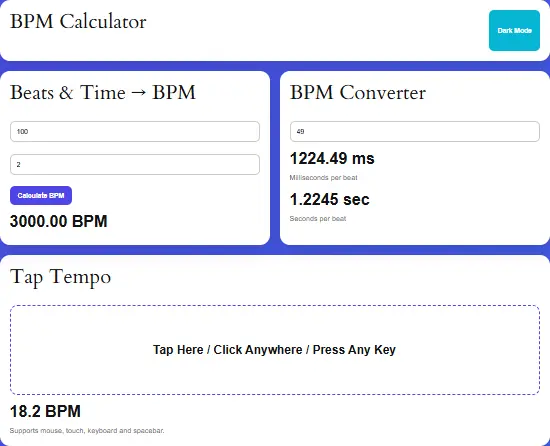
Our BPM Calculator functions as a complete tempo calculator that allows users to calculate BPM from beats and time, convert BPM to milliseconds, analyze beat duration, and determine song tempo with precision. Additionally, the tool supports tap tempo functionality, making it easier to identify the tempo of a song in real time.
Features of This BPM Calculator
Our BPM Calculator has been designed to provide fast, accurate, and user-friendly tempo calculations. Because musicians and producers often need instant results, the tool delivers calculations in real time without requiring downloads or installations.
1. Calculate BPM from Beats and Time
The primary feature allows users to calculate BPM using the number of beats and the duration in seconds. Therefore, you can quickly determine the tempo of any rhythm, song section, or musical pattern.
Because the calculation process is automated, users receive accurate BPM results within seconds.
2. BPM to Milliseconds Converter
The tool also functions as a BPM to milliseconds converter. Therefore, producers can determine the exact duration of each beat when configuring delays, effects, and timing-based plugins.
Because delay timing is critical in music production, converting BPM to milliseconds helps maintain rhythmic consistency.
3. Seconds Per Beat Calculator
In addition to milliseconds, the calculator displays the number of seconds per beat. Consequently, musicians can better understand the timing structure of a song.
This feature is particularly useful for composers, arrangers, and educators who need detailed timing information.
4. Tap Tempo Functionality
The integrated tap tempo calculator allows users to tap along with a rhythm. As a result, the tool estimates the BPM automatically.
Because many songs do not display tempo information, the tap BPM feature provides a convenient solution for tempo detection.
5. Mobile-Friendly Design
The calculator works smoothly on smartphones, tablets, laptops, and desktop computers. Therefore, users can calculate tempo from virtually any device.
Because modern creators often work on multiple devices, responsive design improves accessibility and convenience.
6. Real-Time Updates
As users enter information, the calculator updates results immediately. Consequently, there is no need to refresh the page repeatedly.
Because efficiency matters during creative workflows, instant calculations save valuable time.
Advanced Features of the BPM Calculator
Beyond basic calculations, this BPM tool includes advanced functionality that supports professional music production and performance workflows.
1. Tempo Analysis
The calculator helps users analyze rhythm patterns and tempo structures. Therefore, it becomes easier to compare songs and identify tempo variations.
Because tempo consistency affects musical quality, accurate analysis supports better creative decisions.
2. Beat Duration Calculations
Understanding beat duration is essential for delay effects, loop creation, and arrangement planning. Consequently, the BPM calculator provides valuable timing insights.
Because every beat has a measurable duration, producers can synchronize effects with greater precision.
3. DJ Tempo Matching Support
Although this tool is primarily a BPM calculator, it can also assist DJs during tempo matching. Therefore, users can compare BPM values before transitioning between tracks.
For more advanced DJ applications, a dedicated DJ Beat Match Calculator can provide additional functionality in the future.
4. Song Tempo Analysis
The calculator helps users determine song tempo quickly and accurately. Consequently, it serves as an effective song BPM calculator for musicians, DJs, and producers.
Because tempo influences mood and energy, understanding BPM supports better musical planning.
BPM to Milliseconds Explained
One of the most valuable music production calculations involves converting BPM to milliseconds. Because delay effects often require millisecond values, producers frequently use BPM conversion tools.
For example, a tempo of 120 BPM results in 500 milliseconds per beat. Therefore, delay effects can be synchronized perfectly with the song’s rhythm.
Because rhythmically synchronized delays sound more natural, BPM-to-ms conversion remains a standard technique in professional audio production.
Many producers use BPM timing calculators while configuring delays, reverbs, modulation effects, and automation sequences. Consequently, tempo-based timing improves the overall listening experience.
How to Use This BPM Calculator
Using the BPM Calculator is simple and requires only a few steps.
Method 1: Calculate BPM from Beats and Time
First, enter the total number of beats.
Next, enter the duration in seconds.
Then, click the calculate button.
Finally, the calculator will instantly display the BPM value.
Method 2: Use Tap Tempo
First, start the music or rhythm you want to analyze.
Next, tap along with the beat using the tap tempo area.
Then, continue tapping consistently for several beats.
Finally, the calculator will estimate the tempo automatically.
Method 3: Convert BPM to Milliseconds
First, enter a BPM value.
Next, allow the calculator to process the information.
Finally, view the milliseconds per beat and seconds per beat calculations.
Because all calculations occur instantly, users can experiment with different tempos effortlessly.
Who Benefits Most from This Tool?
This BPM calculator supports a wide range of users.
Musicians benefit because they can identify tempo quickly during practice and performance.
Producers benefit because they can synchronize effects accurately.
DJs benefit because they can compare track tempos before mixing.
Students benefit because they can learn tempo concepts more effectively.
Audio engineers benefit because they can analyze timing and rhythm structures with greater precision.
Because tempo influences nearly every aspect of music, BPM tools remain valuable across the entire industry.
Helpful Related Tools
If you regularly work with music timing, productivity, or calculations, you may also find these Daily Tool Spot resources useful.
You can use the Tap Tempo BPM Calculator to identify song tempo by tapping along with the rhythm.
If you need additional timing calculations, the Time Calculator, Hours Calculator, and Time Tracking Tool can help measure and manage time-related data more efficiently.
For advanced mathematical calculations, the Online Scientific Calculator provides additional functionality that complements tempo calculations.
If you work with schedules and planning, the Pomodoro Timer with Task List, Daily Routine Planner, and Productivity Focus Hub can improve workflow efficiency.
Trusted Resources for Learning More About Tempo
If you want to learn more about tempo, rhythm, and BPM, several trusted educational resources provide valuable information.
The Berklee College of Music offers educational materials related to music theory and production.
The Ableton Learning Music platform provides beginner-friendly lessons about rhythm and tempo.
The Sound On Sound magazine regularly publishes professional articles covering music production techniques and timing concepts.
Because these resources are widely respected within the music industry, they provide additional educational value for musicians and producers.
Why BPM Matters in Music
Tempo is one of the most important elements of music because it determines how fast or slow a piece is played. Furthermore, BPM, which stands for beats per minute, serves as the universal measurement of tempo across all music genres.
For example, a relaxing ballad may have a tempo of 60 to 80 BPM. Meanwhile, many pop songs fall between 100 and 130 BPM. On the other hand, electronic dance music and club tracks often range from 120 to 150 BPM or even higher.
Because tempo directly influences rhythm, groove, and energy, musicians frequently rely on a BPM finder or tempo calculator to maintain consistency. As a result, producers can synchronize instruments, DJs can match tracks, and performers can maintain accurate timing.
How Does a BPM Calculator Work?
A BPM Calculator uses a simple mathematical formula to determine the number of beats that occur within one minute. Therefore, if you know the number of beats and the amount of time, the calculator can instantly determine the tempo.
Instead of performing manual calculations, users simply enter the required values into the beats per minute calculator. Consequently, the tool processes the information and displays the exact BPM value within seconds.
Moreover, many advanced BPM tools provide additional calculations such as BPM to milliseconds conversion, beat duration calculations, and tempo analysis. Therefore, they become valuable resources for musicians, producers, and DJs alike.
Who Can Use a BPM Calculator?
One of the biggest advantages of a BPM calculator is its versatility. Because tempo is important across multiple industries and creative fields, the tool can benefit many different users.
Music Producers
Music producers frequently use a music tempo calculator while creating songs inside digital audio workstations. Additionally, they use BPM values to synchronize drum patterns, loops, effects, and automation.
Because timing accuracy is essential in modern music production, producers often rely on BPM tools to improve workflow efficiency.
DJs
DJs regularly use BPM calculators to match tempos between tracks. Furthermore, accurate BPM measurements help create smooth transitions between songs during live performances.
Many DJs also use a tap BPM calculator when analyzing tracks that do not display tempo information automatically.
Musicians
Musicians often use a song BPM calculator while practicing, composing, or arranging music. Therefore, they can ensure consistent timing during rehearsals and performances.
Additionally, understanding BPM helps musicians communicate tempo instructions clearly with other performers.
Audio Engineers
Audio engineers frequently analyze tempo during editing and mixing sessions. Consequently, a BPM measurement tool helps them align effects, delays, and time-based processing accurately.
Students and Educators
Music students and teachers also benefit from BPM calculators because they simplify tempo analysis. Moreover, they provide an easy way to understand rhythm, beat frequency, and musical timing concepts.
Benefits of Using an Online BPM Calculator
An online BPM calculator offers several advantages compared to manual calculations. Because the process is automated, users save time and reduce the possibility of errors.
Fast Results
The calculator instantly analyzes tempo information. Therefore, users can focus on creating music rather than performing calculations.
Improved Accuracy
Manual calculations can sometimes lead to mistakes. However, a dedicated BPM tool provides precise and consistent results every time.
Easy Accessibility
Because the tool works online, users can access it from desktops, laptops, tablets, and smartphones. Consequently, tempo calculations are available whenever they are needed.
Better Workflow
Whether you are a producer, DJ, or musician, accurate tempo information improves efficiency. As a result, projects can move forward without interruptions.
Beginner-Friendly Design
Even users with no technical experience can calculate beats per minute successfully. Therefore, the tool remains useful for both professionals and beginners.
Understanding Beats Per Minute
Beats per minute refers to the number of rhythmic beats that occur within one minute. Although the concept is simple, BPM serves as the foundation of tempo measurement in music.
For example, a song at 60 BPM contains one beat every second. Meanwhile, a song at 120 BPM contains two beats every second. Therefore, increasing BPM increases the speed of the music.
Because BPM influences the emotional impact of a song, choosing the right tempo is often a critical creative decision. Consequently, many producers spend significant time experimenting with different BPM values.
Common BPM Ranges by Music Genre
Different genres typically use different BPM ranges. Although exceptions exist, certain tempo patterns appear frequently throughout the music industry.
Classical Music
Classical compositions often range between 60 and 120 BPM. However, tempo can vary significantly depending on the style and composer.
Pop Music
Most pop songs fall between 100 and 130 BPM. Therefore, this range has become one of the most recognizable tempo zones in modern music.
Hip-Hop
Hip-hop commonly ranges from 70 to 100 BPM. Additionally, some producers use double-time rhythms that create a faster feel without increasing the actual BPM.
Rock Music
Rock songs often range from 90 to 140 BPM. Consequently, the genre can accommodate both energetic and moderate tempos.
EDM and Dance Music
Electronic dance music frequently ranges between 120 and 150 BPM. Because dance tracks require strong rhythmic energy, higher BPM values are common.
House Music
House music typically remains near 120 to 130 BPM. Therefore, DJs often use BPM matching tools when transitioning between house tracks.
Techno
Techno generally operates between 125 and 150 BPM. Moreover, consistent tempo helps maintain dance floor momentum.
Tap Tempo Calculator: Find BPM by Tapping
One of the most popular features included in modern BPM tools is tap tempo functionality. Instead of entering numerical values manually, users simply tap along with the rhythm.
As you continue tapping, the calculator measures the time between taps and estimates the BPM automatically. Therefore, it becomes an effective tempo finder for songs playing on speakers, radio stations, or streaming platforms.
Many DJs and musicians prefer a tap tempo calculator because it provides a quick way to identify tempo without requiring advanced software. Consequently, it remains one of the most widely used tempo analysis methods available today.
If you specifically need a dedicated tap tempo experience, you can also explore the Tap Tempo BPM Calculator available on Daily Tool Spot. It offers an additional way to measure song tempo quickly and accurately.
BPM Calculator vs Tap Tempo Calculator
Although both tools focus on tempo measurement, they serve slightly different purposes.
A traditional BPM calculator determines tempo using numerical inputs such as beats and time. Therefore, it works best when precise measurements are already available.
A tap BPM calculator, however, estimates tempo through user interaction. Consequently, it becomes useful when analyzing live music or songs without visible BPM information.
Because both methods provide valuable insights, many users utilize them together for maximum accuracy.
Why Accurate Tempo Measurement Matters
Accurate tempo measurement improves nearly every stage of music production and performance. Therefore, professionals place significant importance on BPM analysis.
When tempos remain consistent, musicians perform more confidently. Additionally, producers can synchronize effects more effectively. Likewise, DJs can create smoother transitions between tracks.
Because timing affects every aspect of rhythm, even small BPM differences can influence the final listening experience. Consequently, reliable BPM measurement tools remain essential throughout the music industry.
Popular Music Tools
If you prefer not to manually count beats and divide by time, you can find your tempo instantly by just tapping along to the music with our Tap Tempo BPM Calculator. Once you know your BPM, you might want to know the classical musical term for that speed by checking our Tempo Marking Chart. For composers and producers, understanding how long each note lasts at your calculated BPM is crucial, so be sure to use our Note Length Calculator next.
Frequently Asked Questions
BPM stands for beats per minute. Therefore, it measures how many beats occur within one minute of music.
A BPM calculator is a tool that calculates tempo based on beats and time. Consequently, users can determine song speed quickly.
A tap tempo calculator is highly accurate when users tap consistently. Therefore, it provides reliable tempo estimates for most situations.
Yes, DJs frequently use BPM calculators to compare track tempos. As a result, beat matching becomes easier.
BPM determines the speed and feel of a song. Therefore, it influences rhythm, groove, and energy.
Producers use BPM-to-ms calculations to synchronize delay effects and timing-based plugins. Consequently, effects remain aligned with the song tempo.
Most EDM tracks fall between 120 and 150 BPM. However, specific subgenres may vary.
Yes, you can calculate BPM manually. However, a dedicated BPM calculator provides faster and more accurate results.
A tap BPM calculator estimates tempo based on rhythmic taps entered by the user. Therefore, it helps identify song tempo quickly.
Yes, the tool is completely free to use. Additionally, it works online without requiring registration.
Conclusion
A BPM Calculator is one of the most valuable tools for musicians, DJs, producers, audio engineers, educators, and music enthusiasts. Because tempo affects every aspect of rhythm and timing, accurate BPM calculations help improve creative decisions and technical precision.
Whether you need a beats per minute calculator, a tempo calculator, a song BPM calculator, a BPM finder, a BPM measurement tool, a BPM to milliseconds converter, or a tap tempo calculator, this tool provides a fast and reliable solution. Furthermore, its responsive design and real-time calculations make it suitable for both beginners and professionals.
As music production continues to evolve, accurate tempo analysis remains essential. Therefore, using a trusted BPM calculator can help streamline workflows, improve timing accuracy, and support better musical outcomes.