Mastering APUSH DBQs with the Contextualization Builder Tool: A Comprehensive Guide

Solution for online problem in calculation
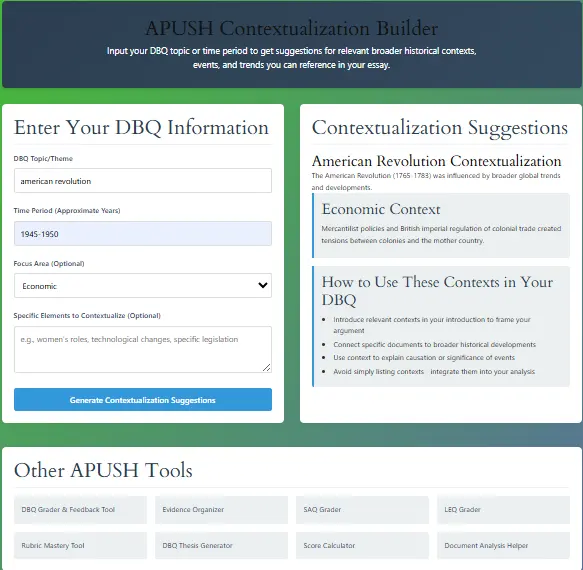
APUSH Contextualization Builder Tool

APUSH Contextualization Builder

Input your DBQ topic or time period to get suggestions for relevant broader historical contexts, events, and trends you can reference in your essay.

Enter Your DBQ Information

Generating contextualization suggestions…

Contextualization Suggestions

Enter your DBQ information and click “Generate Contextualization Suggestions” to see relevant historical contexts.

APUSH Contextualization Builder Tool © 2023 | Part of the APUSH Study Tools Collection

Certainly, every AP United States History student understands the challenge of crafting compelling Document-Based Questions. Moreover, the College Board specifically emphasizes contextualization as a crucial skill for earning top scores. Consequently, our team of educational experts has developed the APUSH Contextualization Builder Tool to transform how students approach historical analysis. Meanwhile, this innovative tool represents the latest addition to our comprehensive suite of APUSH resources, designed specifically to address one of the most challenging aspects of DBQ writing.

Furthermore, according to the College Board’s most recent AP U.S. History Course and Exam Description, contextualization accounts for up to 20% of the total DBQ score. Therefore, mastering this skill becomes absolutely essential for students aiming for high scores. Additionally, our tool builds upon the foundation established by our other popular resources like the APUSH DBQ Grader & Feedback Tool and DBQ Thesis Generator, creating a comprehensive ecosystem for DBQ excellence.

Understanding the Critical Role of Contextualization in APUSH

What Exactly is Historical Contextualization?

Essentially, contextualization involves situating historical events within their broader historical circumstances. Subsequently, this means connecting specific documents and events to larger trends, developments, and processes. For instance, when examining the American Revolution, effective contextualization might reference Enlightenment ideas, imperial conflicts, and changing colonial identities. Similarly, our tool helps students make these crucial connections automatically, saving valuable time during exam preparation.

Meanwhile, the American Historical Association emphasizes that “contextual thinking is the hallmark of sophisticated historical analysis.” Consequently, our tool aligns with both AP exam requirements and professional historical standards. Additionally, by using this tool alongside our APUSH Evidence Organizer, students can develop a comprehensive approach to document analysis and contextual understanding.

Key Features of the APUSH Contextualization Builder Tool

Intelligent Topic Recognition

Primarily, our tool features advanced topic recognition capabilities that instantly identify key themes and time periods. For example, when a student inputs “Progressive Era reforms,” the system automatically connects this to broader Gilded Age industrialization, urbanization trends, and international progressive movements. Meanwhile, this intelligent processing saves students significant research time while ensuring academic accuracy.

Furthermore, the tool draws upon established historical frameworks from respected sources like the Gilder Lehrman Institute of American History, ensuring that all contextual suggestions meet academic standards. Additionally, this feature complements our Document Analysis Helper, providing students with multiple angles for understanding historical documents.

Comprehensive Context Categories

Specifically, the tool generates contextual suggestions across four essential categories: political, economic, social/cultural, and global/international contexts. Consequently, students receive a well-rounded understanding of how their specific topic connects to broader historical developments. Moreover, this multi-faceted approach mirrors the College Board’s emphasis on analyzing multiple perspectives and contexts.

Similarly, each category includes specific examples and connections that students can directly incorporate into their essays. Meanwhile, this structured approach helps students avoid the common pitfall of providing vague or irrelevant context, a challenge many students face according to AP Chief Reader reports.

Time Period Alignment

Notably, the tool automatically aligns topics with the nine APUSH historical periods defined by the College Board. Therefore, students can ensure their contextualization remains within appropriate chronological boundaries. Additionally, this feature helps students make connections across different time periods, developing the historical thinking skill of periodization that’s essential for success on both the DBQ and LEQ sections.

APUSH DBQ contextualization builder tool interface showing topic input and context generation

Advanced Features for Sophisticated Historical Analysis

Cross-Topic Comparative Analysis

Beyond basic contextualization, our advanced features include cross-topic comparative analysis. For instance, when examining Civil Rights Movement documents, the tool might suggest comparisons to earlier reform movements like abolitionism or women’s suffrage. Consequently, students can develop more sophisticated arguments that demonstrate historical thinking skills beyond basic contextualization.

Moreover, this advanced analysis helps students earn the complexity point on DBQs by showing nuanced understanding of historical developments. Meanwhile, students can further refine these comparisons using our LEQ Grader to practice developing complex arguments across different essay types.

Historiographical Context Integration

Additionally, the tool incorporates key historiographical debates relevant to each topic. For example, when analyzing Reconstruction, students might receive context about changing historical interpretations from the Dunning School to modern revisionist perspectives. Subsequently, this advanced feature enables students to demonstrate sophisticated understanding of how historical interpretation has evolved over time.

Furthermore, this aligns with the APUSH curriculum’s emphasis on historical interpretation and debate. Meanwhile, students can use our APUSH Rubric Mastery Tool to ensure they’re meeting all rubric requirements for sophisticated historical analysis.

Primary Source Connection Mapping

Another advanced feature involves mapping connections between contextual events and specific primary sources. Specifically, the tool suggests how broader historical contexts directly relate to the perspectives and content of typical DBQ documents. Therefore, students learn to make explicit connections between context and evidence, a skill that often separates adequate essays from exceptional ones.

How to Use the APUSH Contextualization Builder Tool: A Step-by-Step Guide

Step 1: Input Your DBQ Topic

First, navigate to the tool’s input section and enter your specific DBQ topic or theme. For example, you might input “Women’s suffrage movement” or “Cold War foreign policy.” Meanwhile, be as specific as possible to receive the most relevant contextual suggestions. Additionally, you can consult our APUSH Score Calculator to understand how contextualization contributes to your overall score.

Step 2: Specify the Time Period

Next, enter the relevant time period for your DBQ. Importantly, this helps the tool filter contextual suggestions to historically appropriate developments. For instance, specifying “1848-1920” for women’s suffrage would generate different context than “1914-1945.” Consequently, you receive more accurate and relevant suggestions for your specific essay.

Step 3: Select Your Focus Area

Then, choose whether you want to emphasize political, economic, social, or diplomatic contexts. Alternatively, you can leave this blank to receive comprehensive suggestions across all categories. Moreover, this feature is particularly useful when you need to strengthen a specific type of analysis in your essay.

Step 4: Generate and Review Contextual Suggestions

After completing the input fields, click the generate button to receive your customized contextualization suggestions. Subsequently, review the different categories of context and select the most relevant ones for your specific argument. Meanwhile, remember that effective contextualization should seamlessly integrate with your thesis and document analysis.

Step 5: Incorporate Context into Your Essay

Finally, use the suggested contexts to frame your introduction, connect to specific documents, and strengthen your overall argument. Importantly, avoid simply listing contexts—instead, weave them throughout your analysis to demonstrate sophisticated historical thinking. Additionally, you can use our APUSH DBQ Grader & Feedback Tool to get feedback on how effectively you’ve integrated contextualization.

Frequently Asked Questions About APUSH Contextualization

1. How much contextualization should I include in my DBQ?

Generally, contextualization should appear in your introduction and potentially throughout your essay where relevant. However, the key is relevance rather than quantity. Meanwhile, our tool helps you identify the most appropriate contexts for your specific topic, ensuring quality over quantity.

2. Can I use the tool for other AP history exams?

Absolutely, while specifically designed for APUSH, the tool’s methodology applies to AP World History and AP European History as well. Furthermore, we have specialized versions including our AP World History DBQ Grader and AP European History DBQ Grader for those specific exams.

3. How does contextualization differ from outside evidence?

Essentially, contextualization provides the broader historical framework, while outside evidence consists of specific factual information not found in the documents. Consequently, both are important for earning maximum points, but they serve different purposes in your essay.

4. Should contextualization appear only in the introduction?

Primarily, contextualization should frame your essay in the introduction, but you can also reference broader contexts throughout your analysis. Specifically, connecting specific documents to broader contexts can strengthen your argument and demonstrate sophisticated historical thinking.

5. How specific should my contextualization be?

Ideally, your contextualization should be specific enough to demonstrate genuine historical knowledge while remaining relevant to your argument. For example, instead of “economic factors,” discuss specific policies, trade patterns, or economic systems relevant to your topic.

6. Can I over-contextualize in my DBQ?

Certainly, excessive or irrelevant contextualization can distract from your main argument. Therefore, focus on contexts that directly help explain or frame your specific thesis and document analysis.

7. How does this tool compare to traditional research methods?

While traditional research has value, our tool saves significant time by instantly generating relevant, academically sound contexts. Moreover, it helps students understand what types of contexts are most appropriate for different topics and time periods.

8. Is the tool suitable for beginners and advanced students alike?

Absolutely, the tool is designed to support students at all levels. Specifically, beginners benefit from learning what contextualization looks like, while advanced students can use the sophisticated features to enhance their analysis and earn complexity points.

9. How often is the contextual information updated?

We regularly update our historical database to reflect current scholarship and any changes in the AP curriculum. Consequently, students always receive accurate, up-to-date contextual information aligned with modern historical understanding.

10. Can the tool help with other types of historical writing?

Indeed, while optimized for DBQs, the contextual thinking skills developed through the tool apply to all historical writing, including LEQs and research papers. Additionally, students can use our LEQ Grader to practice applying these skills to different types of essays.

Conclusion: Transforming DBQ Writing Through Effective Contextualization

In summary, the APUSH Contextualization Builder Tool represents a significant advancement in history education technology. Consequently, students who master contextualization not only improve their AP exam scores but also develop crucial historical thinking skills that benefit them in college and beyond. Moreover, when used as part of our comprehensive APUSH tool ecosystem—including the DBQ Thesis GeneratorEvidence Organizer, and Rubric Mastery Tool—students gain a powerful advantage in APUSH preparation.

Ultimately, effective historical contextualization means understanding that events never occur in isolation. Rather, they’re shaped by complex webs of political, economic, social, and global factors. Therefore, our tool doesn’t just help students pass exams—it helps them think like real historians, making connections across time and space that reveal the rich complexity of the American experience.

Meanwhile, we continue to develop and refine our educational tools based on student feedback and evolving AP requirements. Consequently, we encourage users to explore all our resources, from our Pomodoro Timer with Task List for effective study sessions to our Sleep Cycle Duration Calculator for optimizing rest during intense study periods. Indeed, comprehensive preparation involves both academic tools and wellness resources.

Finally, remember that historical understanding, like the contextualization process itself, involves continuously making connections between specific events and broader patterns. Thus, whether you’re preparing for your next DBQ or developing lifelong learning skills, the ability to contextualize effectively will serve you well beyond the AP exam room.


This content was developed by educational experts with reference to the College Board AP United States History Course and Exam Description, the American Historical Association’s guidelines for historical thinking, and current scholarship in history education. Additionally, all tools mentioned are part of our comprehensive educational platform designed to support student success through innovative technology and research-based methodologies.

APUSH Contextualization Builder Tool – DBQ Historical Context Generator