Experience the complete legislative process from idea to law
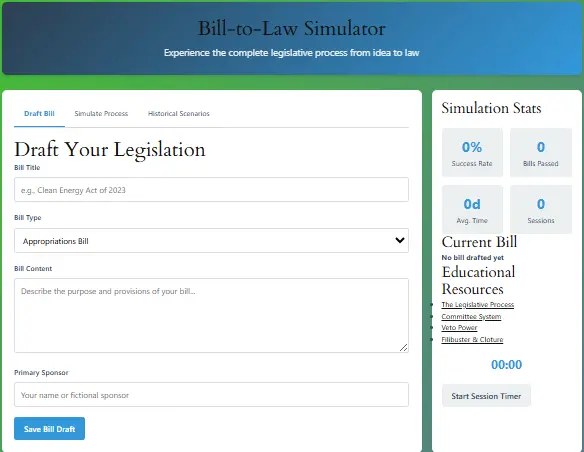
Draft Your Legislation
Legislative Process Simulation
Historical Scenarios
Learn from famous legislative battles in U.S. history:
Furthermore, understanding how laws are made represents a fundamental aspect of civic education. However, the legislative process often seems complex and inaccessible to students and educators alike. Therefore, we’ve developed an innovative Bill-to-Law Simulator that transforms this abstract process into an engaging, interactive experience. Subsequently, this comprehensive guide will explore how our legislative process simulator revolutionizes civics education while connecting it to our broader ecosystem of educational tools.
Understanding the Legislative Process
Initially, the journey from bill to law involves multiple intricate stages. Specifically, our bill to law simulator breaks down this complex procedure into digestible components. Moreover, this interactive approach helps students visualize how ideas transform into legislation through congressional action. Consequently, learners develop a practical understanding of the U.S. government simulation that traditional textbooks cannot provide. Official Congressional legislative process overview.
The Evolution of Civics Education Tools
Traditionally, civics education relied heavily on textbooks and lectures. Meanwhile, digital transformation has revolutionized how we teach governmental processes. For instance, our US government simulation tools represent the cutting edge of this educational evolution. Additionally, these resources complement our broader collection of AP US Government resources, creating a comprehensive learning ecosystem.
Key Features of Our Legislative Process Simulator
1. Realistic Bill Drafting Interface
Primarily, users begin by creating legislation using our intuitive drafting system. Similarly, this mirrors the actual process lawmakers use when developing new bills.
2. Interactive Committee Simulations
Subsequently, bills move through committee review processes. Specifically, our simulator replicates the scrutiny that legislation undergoes in specialized committees.
3. Dynamic Floor Voting Mechanisms
Moreover, the tool features realistic voting simulations that demonstrate how bills succeed or fail in congressional chambers.
4. Comprehensive Presidential Action Scenarios
Additionally, students experience executive branch involvement through signing, vetoing, or pocket veto scenarios.
5. Historical Context Integration
Meanwhile, users can explore famous legislative battles from American history, providing crucial context for current processes.
Advanced Features for Enhanced Learning
Real-Time Decision Impact Analysis
Not only does the simulator track progress, but it also provides immediate feedback on strategic choices. Likewise, this helps students understand the consequences of political decisions.
Multi-Layer Difficulty Settings
Furthermore, educators can adjust complexity levels to suit different learning stages, from beginner to advanced political science students.
Collaborative Legislative Drafting
Similarly, the tool supports group work, enabling classroom teams to collaborate on bill creation and strategy.
Assessment and Analytics Dashboard
Consequently, teachers can monitor student progress and identify areas needing additional instruction through detailed analytics.
How to Use the Bill-to-Law Simulator: A Step-by-Step Guide
Step 1: Bill Conceptualization
First, access the simulator and select “Draft Bill” from the main menu. Meanwhile, consider using our Document Analysis Helper to research potential bill topics.
Step 2: Committee Assignment
Next, choose appropriate committees for your legislation. Specifically, this decision significantly impacts your bill’s chances of success.
Step 3: Floor Strategy Development
Then, develop a comprehensive strategy for floor debate and voting. Additionally, our APUSH Evidence Organizer can help structure persuasive arguments.
Step 4: Cross-Chamber Navigation
Afterward, navigate the complex process of reconciling differences between House and Senate versions.
Step 5: Executive Engagement
Finally, manage presidential interactions and potential veto scenarios to complete the legislative journey.
Integrating Complementary Educational Tools
Enhancing Research Capabilities
Significantly, our Document Analysis Helper provides essential research support for bill development. Similarly, this tool helps students analyze historical documents and contemporary sources. House of Representatives guide to how laws are made.
Improving Writing Skills
Moreover, the DBQ Thesis Generator strengthens legislative argumentation by teaching effective thesis construction. Consequently, students develop more persuasive bill justifications.
Assessment and Feedback Integration
Additionally, our APUSH DBQ Grader and SAQ Grader provide immediate feedback on written components related to legislative analysis.
Study Management
Meanwhile, the Pomodoro Timer with Task List helps students manage extended legislative simulation projects through structured study sessions.
The Educational Value of Government Simulations
Building Critical Thinking Skills
Ultimately, interactive simulations develop higher-order thinking skills that traditional instruction often misses. Specifically, students learn to analyze political situations from multiple perspectives.
Fostering Civic Engagement
Additionally, understanding legislative processes empowers students to become more active, informed citizens. Notably, this practical knowledge demystifies government operations.
Supporting Different Learning Styles
Furthermore, the multimodal nature of simulations accommodates visual, auditory, and kinesthetic learners through diverse interactive elements.
Features That Set Our Simulator Apart
Authentic Scenario Replication
Unlike basic educational games, our simulator incorporates real-world political constraints and opportunities. For example, budget limitations, political opposition, and public opinion factors all influence outcomes.
Adaptive Learning Technology
The tool automatically adjusts challenge levels based on student performance, ensuring appropriate difficulty progression.
Comprehensive Assessment Tools
Educators can track student understanding through built-in analytics and assessment features that measure conceptual grasp.
Advanced Applications for Different Educational Settings
Classroom Integration Strategies
Teachers can incorporate the simulator into existing curricula through various implementation models, from standalone activities to semester-long projects.
Homeschooling Applications
The self-paced nature makes it ideal for homeschooling environments seeking comprehensive civics education resources.
College-Level Political Science Use
Advanced features support higher education needs, including complex legislative strategy development and political analysis.
Frequently Asked Questions (FAQs)
Primarily, the tool serves middle school through college levels, with adjustable difficulty settings for different age groups.
Specifically, it addresses multiple state and national standards for civics and government education, including C3 Framework requirements.
Absolutely, the simulator supports both individual and group work, making it ideal for classroom team projects.
Fortunately, it operates on any modern web browser without additional software installations or downloads.
Notably, the tool presents balanced scenarios that encourage critical analysis of multiple viewpoints on legislative issues.
Yes, the system includes comprehensive analytics that help teachers monitor engagement and understanding.
We regularly update scenarios and features to reflect current political developments and educational best practices.
Indeed, we provide comprehensive tutorial resources and professional development materials for effective implementation.
Research shows simulation-based learning significantly improves retention and understanding compared to lecture-based approaches.
Certainly, educators can use the built-in assessment features or complement them with our APUSH Rubric Mastery Tool.
The Future of Interactive Civics Education
Emerging Technological Integration
Looking ahead, we’re exploring augmented reality features and artificial intelligence enhancements to further improve the learning experience.
Expanded Curriculum Connections
Additionally, we’re developing connections to economic and historical simulations that provide broader context for legislative decision-making.
Global Government Simulations
Eventually, we plan to expand beyond the U.S. system to include comparative government simulations from around the world.
Conclusion: Transforming Civic Education Through Innovation
In summary, our Bill-to-Law Simulator represents a significant advancement in civics education technology. Ultimately, by making the legislative process accessible and engaging, we empower students to become informed, active citizens. Moreover, when combined with our complete suite of educational tools including the LEQ Grader and APUSH Score Calculator, educators have everything needed for comprehensive social studies instruction. Therefore, we invite you to explore these resources and discover how interactive simulations can transform your approach to teaching government and civics.
Experience the future of civics education today with our complete toolkit:
Bill-to-Law Simulator | Document Analysis Helper | APUSH DBQ Grader | Pomodoro Timer | All Educational Tools