APUSH Score Calculator
Turn your practice section results into a clear 1–5 AP U.S. History estimate in seconds — with a full weighted breakdown of every exam section.
- 40% Multiple Choice
- 20% Short Answer
- 25% DBQ
- 15% LEQ
- Instant 1–5 Estimate
APUSH Score Calculator
Estimate your AP U.S. History score from your practice section results.
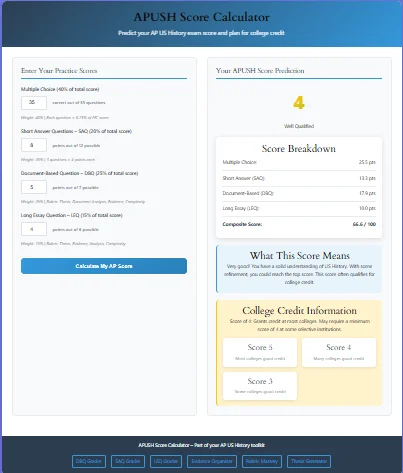
Enter Your Practice Scores
Enter the number of points you earned in each section. This calculator uses the APUSH section weights to produce an unofficial score estimate.
Your Estimated APUSH Score
Estimated AP Score
—
This is an unofficial estimate based on the weighting and conversion rules used by this calculator. It is not an official College Board score.
Score Breakdown
What This Score Means
The APUSH Score Calculator helps students estimate their performance from practice scores. It applies the section weights used by the current AP U.S. History exam format and provides an unofficial score estimate. Because College Board determines final AP scores through its official scoring and equating processes, this calculator should be used for practice and preparation rather than as a prediction of an official score.
What is the APUSH Score Calculator?
Fundamentally, the APUSH Score Calculator represents a sophisticated digital tool designed to predict your AP United States History exam performance. Specifically, it calculates weighted scores across all four exam sections: Multiple Choice Questions (MCQ), Short Answer Questions (SAQ), Document-Based Question (DBQ), and Long Essay Question (LEQ). Additionally, it translates these scores into the familiar 1–5 AP scale.
Furthermore, this tool integrates seamlessly with our other APUSH resources, including our DBQ Grader, SAQ Grader, and LEQ Grader, consequently creating a comprehensive preparation ecosystem. Also please check out our free Essay Writing Tool.
The Importance of Score Prediction in APUSH Preparation
Understanding your potential APUSH exam score provides numerous strategic advantages throughout your preparation journey.
Spot Gaps Early
Identify knowledge gaps and skill deficiencies before they become habits.
Study Smarter
Allocate limited study time toward the sections that need the most work.
Track Progress
Regular score checks document improvement and keep motivation high.
Prioritize
Understand section weights so you know where each point matters most.
Comprehensive Features of Our APUSH Score Calculator
Real-Time Weighted Calculations
The calculator immediately processes inputs according to official College Board weighting specifications: 40% Multiple Choice, 20% Short Answer, 25% DBQ, and 15% LEQ. You get an accurate composite without manual math.
Detailed Score Breakdown
See exactly how each section contributes to your weighted composite. This makes it easy to identify which exam components deserve the most attention.
College Credit Reminder
AP credit and placement policies vary by institution. Always check the AP credit policy of each college you are considering rather than assuming a score will earn credit.
Advanced Features for Serious Students
Integration with Other APUSH Tools
Our calculator functions as the central hub connecting all our specialized APUSH tools. For example, after identifying DBQ weaknesses, students can directly access our DBQ Grader for detailed rubric-based feedback. Likewise, those struggling with evidence incorporation might benefit from our APUSH Evidence Organizer, while rubric comprehension issues could be addressed with our Rubric Mastery Tool.
How to Use the APUSH Score Calculator
Gather Your Practice Materials
First complete a timed practice exam or collect scores from recent practice sections. You’ll need your Multiple Choice correct answers (out of 55), SAQ scores (out of 12 total points), DBQ score (out of 7), and LEQ score (out of 6). Use recent, timed sessions that simulate actual exam conditions for the best accuracy.
Enter Your Scores
Enter your correct Multiple Choice answers, SAQ points, DBQ rubric score, and LEQ rubric score. The calculator accepts scores within the ranges shown in each field.
Analyze Your Results
After clicking “Calculate,” review your estimated AP score from 1–5 and the section-by-section breakdown. The breakdown shows your percentage in each section and its weighted contribution to the calculator’s composite.
Implement Improvement Strategies
Based on your results, plan your continued preparation using our interconnected APUSH tools. If your DBQ score needs improvement, practice with our DBQ Grader for specific feedback on thesis development, document analysis, and evidence usage. Low LEQ performance might indicate a need for our LEQ Grader. You can also use the APUSH Contextualization Builder to practice building relevant historical context.
Track Progress Over Time
Repeat the calculator after completing additional practice tests. Compare your results yourself and use the section breakdown to decide which APUSH skills you should practice next.
Understanding the APUSH Exam Structure and Scoring
Multiple Choice Section
The MCQ section contains 55 questions assessing factual knowledge and historical thinking skills across nine periods of US History. Students typically have 55 minutes, requiring rapid recall and application of historical knowledge. This section includes stimulus-based questions requiring analysis of primary sources, graphs, maps, or political cartoons.
Short Answer Questions
The SAQ section consists of three required questions with four points available for each response. Students generally have 40 minutes to complete all three, which typically include one secondary source, one primary source, and one question with no stimulus.
Document-Based Question
The DBQ presents seven documents and requires developing an argument using those documents alongside outside knowledge. Students have 60 minutes (including a 15-minute reading period) to craft a sophisticated historical argument that demonstrates document analysis, thesis development, and contextualization.
Long Essay Question
The LEQ requires students to select one of three prompts and develop a coherent historical argument in 40 minutes. Unlike the DBQ, no documents are provided, so students must draw entirely from their own knowledge while still demonstrating strong argument development.
About the APUSH Exam
The AP United States History exam is administered annually by the College Board. Check the official College Board APUSH page for the current exam date and exam details.
This comprehensive test evaluates your understanding of American history from pre-Columbian times to the present day. For complete exam details including format, timing, and question types, you can review the official AP Central APUSH exam page. Understanding the exam structure is essential for effective preparation and accurate score prediction.
The course covers nine historical periods. For detailed course requirements and learning objectives, refer to the official AP US History course page.
The Importance of APUSH Scores for College Credit
AP credit and placement policies vary by college. Some colleges may award credit or placement for APUSH scores of 3, 4, or 5, while others may require a higher score or may not award credit at all. Check the AP credit policy for each college you are considering.
Beyond simple credit, high APUSH scores can fulfill general education requirements, thus freeing space in college schedules for other courses. Additionally, they may enable placement into advanced history courses or satisfy graduation requirements without taking additional humanities courses. Furthermore, demonstrating strong historical thinking skills through AP scores can strengthen college applications, particularly for humanities and social science majors.
Frequently Asked Questions About APUSH Scoring
1. How accurate is the APUSH Score Calculator?
Remember that actual exam performance can vary due to stress, question difficulty variations, or grading nuances. This calculator is a study aid, not an official prediction.
2. How is the APUSH exam scored?
The exam uses a complex weighting system: Multiple Choice (40%), Short Answer Questions (20%), Document-Based Question (25%), and Long Essay Question (15%). These weighted scores combine into a composite score, which then converts to the 1–5 scale using statistical processes equating different exam versions.
3. Can I predict my score without all sections completed?
The calculator requires scores for all four sections before it can produce an estimate. For the most useful result, enter scores from a complete timed practice exam or from completed practice sections.
4. How much does each MCQ question affect my score?
Each correct MCQ question contributes approximately 0.73% to your Multiple Choice score, which then represents 40% of your composite. Therefore, each question represents about 0.29% of your final composite score, making careful attention to this section crucial.
5. How do I improve my DBQ score?
Systematically practice with our DBQ Grader for immediate rubric-based feedback. Additionally, use our Thesis Generator to strengthen argument development and our Document Analysis Helper to improve source interpretation skills.
Understanding Score Distributions
Historical performance data shows how students have performed on the APUSH exam over recent years. You can view the official APUSH score distributions directly from College Board to understand typical scoring patterns.
College Board publishes historical APUSH score distributions. These statistics can provide context about how students performed in previous years, but they are not used by this calculator to determine your estimated score.
Historical score trend data is also compiled in College Board’s score distribution report (PDF), which helps students understand long-term performance patterns across all AP exams.
Study Resources and Preparation
Preparing for the APUSH exam requires quality study materials beyond just practice tests. We recommend using official materials to ensure accuracy. For a broader collection of APUSH preparation resources, visit the APUSH History Study Tools hub.
For the most current course and exam description, check the 2026 APUSH course and exam guide. For institution-specific course information, some universities publish detailed guides like this APUSH course information sheet (PDF) from the University of Florida.
Tips for Improving Your Score
- Focus on Periods 3–6: These periods (1754–1898) often make up the largest chunk of multiple-choice questions.
- Practice DBQs weekly: The Document-Based Question is heavily weighted. Practice analyzing documents under timed conditions.
- Know the contextualization point: In both the DBQ and LEQ, earning the contextualization point is often the difference between a 3 and a 4.
- Use this tool regularly: Track your progress monthly. If your estimated score stalls, adjust your study plan to focus on weaker periods.
Ready to see where you stand?
Enter your practice section scores above and get an instant 1–5 estimate with a full weighted breakdown of every APUSH exam section.
Calculate My Score