I Got a 4/6 on Every Single LEQ. Here’s Why This Grader Finally Fixed That.My name is Ali, and I built this tool out of sheer frustration. In my APUSH class, I knew my history cold—dates, names, events—but my LEQ scores were stuck at 4/6. My teacher would write “vague” or “needs more analysis,” but I never truly understood how to fix it.I built this AI Grader to do one thing: tell you exactly which sentence lost you the point, and give you the specific replacement words to earn it back.It doesn’t just give you a score. It reads your essay like a strict (but fair) AP Reader, breaking down your argument sentence-by-sentence so you stop guessing and start writing 6/6 essays.
Grade Your LEQ
Grading Results
Submit an essay to see rubric analysis.
📝 Specific Feedback
Write your essay and click “Grade My LEQ” to get actionable feedback.
🎯 Quick Improvement Tips
• Focus on writing a clear thesis that directly answers the prompt.
• Include at least 3 specific historical examples.
Why Use Our LEQ Grader?
⚡ Instant Feedback
Get detailed rubric analysis and scores immediately after submission.
🎯 Actionable Tips
Receive specific, actionable advice to improve your score.
⏱️ Real Exam Simulation
Practice with our built-in timer and realistic prompts.
📊 Detailed Analysis
Comprehensive breakdown of every rubric point with specific feedback.
📝 See How Our Grader Works (Live Demo Example)
Prompt: Evaluate the extent to which the New Deal transformed the role of the federal government in the United States from 1933 to 1945.
Student Essay Sample
“The New Deal fundamentally transformed the role of the federal government in the United States by expanding its responsibility for economic security and creating a precedent for federal intervention in the economy. Before 1933, the federal government largely followed a laissez-faire approach, with President Hoover emphasizing voluntary cooperation and limited federal aid during the early years of the Great Depression. However, the severity of the economic crisis—with unemployment reaching 25%—forced a radical shift in federal policy under Franklin D. Roosevelt.
Roosevelt’s administration established groundbreaking programs such as the Works Progress Administration (WPA), which employed over 8.5 million Americans in public works projects, and the Social Security Act of 1935, which created a federal safety net for the elderly and unemployed. These programs represented a permanent departure from previous practices, as they established the federal government as the primary guarantor of economic welfare.
Although critics like the Liberty League argued that the New Deal expanded executive power too dramatically and did not fully end the Depression until World War II, the institutional changes proved enduring. The federal government’s role in regulating the stock market, insuring bank deposits, and providing direct relief became accepted norms. Ultimately, the New Deal fundamentally shifted American expectations of government, establishing a legacy of federal responsibility that continued through subsequent administrations.”
AI Evaluation Results
Paste your Long Essay Question response into the tool above to get a rubric-based practice assessment covering Thesis, Contextualization, Evidence, and Analysis & Reasoning. The grader provides a score out of 6 points along with feedback designed to help you identify areas that need improvement.
This page explains how the LEQ rubric works, how to build a defensible thesis, how to use historical evidence effectively, and how to strengthen your analysis before submitting an essay in practice.
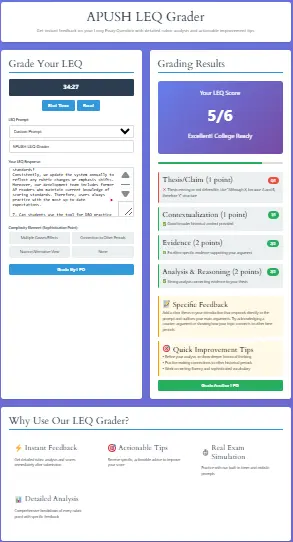
The LEQ, or Long Essay Question, is a timed AP History writing task. For AP U.S. History, students write an argument using their own historical knowledge rather than a set of provided documents. The LEQ is scored using a six-point rubric covering Thesis/Claim, Contextualization, Evidence, and Analysis & Reasoning.
Before writing, you can use the APUSH Evidence Organizer to collect relevant historical examples and the APUSH Contextualization Builder to develop the historical background for your argument.
What Does the LEQ Grader Check?
The grader is designed as a practice diagnostic. It looks for structural and language patterns associated with the major LEQ rubric categories. It can help you quickly identify areas that may need revision, but it does not replace a teacher, official scoring commentary, or careful review of historical accuracy.
- A defensible claim that answers the prompt rather than simply restating it
- Historical context connected to the topic of the prompt
- Specific historical evidence relevant to the argument
- Reasoning that explains how evidence supports the argument
- Language and argumentative patterns that may indicate more developed reasoning
Use the result as a first-pass diagnostic rather than a guaranteed College Board score. Historical accuracy, relevance, and the quality of your argument still require human judgment.
The Official 6-Point LEQ Rubric
The LEQ rubric has four scoring areas that together total six points. Thesis/Claim and Contextualization are each worth one point, while Evidence and Analysis & Reasoning are each worth two points.
| Category | Points | What the Category Measures |
|---|---|---|
| Thesis/Claim | 1 | A defensible claim that directly answers the prompt and establishes an argument. |
| Contextualization | 1 | Relevant historical developments that provide broader context for the topic. |
| Evidence | 2 | Specific historical evidence and effective use of that evidence to support the argument. |
| Analysis & Reasoning | 2 | Historical reasoning and demonstration of a more complex understanding of the topic. |
The categories are scored separately. For example, an essay can earn the first Evidence point without earning the second Evidence point, just as it can demonstrate historical reasoning without demonstrating the more advanced understanding required for the second Analysis & Reasoning point.
Thesis/Claim: Earn the First Point
A strong LEQ thesis does more than repeat the question. It makes a defensible historical claim and gives the reader a clear sense of the argument you will develop.
- Answer the exact historical question being asked.
- Take a clear position rather than remaining neutral.
- Establish a line of reasoning that your evidence can support.
A Useful Thesis Structure
One useful practice structure is: “Although [limiting factor or alternative view], [topic] changed/continued primarily because of [reason one] and [reason two], which resulted in [broader consequence].”
Do not memorize this sentence as a formula that works for every prompt. Adapt the structure to the question and make sure every part of the thesis actually answers what the prompt is asking.
Contextualization: Connect the Prompt to History
Contextualization places the topic in a broader historical setting. Instead of mentioning an unrelated fact, explain developments that help the reader understand why the events in the prompt occurred or mattered.
For an APUSH essay, this might mean explaining an earlier political development, economic condition, social movement, or international event that helps establish the background for the period being discussed.
If you struggle to build historical background, practice with the APUSH Contextualization Builder before writing your next LEQ.
Evidence: Use Specific Historical Examples
Specific evidence gives your argument historical substance. Instead of writing broad statements such as “the government changed society,” identify the people, laws, movements, institutions, events, or developments that demonstrate the change.
From Evidence to Argument
Naming an event is only the beginning. Your strongest paragraphs explain why the evidence matters and how it supports your thesis.
Descriptive: “The New Deal created the WPA, which provided jobs through public works projects.”
Analytical: “The WPA expanded the federal government’s direct role in employment, supporting the broader argument that the New Deal permanently changed expectations about federal responsibility for economic security.”
The second example connects the historical evidence directly to the argument. That connection is what turns a historical fact into useful evidence.
Use the APUSH Evidence Organizer to sort historical examples before drafting your essay.
Analysis & Reasoning: Go Beyond Listing Facts
Analysis & Reasoning is where you explain the relationship between your evidence and your argument. Depending on the prompt, this can involve reasoning based on causation, comparison, continuity and change, or another appropriate historical approach.
The second Analysis & Reasoning point is connected to demonstrating a complex understanding of the historical issue. Complexity is therefore not a separate seventh point on the LEQ rubric. It is incorporated into the Analysis & Reasoning category.
Ways to Develop More Complex Understanding
- Explain multiple causes or effects when the prompt calls for causal reasoning.
- Compare similarities and differences rather than identifying only one side.
- Explain both change and continuity when evaluating historical developments.
- Qualify an argument by recognizing an important limitation, exception, or alternative perspective.
- Connect the argument to a broader historical development when relevant.
LEQ vs. DBQ vs. SAQ
The LEQ is different from the other AP History written-response questions. The LEQ requires students to construct an argument using their own historical knowledge rather than analyzing a set of provided documents. The DBQ requires document analysis in addition to outside historical knowledge, while the SAQ uses shorter responses and a different scoring structure.
| Question Type | Main Task | Key Difference |
|---|---|---|
| LEQ | Develop a historical argument | Uses outside historical knowledge rather than a required set of documents |
| DBQ | Develop an argument using documents and historical knowledge | Requires analysis and use of provided documents |
| SAQ | Answer focused historical questions briefly | Short responses rather than a full essay argument |
If you are practicing multiple APUSH writing formats, try the APUSH DBQ Grader and APUSH SAQ Grader as well.
Example: Building a Strong LEQ Response
Consider this practice prompt: Evaluate the extent to which the New Deal transformed the role of the federal government in the United States from 1933 to 1945.
Example thesis: “Although the New Deal did not completely end the economic crisis, it fundamentally transformed the federal government’s role by expanding direct economic assistance and establishing long-term programs that increased federal responsibility for economic security.”
Context: Before the New Deal, the federal government’s response to the Great Depression was more limited, while the severity of the economic crisis created pressure for a larger federal response after Franklin D. Roosevelt took office.
Evidence: Programs such as the Works Progress Administration and the Social Security Act can be used as specific examples of expanded federal involvement in economic and social welfare.
Analysis: Rather than simply listing these programs, explain how they changed the relationship between citizens and the federal government and connect that change directly to the argument in the thesis.
This is an example of how the different rubric categories can work together. A strong essay does not treat each point as an isolated checklist; its thesis, context, evidence, and reasoning should support the same overall argument.
LEQ Practice Timing and Planning
For AP U.S. History, the LEQ is designed as a timed writing task. Practicing under a realistic time constraint can help you learn how long to spend planning, developing your argument, and revising your response.
A practical approach is to spend a few minutes identifying the task, choosing your argument, and listing evidence before you begin writing. The exact amount of planning time can vary depending on your writing speed and experience.
If time management is your main problem, use the AP History Time Management Guide alongside this grader.
LEQ Practice Tips
| Tip | Why It Matters |
|---|---|
| Answer every part of the prompt | Keeps your argument focused on the actual task. |
| Write a defensible thesis | Establishes the central argument of the essay. |
| Use specific historical evidence | Gives your argument concrete historical support. |
| Explain your evidence | Shows how historical facts support your argument. |
| Review your reasoning | Helps you identify places where the essay describes rather than analyzes. |
For a complete approach to APUSH essay preparation, see the APUSH Essay Writing Guide.
Frequently Asked Questions
No. The LEQ Grader is a practice diagnostic designed to help you identify possible weaknesses in your thesis, context, evidence, and reasoning. A teacher or qualified reader can provide more complete feedback, especially on historical accuracy and the quality of your argument.
Focus on developing your argument rather than adding filler. Make sure each major piece of evidence is explained and connected to your thesis. Practice planning quickly so you have enough time to develop your reasoning.
The grader analyzes your response using the checks built into the tool and produces a rubric-based practice result. It can highlight structural patterns and areas that may need improvement, but the result should not be treated as an official College Board score.
The LEQ asks students to develop an argument using their own historical knowledge. The DBQ also requires students to analyze and use a set of provided documents as evidence.
No. The LEQ is only one part of the overall AP History exam. Your final AP score is based on the complete exam scoring process rather than simply converting your LEQ score into a 1–5 AP score.
More APUSH Writing Tools
Keep practicing the other written sections and planning skills with these DailyToolSpot resources:
- APUSH DBQ Grader
- APUSH SAQ Grader
- DBQ/LEQ Outline Generator
- AP US History Score Calculator
- AP History Study Tools
For the complete official scoring information and current AP U.S. History exam guidance, consult the AP U.S. History Course and Exam Description published by College Board.