📅 APUSH Timeline Generator & Study Tool
Filter U.S. history from 1491 to today by period, theme, or difficulty — then quiz yourself on it. Built to track the College Board’s Course and Exam Description, not just a list of dates.
AP U.S. History Master Study Guide
Generated by Ultimate APUSH Pro Generator v2.0
What’s actually inside this tool
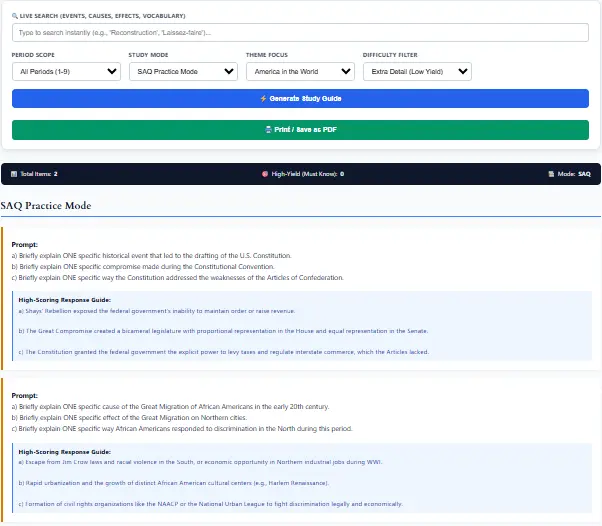
This isn’t a static timeline. It currently covers 15 major events, 7 presidential administrations, 6 landmark Supreme Court cases, and 8 constitutional amendments, each tagged with its period, theme, and difficulty level. Beyond that, you’ll find two cause-and-effect chains tracing the road to the Revolution and the road to the Civil War, five flashcards, a four-question scored quiz, and dedicated strategy prompts for the DBQ, LEQ, and SAQ.
Why a timeline beats a list of dates
APUSH doesn’t reward memorizing when something happened. It rewards explaining why it happened and what changed because of it — the skills the exam calls causation and continuity-and-change-over-time. A plain list of dates can’t show you that the collapse of the Spanish encomienda system in the 1500s helped set the stage for African chattel slavery in English colonies a century later. A filtered, connected timeline can — that’s what the causes, effects, and cause-and-effect chain modes in this tool are built for.
Exam weighting by period
Not every period is worth equal study time. The nine APUSH periods aren’t weighted evenly on the multiple-choice and short-answer sections — Periods 3 through 8 (1754–1980) carry roughly two to three times the weight of Periods 1, 2, and 9. If you’re short on time, that’s where to focus first.
| Period | Years | Approx. exam weight |
|---|---|---|
| 1 | 1491–1607 | 4–6% |
| 2 | 1607–1754 | 4–8% |
| 3 | 1754–1800 | 10–17% |
| 4 | 1800–1848 | 10–17% |
| 5 | 1844–1877 | 10–17% |
| 6 | 1865–1898 | 10–17% |
| 7 | 1890–1945 | 10–17% |
| 8 | 1945–1980 | 10–17% |
| 9 | 1980–Present | 4–6% |
Weighting can shift slightly between College Board CED editions — check the current-year Course and Exam Description before finalizing a study plan around these numbers.
How to use it
- Pick a Study Mode — Comprehensive Events, Presidents, Supreme Court Cases, Amendments, Cause & Effect Chains, Flashcards, Quiz, or DBQ/LEQ/SAQ Strategy.
- Narrow by Period if you’re reviewing one unit — for example, Periods 1–5 for a midterm covering Colonial America through Reconstruction.
- Filter by Theme (Politics & Power, Work Exchange & Technology, Social Structures, and so on) if you’re building an essay around one thread of history.
- Set a Difficulty filter to “Must Know” when you’re short on time, or “All Levels” for a full review.
- Click Generate Study Guide, then use the live search bar to jump straight to a term, person, or event and see it highlighted in context.
Common mistakes students make with a study timeline
- Treating it as a memorization list. Read the “Causes” and “Effects” fields, not just the year — that’s what the exam actually tests.
- Cramming it the night before. A timeline works best built up over weeks, added to after each unit, not consumed in one sitting.
- Ignoring themes. The same event — the Kansas-Nebraska Act, say — matters for more than one theme (Politics & Power, Social Structures). Filtering by theme surfaces connections a chronological read-through misses.
- Skipping “Extra Detail” entirely. It’s there so you can skip it under time pressure, not so you always should — some low-yield events show up as answer choices you need to rule out on multiple choice.
Related tools for the rest of your prep
Once your timeline is mapped out, put it to work:
- DBQ Thesis Generator — draft a defensible thesis from the periods you just reviewed.
- Free Thesis Checker — validate your claim against the rubric before writing the full essay.
- DBQ/LEQ Outline Generator — structure your body paragraphs.
- Document Analysis Helper — practice HIPP analysis for sourcing points.
- APUSH DBQ Grader & Feedback Tool and LEQ Grader — get a simulated score.
- AP US History Score Calculator — track where you stand overall.
For the official rubric language, see College Board AP Central.
Frequently Asked Questions (FAQs) About APUSH
Don’t just read it in date order. Filter by theme to see how one thread — Politics & Power, for instance — evolves across periods, then filter by difficulty to prioritize what’s tested most often.
No. The exam tests concepts and causation far more than exact dates. Use the “Must Know” filter to focus on the events most likely to matter for multiple choice and free response alike.
Yes — set the Period Scope to 1–5 and switch to Flashcard or Quiz mode for a focused review of Colonial America through Reconstruction.
Understand the 7-point rubric — thesis, contextualization, evidence, and analysis/reasoning — then practice with the APUSH DBQ Rubric Calculator.
The current format runs 3 hours 15 minutes: 55 minutes for multiple choice, 40 minutes for short-answer questions, then a break, followed by a 60-minute DBQ and a 40-minute LEQ. Formats occasionally change year to year, so confirm the current timing with the College Board before test day.
Editorial and Tool Information
This page provides an interactive AP U.S. History timeline generator and study tool built around the College Board’s Course and Exam Description. It is designed for unit review, thematic study, and exam preparation.
The tool was developed around a simple workflow: pick a study mode → filter by period, theme, and difficulty → generate your guide → search and quiz.
The page and tool information are reviewed periodically to improve clarity and reflect changes to the tool. When discussing AP exam requirements or scoring criteria, students should use current official College Board materials as the authoritative source.
Last reviewed: September 2026
Keep Building Your APUSH Skills
Consistent timeline review and rubric-based practice are the fastest ways to improve your APUSH score — use this generator to map the big picture, then pair it with the thesis and evidence tools above for focused revision.
When you’re ready, try the DBQ Thesis Generator, the DBQ Grader, or explore the AP History Study Tools hub for more resources.