AP Government Argument Essay Grader
Get instant scoring and feedback for your AP Gov argument essays.
Essay Input
Analyzing your essay… Checking for thesis, evidence, reasoning, and sophistication…
Rubric Breakdown
Detailed Feedback
Evidence Analysis
We’ve scanned your essay for required AP Government evidence:
Improvement Roadmap
- Review the 15 Required Supreme Court Cases
- Study the 9 Foundational Documents
- Practice identifying thesis statements in sample essays
- Work on connecting evidence to your argument more explicitly
Export Feedback Report
Download your essay analysis for review, sharing with teachers, or portfolio inclusion.
Navigating the complexities of the AP United States Government and Politics exam presents significant challenges for students; consequently, the argument essay section often becomes a source of considerable anxiety. Fortunately, technological innovation now provides powerful solutions for this exact problem. Specifically, our free AP Government essay grader represents a groundbreaking advancement in educational technology, designed meticulously to demystify the scoring process while providing actionable, instant feedback. Essentially, this comprehensive tool transforms how students prepare for one of the exam’s most demanding components by leveraging sophisticated algorithms aligned perfectly with the College Board’s rigorous rubric. Moreover, as part of a broader suite of academic tools on our platform—including the APUSH DBQ grader and LEQ grader this resource embodies our commitment to accessible, high-quality educational support. Ultimately, this guide will explore every facet of this innovative tool, demonstrating conclusively how it can elevate your writing, boost your confidence, and maximize your final exam score.
Key Features of Our AP Government Essay Grader
1. Core Automated Grading Engine
The tool’s heart is its advanced grading engine, which conducts a multi-layered analysis of your submission. Firstly, it performs automated thesis detection, identifying your central claim and evaluating its clarity and defensibility. Simultaneously, its evidence recognition system scans your text for references to the 15 required Supreme Court cases, 9 foundational documents, and other relevant legislation. Subsequently, the engine conducts a reasoning analysis, assessing how effectively you connect evidence back to your thesis. Moreover, it actively identifies potential counterarguments and evaluates the essay’s overall sophistication scoring. This comprehensive approach ensures that every critical rubric component receives thorough evaluation.
2. User-Friendly Interface & Experience
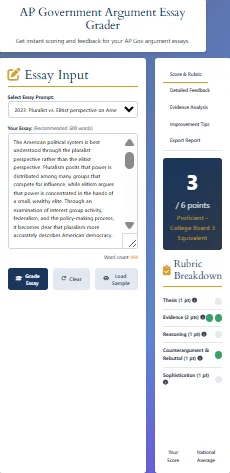
Designed with the user in mind, the interface boasts a clean, responsive design that works flawlessly on desktops, tablets, and mobile phones. The tabbed interface neatly organizes different feedback sections—such as scores, strengths, weaknesses, and improvements—preventing overwhelm. A dynamic visual rubric breakdown uses color-coded indicators to show your performance in each category at a glance. Furthermore, a live word counter with color coding helps you manage length requirements, while the sample essay loading feature lets you analyze high-scoring examples to understand excellence in practice.
3. Comprehensive Feedback & Reporting System
Beyond a simple score, the tool generates a detailed feedback system. It produces a balanced strengths and weaknesses analysis, celebrating what you did well while clearly identifying areas needing work. Crucially, it offers specific improvement suggestions, such as “Strengthen your link between U.S. v. Lopez and your thesis about federalism.” It also provides targeted evidence recommendations, suggesting alternative or additional cases you could have used. Finally, it outlines a personalized next steps roadmap, giving you a clear study path forward.
4. AP-Specific Curriculum Alignment
This tool is uniquely valuable because it is built specifically for AP Gov. It contains a built-in database of all 15 required SCOTUS cases and recognizes all 9 foundational documents. Your score is presented alongside national averages for context, and the entire grading logic is meticulously aligned with the College Board rubric. This specialization ensures the feedback is relevant and authoritative, unlike generic writing aids.
5. Robust Export & Sharing Capabilities
Once you’ve received your feedback, the tool’s export functionality lets you save and share your results. You can download a formatted text file report, generate a professional PDF report using integrated technology, or use the print-friendly view for physical study copies. The Web Share API option allows easy sharing with teachers or study groups, making collaboration simple.

Advanced Features for Power Users
For students seeking to maximize their preparation, the tool offers several advanced features. The expanded prompt database includes over 20 authentic, historical AP Government prompts from 2004 to 2023, covering every major topic like civil liberties, interactions among branches, and political participation. This allows for limitless, realistic practice. Additionally, the system provides a professional report format complete with timestamps and actionable recommendations, turning each practice session into a documented step in your progress. For those integrating multiple study tools, the consistent, responsive design across our platform—from this grader to our APUSH SAQ grader and AP World History DBQ grader creates a seamless study ecosystem.
How to Use the AP Gov Essay Grader: A Step-by-Step Guide
Using the tool effectively is straightforward; follow these steps for optimal results.
Step 1: Access the Tool
Firstly, navigate to the AP Government essay grader page on our website. The tool loads instantly with no login required, ensuring immediate access.
Step 2: Select or Input Your Essay Prompt
Secondly, either choose a prompt from the extensive database of AP Gov prompts or paste your own custom prompt into the designated field. Selecting an authentic past prompt is recommended for the most realistic practice.
Step 3: Compose or Paste Your Essay
Thirdly, in the large text editor provided, type or paste your completed argument essay. Utilize the live word counter to ensure you meet the recommended length. For guidance, you can load a sample essay to see structure and content expectations.
Step 4: Initiate the Grading Analysis
Next, click the “Grade My Essay” button. The client-side processing engine will analyze your text within seconds, eliminating any wait for server responses.
Step 5: Review Your Score and Feedback
Afterward, examine your overall score and the visual rubric breakdown. Navigate through the tabs to see detailed feedback on your thesis, evidence, reasoning, and sophistication.
Step 6: Implement Suggestions and Export
Finally, read the specific improvement suggestions and evidence recommendations. Use this feedback to revise your essay. Then, export your report as a PDF or text file to share with your teacher or add to your study portfolio. For continued practice, consider using our DBQ thesis generator to hone your claim-writing skills across history subjects.
Understanding the AP Government Argument Essay Rubric
Before examining the tool’s capabilities, one must first understand the framework it assesses. According to the College Board rubric, the argument essay evaluates four core competencies: argumentation, use of evidence, reasoning, and sophistication. Subsequently, each point hinges on specific, demonstrable skills. For instance, a defensible thesis must establish a clear line of reasoning, while high-quality evidence must reference required SCOTUS cases and foundational documents. Furthermore, the reasoning must explain convincingly how evidence supports the thesis, and sophistication requires nuanced analysis, such as discussing broader implications or counterarguments. Traditionally, students waited days or weeks for teacher feedback; however, our AP Gov essay scoring tool delivers this analysis instantaneously, effectively compressing the feedback loop from weeks to seconds. Therefore, by internalizing the rubric’s demands through immediate, detailed evaluation, students can practice more efficiently and target their weaknesses with precision.
What Is the AP Government Argument Essay Grader? A Detailed Overview
Our AP Government argument essay grader is a sophisticated, web-based application built to simulate official scoring protocols. Fundamentally, it functions as an intelligent writing coach, analyzing your essay’s structure, content, and persuasiveness against the exact criteria used by AP readers. Notably, unlike generic grammar checkers, this tool specializes in the unique demands of the AP Gov curriculum, recognizing and evaluating references to specific required cases like McCulloch v. Maryland and documents like the Federalist Papers. Additionally, the tool provides a detailed rubric breakdown, assigning scores for each row and offering specific, actionable suggestions for improvement. Importantly, all processing occurs securely in your browser, ensuring your essays remain private while enabling instant scoring without server delays. Consequently, this tool serves as an indispensable companion for dedicated study, allowing for iterative practice that is both efficient and highly targeted.
Educational Disclaimer
This tool is intended for educational practice and self-assessment purposes only. Scores and feedback generated by this AP Government Essay Grader are estimates based on general rubric patterns and writing analysis methods. Official AP exam essays are scored by trained evaluators using official College Board scoring guidelines.
Students should use this tool alongside teacher feedback, classroom instruction, and official AP study resources.
Why Students Use AP Government Essay Graders
Many students use essay grading tools to improve:
- Thesis development
- Constitutional analysis
- Evidence usage
- Political reasoning
- Essay organization
- Time management during FRQs
Regular writing practice and feedback can help students become more confident before the AP U.S. Government and Politics exam.
Common AP Government Essay Mistakes
Students often lose points because of:
- Weak thesis statements
- Lack of constitutional evidence
- Missing Supreme Court case references
- Poor explanation of evidence
- Off-topic arguments
- Limited political analysis
- Weak paragraph organization
Reviewing essay feedback carefully can help students identify and correct these problems before test day.
Recommended Study Resources
Students preparing for AP Government essays should also review:
- Official AP Government scoring guidelines
- Sample FRQ responses
- Supreme Court case summaries
- Foundational documents
- Constitutional amendments
- Federalism and civil liberties concepts
Combining essay practice with content review usually produces stronger AP exam performance.
Frequently Asked Questions (FAQs)
While no algorithm can perfectly replicate human judgment, our tool is meticulously programmed against the official College Board rubric. It provides highly consistent and objective feedback on rubric-based criteria like thesis clarity and evidence usage.
This specific tool is optimized for the AP Government argument essay. However, our platform offers specialized graders for other subjects, including the APUSH DBQ grader, the AP World History DBQ grader, and a standalone LEQ grader. Each is tailored to the unique rubrics of those tasks.
The tool is pre-loaded with all 15 required Supreme Court cases (e.g., Brown v. Board of Education, Citizens United v. FEC) and all 9 foundational documents (e.g., the Declaration of Independence, Federalist No. 10) as outlined by the College Board. For a complete list, visit the official AP U.S. Government and Politics Course and Exam Description.
The sophistication point is often the most challenging. The tool will suggest strategies such as discussing broader implications, effectively addressing counterarguments, or crafting a more nuanced thesis. Studying sample essays and practicing with our DBQ complexity analyzer can also help develop this skill.
This grader is designed to be one component of a robust study plan. Use it for timed practice sessions, then review your weaknesses analysis to guide further reading. Complement it with our bill to law simulator to understand legislative processes or our citation generators for research-based projects.
Conclusion: Elevate Your AP Gov Prep with Intelligent Feedback
In summary, mastering the AP Government argument essay requires understanding a specific rubric, applying precise knowledge, and practicing relentlessly. Our free AP Government essay grader is engineered to accelerate this entire process by delivering instant, rubric-aligned scoring and actionable feedback the moment you finish writing. By integrating this tool into your regular study routine—alongside related resources like the APUSH evidence organizer and productivity focus hub you create a powerful, personalized preparation ecosystem. Ultimately, consistent practice with detailed feedback is the proven path to improvement. Therefore, we invite you to use this tool not just as a grader, but as your dedicated digital tutor, helping you build confidence, competence, and the critical skills needed to excel on exam day and beyond.
Ready to tackle other academic challenges? Explore our suite of free tools:
- Prepare for your history exams with our AP European History DBQ grader.
- Organize your research with our bibliography organizer citation tool.
- Boost your vocabulary for standardized tests with our SAT vocabulary practice tool.
- Manage your study time effectively with our suite of time management tools.
About the Author
Written by Saad Ahmed
Educational Tools Publisher & Academic Resource Creator
Saad Ahmed develops online educational tools that help students improve academic writing, exam preparation, and research skills. His work focuses on creating simple and accessible learning resources for AP students, teachers, and self-learners.
This AP Government Essay Grader is regularly updated to reflect modern educational standards, rubric-based scoring methods, and AP-style writing expectations.
Last Updated: May 2026