DBQ Complexity Point

The DBQ Complexity Point: A Complete Guide to Earning It Every Time

DBQ Grader

Get detailed feedback and scoring for your DBQ essays.

Pomodoro Timer with Task List

Stay focused with timed study sessions and task management.

25:00

Task List

Evidence Organizer

Structure and categorize evidence for your DBQ essays.

SAQ Grader

Evaluate your Short Answer Questions with detailed feedback.

LEQ Grader

Get scoring and feedback for your Long Essay Questions.

Rubric Mastery Tool

Understand and master the APUSH scoring rubrics.

DBQ Thesis Generator

Create strong, argument-driven thesis statements.

The Document-Based Question is the most demanding task on any AP History exam, and within it, one single point causes more confusion than all the others combined: the complexity point. Students can write a well-sourced, well-argued essay and still watch that seventh point slip away because a reader never sees genuine complexity in the analysis. This DBQ complexity analyzer guide breaks down exactly what the complexity point is, why it’s structured the way it is, how it fits into the wider DBQ rubric, and what a student needs to actually do — not just know — to earn it consistently, whether the exam is APUSH, AP World History, or AP European History.

What the DBQ Actually Tests

Before complexity makes sense, it helps to understand what the Document-Based Question is designed to measure. Unlike a Short Answer Question, which checks for accurate recall, the DBQ evaluates historical thinking as a skill set. Students receive seven documents on a given prompt and must construct an evidence-based argument that draws on those sources, incorporates outside historical knowledge, and demonstrates reasoning about how historical developments connect, cause one another, or change over time.

The College Board’s official AP History rubric scores the DBQ out of seven points, distributed across four categories:

  • Thesis / Claim (1 point): A defensible, historically grounded argument that responds directly to the prompt. A thesis statement generator and grader or a dedicated DBQ thesis generator can help confirm a claim is arguable before writing begins.
  • Contextualization (1 point): Situating the prompt’s topic within a broader historical situation, event, or process. Tools like an APUSH contextualization builder are built specifically to practice this skill in isolation.
  • Evidence (up to 3 points): Using document content accurately and supporting the argument with relevant outside information. An APUSH evidence organizer or a document analysis helper can make this sorting process far more systematic.
  • Analysis and Reasoning (up to 2 points): This category includes sourcing (explaining a document’s point of view, purpose, situation, or audience) and, crucially, the complexity point.

Complexity sits at the top of this hierarchy because it doesn’t reward more writing — it rewards better thinking. A student can hit every other box and still fall short here if the essay never rises above description into genuine interpretation. For a full breakdown of how every point is weighted, the APUSH DBQ rubric calculator and the AP DBQ scoring sheet both map each rubric line to a point value.

What Is the Complexity Point, Exactly?

The complexity point is awarded when an essay demonstrates a “complex understanding” of the historical development in the prompt, sustained throughout the argument rather than confined to a single sentence. The College Board’s AP scoring guidelines are explicit that this cannot be achieved through a formulaic phrase inserted for effect; it must emerge organically from the way the essay is reasoned.

In practice, an essay can earn complexity through several recognized pathways:

  • Explaining both continuity and change, rather than treating a historical development as purely one or the other.
  • Analyzing multiple variables — political, economic, social, cultural, or intellectual — and showing how they interact rather than listing them side by side.
  • Explaining corroboration or contradiction among the documents, showing how different sources support, complicate, or challenge one another.
  • Explaining relevant and insightful connections within and across periods, linking the prompt’s topic to broader patterns in world or national history.
  • Confirming the validity of an argument by using diverse and sometimes contradictory evidence.

The unifying thread is that complexity is a quality of reasoning, not a checklist item. It’s the difference between an essay that says “industrialization changed the economy” and one that explains how industrialization simultaneously accelerated urban growth while entrenching existing labor hierarchies, and why that tension matters to the broader historical narrative.

Why This Point Is So Hard to Self-Assess without DBQ complexity analyzer

Most students struggle with complexity not because they lack historical knowledge, but because complexity is inherently about the relationship between ideas, and it’s difficult to see the gaps in your own reasoning from the inside. A writer often knows what they meant to argue, so a sentence that reads as sophisticated to its author may read as a simple assertion to an outside reader — including an AP exam grader.

This is precisely the gap that feedback tools, teacher conferences, and rubric-based self-review are designed to close. Immediate, rubric-aligned feedback shortens the loop between writing and understanding, which is why AI-driven essay analysis has become a popular supplement to traditional classroom review: it gives students a way to test their reasoning against rubric standards before the exam, not after. Broader feedback tools such as the APUSH DBQ grader and feedback tool or the APUSH rubric mastery tool apply this same principle across the entire essay, not just the complexity category.

Screenshot of DBQ Complexity Analyzer showing essay feedback and complexity scoring

How an AI-Driven DBQ complexity analyzer Works

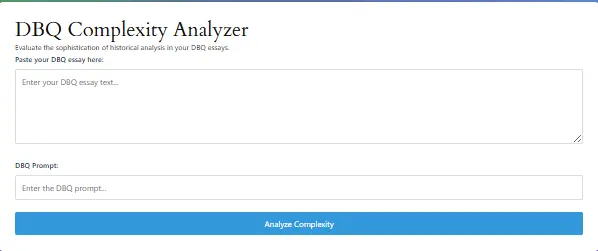
Tools built for this purpose — such as the DBQ Complexity Analyzer — function as an on-demand reader that evaluates a submitted essay against the specific language of the AP rubric. Rather than scanning for keywords, a well-built analyzer looks at the structure of the argument itself:

  1. Thesis evaluation — checking whether the claim is defensible, specific, and establishes a clear line of reasoning that the rest of the essay can build on.
  2. Evidence integration analysis — assessing whether documents and outside information are used to support an argument rather than simply cited or summarized.
  3. Sourcing detection — identifying language that addresses a document’s point of view, purpose, audience, or historical situation.
  4. Contextualization check — confirming that the essay connects the prompt to a broader historical process before diving into the argument.
  5. Reasoning sophistication scoring — the core complexity assessment, looking for causation, comparison, continuity-and-change analysis, and cross-document synthesis sustained across the essay.

Because the underlying rubric differs slightly between APUSH, AP World History, and AP European History (each course emphasizes historical thinking skills a little differently), an effective analyzer adjusts its evaluation criteria depending on which exam a student selects, rather than applying a single generic standard. This is why exam-specific tools exist side by side — an AP World History DBQ grader and an AP European History DBQ grader apply the same complexity logic but calibrate it to each course’s own historical reasoning skills and official course framework.

The output is typically a numeric score (often out of 7, mirroring the full DBQ rubric) along with categorical feedback and, in more advanced tools, line-by-line annotations that point to the exact sentence where an argument could be pushed further.

Common Reasons Students Lose the Complexity Point

Recognizing these patterns is often more useful than reading abstract rubric language, because they describe what actually shows up in student essays:

  • The thesis restates the prompt instead of making an arguable claim, leaving nothing complex to build toward.
  • Documents are summarized rather than analyzed — the essay says what a document contains but never explains what that content means for the argument.
  • Contextualization is a single generic sentence disconnected from the rest of the essay, rather than a thread that informs the analysis.
  • The essay picks one side of a debate without acknowledging tension, contradiction, or nuance, even when the prompt invites it.
  • Change is described but continuity is ignored, or vice versa, when the historical reality involves both.
  • Outside evidence is dropped in without connection to the surrounding argument, functioning as a fact rather than support for reasoning.

Best Practices for Building Complexity Into an Essay

Complexity is easier to build in from the outline stage than to retrofit into a finished draft. A few practical habits make a measurable difference:

Write a thesis with built-in tension. Instead of a single-clause claim, structure a thesis around two or three lines of reasoning that interact — for example, acknowledging a driving cause and a limiting factor. This gives the rest of the essay somewhere to go.

Group evidence by argument, not by document. Organizing body paragraphs around ideas (economic pressure, social resistance, political response) rather than “Document 1, Document 2, Document 3” naturally pushes toward synthesis instead of summary.

Use explicit connective language. Phrases that link one idea to another — “this reinforced,” “in contrast,” “this shift, however, coexisted with” — signal reasoning to a reader far more effectively than sophisticated vocabulary alone.

Bring in outside context deliberately. A well-placed reference to a broader trend (a prior war, a preceding economic policy, a parallel development elsewhere) demonstrates the cross-period thinking the rubric specifically rewards.

Revisit the thesis in the conclusion with development, not repetition. A conclusion that shows how the argument evolved through the essay — rather than restating the opening line — reinforces the sustained reasoning graders are trained to look for.

Where the Complexity Point Fits Into Broader Exam Strategy

It’s worth remembering that the complexity point is only one point out of seven on the DBQ, and the DBQ itself is one section of a multi-part exam that also includes the Long Essay Question and Short Answer Questions. Students preparing seriously typically work across several skill areas in parallel: thesis construction, evidence organization, sourcing practice, and time management during the exam itself. Tools that isolate a single skill — like a complexity analyzer — are most effective when paired with broader practice, such as full-essay grading against all rubric categories, contextualization drafting practice, and rubric review sessions that clarify exactly how points are awarded.

This is also why complexity should be practiced in isolation before it’s expected to appear automatically in a timed essay. Writing several short paragraphs that focus purely on synthesizing two documents, or purely on connecting an event to a broader process, builds the reasoning habit without the added pressure of full-essay construction. Since the same reasoning skill also drives the Long Essay Question, practicing with an LEQ grader or an LEQ comparison tool reinforces complexity in a lower-stakes, shorter-format essay before applying it to the full DBQ. A DBQ/LEQ outline generator can also help structure both essay types around argument-driven paragraphs rather than document-by-document summary.

Beyond essay-specific practice, students often round out review with an APUSH study guide, an APUSH timeline generator for keeping chronology straight, an APUSH flashcard and quiz tool for content recall, and an APUSH SAQ grader to make sure short-answer skills stay sharp alongside long-form writing. For a final readiness check, an APUSH score calculator or the broader AP US History score calculator can translate practice essay performance into a projected exam score.

Frequently Asked Questions (FAQs) About the DBQ Complexity Analyzer

1. Is the complexity point the hardest point to earn on the DBQ?

Most AP readers and teachers would agree it is. It requires sustained, higher-order reasoning across an entire essay rather than a single correct statement, which makes it structurally more difficult than points like contextualization or basic evidence use.

2. Can an essay earn the complexity point without earning full evidence points?

Yes. Complexity is scored independently. An essay with slightly thinner evidence can still demonstrate excellent reasoning about the relationships between the evidence it does use, and vice versa — strong evidence use doesn’t automatically guarantee complexity.

3. What’s the difference between this and the full DBQ Grader?

The DBQ Complexity Analyzer focuses intensely on the single complexity point and the skills required to earn it. Conversely, the full APUSH DBQ Grader provides a comprehensive score and feedback on all rubric categories.

4. Does complexity require using outside historical knowledge?

Not strictly, but it often helps. Explaining how a document-based argument connects to broader historical patterns is one of the recognized pathways to the point, and outside knowledge is frequently the vehicle for that connection.

5. The tool says my thesis is too simplistic. How can I improve it?

A complex thesis often acknowledges multiple perspectives, explores cause-and-effect relationships, or discusses both change and continuity. Our DBQ Thesis Generator is an excellent resource for seeing examples of sophisticated claims and building your own.

6. Can the tool help me with sourcing the documents?

Yes, to an extent. It can identify where you have attempted to source a document (e.g., “The purpose of this cartoon was…”) and assess the quality of that analysis. For more practice, the Document Analysis Helper is a great complementary tool.

7. I’m not getting the complexity point. What should I do next?

First, carefully review the feedback from the analyzer. Then, practice writing essays focusing on just one element of complexity at a time. Additionally, using the APUSH Rubric Mastery Tool can deepen your understanding of what AP readers are looking for.

8. Are there any similar tools for other parts of the AP exam?

Yes. We offer a full suite of tools, including an SAQ Grader for Short Answer Questions and an LEQ Grader for the Long Essay Question.

Key Takeaways

The complexity point rewards historical reasoning that goes beyond description — reasoning that connects causes and effects, acknowledges continuity alongside change, synthesizes documents rather than summarizing them, and situates an argument within a larger historical narrative. It cannot be manufactured with a single inserted sentence; it has to run through the structure of the entire essay, starting with a thesis built for tension and carried through evidence that’s organized around ideas rather than individual sources.

Because complexity is difficult to self-diagnose, rubric-aligned feedback — whether from a teacher, a study group, or an AI-driven analysis tool — plays a genuinely useful role in closing the gap between what a student intends to argue and what actually reads as complex to a grader. Used alongside deliberate practice on thesis construction, evidence organization, and contextualization, that kind of feedback turns the complexity point from the DBQ’s most elusive score into one of its most consistently earnable.

For direct practice, the DBQ Complexity Analyzer checks a submitted essay against this exact rubric logic, while a free thesis checker and a thesis outline generator help build the argumentative foundation complexity depends on. Students working from the official AP course description will find that every pathway to the complexity point described above maps directly back to the historical reasoning skills the College Board lists as course objectives — which is exactly why this point rewards genuine understanding rather than a memorized formula.

About the Author: This guide was crafted by a team of former AP History students and educational technology enthusiasts. Our content undergoes regular review against the latest College Board standards and rubrics to ensure maximum accuracy and pedagogical soundness. We believe in creating tools that not only assist but also educate, empowering students to become more confident and capable historians.

For further reading on historical thinking skills, we recommend these authoritative resources: