AP World History DBQ Grader
Score your Document-Based Question essay against the College Board’s 7-point rubric — thesis, contextualization, evidence, and analysis.
Evaluate your Document-Based Question essays with detailed feedback
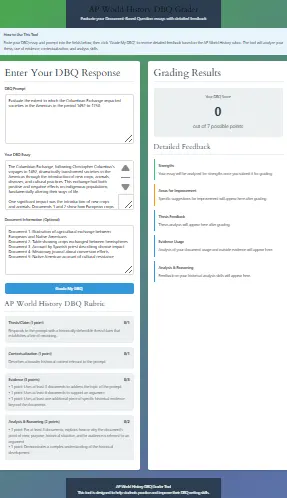
Enter Your DBQ Response
AP World History DBQ Rubric
Responds to the prompt with a historically defensible thesis/claim that establishes a line of reasoning.
Describes a broader historical context relevant to the prompt.
• 1 point: Uses at least 3 documents to address the topic of the prompt
• 1 point: Uses at least 6 documents to support an argument
• 1 point: Uses at least one additional piece of specific historical evidence beyond the documents
• 1 point: For at least 3 documents, explains how or why the document’s point of view, purpose, historical situation, and/or audience is relevant to an argument
• 1 point: Demonstrates a complex understanding of the historical development
Grading Results
Detailed Feedback
What the DBQ Rubric Actually Scores
The AP World History DBQ is worth 7 points, split across four skills:
- Thesis/Claim (1 pt) — a historically defensible argument that answers the prompt, not just restates it
- Contextualization (1 pt) — situating your argument in a broader historical process (what came before, what caused it)
- Evidence (3 pts) — using 3+ documents to address the topic, 6+ documents to build your argument, and at least one piece of outside evidence
- Analysis & Reasoning (2 pts) — explaining a document’s point of view, purpose, audience, or historical situation (HIPP), plus showing complexity — nuance, counterargument, or change over time
A Weak vs. Strong Thesis, Side by Side
Prompt: Evaluate the extent to which the Columbian Exchange impacted societies in the Americas, 1492–1750.
Weak (restates the prompt):
“The Columbian Exchange had many impacts on societies in the Americas between 1492 and 1750.”
Strong (makes an arguable claim with reasoning):
“While the Columbian Exchange introduced new crops that reshaped diets and agriculture across the Americas, its most transformative impact was demographic: the diseases Europeans carried devastated Indigenous populations far more than any crop or animal reshaped daily life.”
The difference isn’t length — it’s that the second version takes a position a reader could disagree with, and previews why.
Frequently Asked Questions About the AP World History DBQ Grader
The AP World History DBQ Grader demonstrates remarkable accuracy when benchmarked against experienced AP teachers’ evaluations. Specifically, its algorithm analyzes key phrases, structural elements, and rubric requirements that human graders prioritize. Consequently, students can trust that the feedback aligns closely with official scoring standards while recognizing that final exam grading involves some subjective elements.
Yes, the AP World History DBQ Grader features full responsive design that works seamlessly across all devices. Specifically, the interface adapts to smartphones, tablets, and desktop computers without sacrificing functionality. Therefore, you can practice and receive feedback whenever inspiration strikes, regardless of your location or available technology.
No. It’s a practice tool to catch obvious gaps before you write under real exam conditions — not a substitute for feedback from your teacher.
At least 3 to earn the base evidence point, and 6 (out of the typical 7 provided) to earn the second evidence point.
A few sentences connecting your prompt’s time period to a larger trend — for example, tying the Columbian Exchange to the broader age of European maritime expansion.
Editorial and Tool Information
This page provides practical guidance for scoring AP World History Document-Based Question essays against the official College Board rubric.
The tool was developed around a simple workflow: paste → grade → review feedback → revise.
The page and tool information are reviewed periodically to improve clarity and reflect changes to the tool. When discussing AP exam requirements or scoring criteria, students should use current official College Board materials as the authoritative source.
Last reviewed: September 2026
Keep Practicing Your DBQ Skills
Use the grader to identify gaps in your thesis, evidence usage, and analysis before exam day. For best results, revise your essay based on the feedback and grade it again.
When you’re ready to continue, try the DBQ Thesis Generator, Rubric Mastery Tool, LEQ Grader, or explore the AP History Study Tools hub for more resources.