🎯 APUSH Rubric Mastery Tool
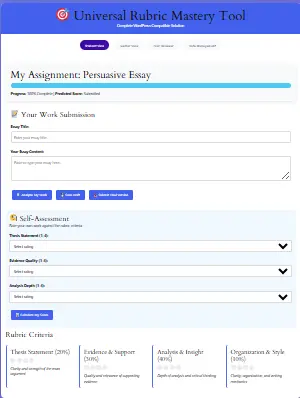
Stop guessing where your DBQ and LEQ points go. Build or load a rubric, score your own writing criterion by criterion, and get instant feedback — the same way an AP reader would.
My Assignment: Persuasive Essay
Progress: 0% Complete | Predicted Score: Not calculated
📝 Your Work Submission
🧐 Self-Assessment
Rate your own work against the rubric criteria:
Rubric Criteria
Class Management Dashboard
0
Students
0
Submitted
0
Pending
0%
Average
📋 Rubric Builder
👀 Rubric Preview
No rubric created yet. Add criteria to see preview.
📝 Create Assignment
📂 Current Assignments
📄 Student Submissions
No submissions yet.
🎯 Grade Submissions
Select a submission from the Submissions tab to begin grading.
Peer Review Assignment
No assignment selected
📄 Available Works for Review
No submissions available for review.
🔧 Data Management
This tool stores all data in your browser’s local storage. Use these tools to manage your data.
📊 Storage Statistics
🔍 Data Browser
Losing a single point on the AP US History exam’s Document-Based Question (DBQ) or Long Essay Question (LEQ) can be the difference between a 4 and a 5. Yet most students never really study the official College Board rubric until after they’ve already written dozens of practice essays the wrong way. That’s the real problem: you can memorize every event from 1491 to the present and still walk out with a mediocre score — simply because you never learned how graders actually assign each point.
The APUSH Rubric Mastery Tool below is built to close that gap. Instead of reading a static PDF of scoring guidelines, you build or load a rubric, score your own writing against it, and get instant, criterion-by-criterion feedback — the same way an AP reader would.
What Is the APUSH DBQ/LEQ Rubric, Exactly?
The DBQ is graded on a 7-point scale across five categories: Thesis (1 pt), Contextualization (1 pt), Evidence (up to 4 pts, split between documents and outside knowledge), Analysis and Reasoning/Sourcing (2 pts), and Complex Understanding (1 pt). The LEQ follows a similar structure but drops the document-based evidence requirement in favor of outside knowledge alone — a distinction that trips up a lot of students the first few times they practice.
Reading that list once isn’t enough, though. You have to internalize what “sourcing” actually looks like in your own paragraph versus a classmate’s — and that only happens through repeated, structured self-assessment.
The Problem With Most Rubric Guides
Most rubric explainers online are static: a table, a PDF, maybe a video breakdown. They tell you what the criteria are, but not how close your specific essay comes to meeting them. That’s the real gap between reading about a rubric and actually applying it to your own writing.
How This Tool Solves It
The Rubric Mastery Tool gives you four connected workspaces:
Because the tool is rubric-driven rather than hard-coded to one exam, you can load the official APUSH criteria as-is or adjust the weighting if your teacher’s version differs — something a static PDF simply can’t do.
Step-by-Step: Getting an Honest Score
- Write under real conditions. Time yourself the way you would on exam day — 60 minutes for the DBQ, 40 for the LEQ.
- Load the APUSH rubric in the tool and paste in your essay.
- Score yourself criterion by criterion, not holistically. Did I state a defensible thesis? Did I use at least two documents for sourcing?
- Compare your self-score to a peer’s or teacher’s score on the same rubric — the gap tells you exactly where your self-perception is off.
- Revise one weak criterion at a time, then rescore. Chasing one point at a time beats rewriting the whole essay from scratch.
Frequently Asked Questions (FAQs)
Seven: Thesis (1), Contextualization (1), Evidence (up to 4), Analysis and Reasoning (2), and Complex Understanding (1).
The primary difference is the use of documents. While the DBQ provides you with 7 documents to use as evidence, the LEQ requires you to rely entirely on your own outside knowledge.
Mostly — it shares the Thesis, Contextualization, and Complex Understanding categories, but evidence comes entirely from outside knowledge instead of provided documents.
Yes. The Teacher view lets you build a rubric from scratch with custom criteria and weights, so it works for any grading scheme, not just the College Board version.
Yes — deliberate, criterion-level self-assessment is one of the better-supported study techniques for rubric-based writing exams, because it forces you to spot gaps before a grader does.
Yes, definitively. The tool is meticulously designed to reflect the current APUSH Course and Exam Description published by the College Board.
Editorial and Tool Information
This page provides a self-scoring rubric mastery tool aligned with the official AP U.S. History DBQ and LEQ rubrics.
The tool was developed around a simple workflow: build or load rubric → score each criterion → compare with peers → revise weak areas → rescore.
The page and tool information are reviewed periodically to improve clarity and reflect changes to the tool. When discussing AP exam requirements or scoring criteria, students should use current official College Board materials as the authoritative source.
Last reviewed: September 2026
Keep Practicing Your DBQ and LEQ Skills
Use the Rubric Mastery Tool to internalize every criterion, then pair it with the DBQ Grader or LEQ Grader for sentence-by-sentence feedback on full essays.
When you’re ready, try the DBQ Grader, LEQ Grader, or explore the AP History Study Tools hub for more resources.