Balance any chemical equation instantly. Our database contains thousands of equations for quick balancing. Enter your equation or choose from examples below.
Enter Chemical Equation
Example Equations
Balanced Result
Balancing equation…
Introduction: The Art and Science of Chemical Equation Balancing
Balancing chemical equations represents a fundamental skill in chemistry that transforms abstract chemical reactions into precise mathematical representations. Indeed, every chemistry student encounters this crucial process when learning about chemical reactions, stoichiometry, and conservation of mass. Consequently, mastering equation balancing opens doors to understanding complex chemical processes, predicting reaction products, and calculating quantitative relationships in chemical systems. Fortunately, with modern technology, balancing chemical equations has evolved from a tedious manual task into an efficient, educational process supported by sophisticated digital tools.
First and foremost, chemical equations serve as the language of chemistry, communicating intricate information about reactants, products, and reaction conditions. Therefore, learning to balance these equations properly ensures accurate interpretation of chemical processes in laboratories, industrial settings, and educational environments. Moreover, properly balanced chemical equations provide the foundation for stoichiometry calculations, yield predictions, and limiting reagent determinations—essential skills for chemists, engineers, and students alike.
Traditionally, balancing chemical equations involved manual trial-and-error methods that could be time-consuming and frustrating for learners. However, today’s digital solutions combine computational power with educational insights, offering instant balancing with detailed step-by-step explanations. Accordingly, our comprehensive chemical equation balancer bridges the gap between manual calculation and digital assistance, providing both instant results and educational value through multiple solving methodologies.
The Critical Importance of Properly Balanced Chemical Equations
Understanding why balancing chemical equations matters reveals fundamental principles governing all chemical reactions. Essentially, the law of conservation of mass dictates that atoms cannot be created or destroyed during ordinary chemical reactions. Consequently, every atom present in the reactants must appear in the products, though rearranged into different molecular configurations. Thus, balanced chemical equations mathematically express this conservation principle through equal numbers of each atom type on both sides of the reaction arrow.
Furthermore, properly balanced chemical equations serve multiple crucial functions beyond simple atom counting. Specifically, they enable accurate stoichiometric calculations determining exact quantitative relationships between reactants and products. Additionally, these balanced equations provide insights into reaction mechanisms, energy changes, and equilibrium conditions. Moreover, in industrial applications, correctly balanced chemical equations ensure efficient resource utilization, waste minimization, and production optimization in chemical manufacturing processes.
Educational contexts particularly benefit from proper equation balancing. For instance, students developing chemical intuition must recognize that balancing chemical equations represents more than mechanical manipulation—it embodies fundamental chemical principles. Accordingly, our chemical equation balancer emphasizes both computational accuracy and conceptual understanding, helping learners connect mathematical balancing with chemical reality. Simultaneously, the tool supports multiple solving methods, allowing users to approach problems from different perspectives depending on reaction complexity and personal preference.
Core Methods for Balancing Chemical Equations: From Simple to Complex
The Inspection Method: Foundation of Chemical Equation Balancing
Commonly called the trial-and-error method, the inspection method for balancing chemical equations represents the most intuitive approach for simple reactions. Typically, beginners start with this technique because it builds fundamental understanding of atomic conservation. Essentially, this method involves systematically adjusting coefficients while visually inspecting atom counts on both sides of the equation. Consequently, users develop chemical intuition about common coefficient patterns and typical reaction stoichiometries.
Primarily, the inspection method works excellently for straightforward reactions like synthesis, decomposition, and single replacement reactions. For example, balancing the combustion of methane (CH₄ + O₂ → CO₂ + H₂O) using inspection begins by balancing carbon atoms, then hydrogen atoms, and finally oxygen atoms. However, complex reactions with multiple elements often prove challenging for pure inspection methods, necessitating more systematic approaches.
Our chemical equation balancer implements this traditional method digitally, providing step-by-step guidance through the inspection process. Specifically, the tool highlights which elements remain unbalanced at each step, suggests coefficient adjustments, and explains the reasoning behind each modification. Therefore, learners can follow along with the balancing process rather than simply receiving a final answer, transforming the tool from a simple calculator into an interactive teaching assistant.
The Algebraic Method: Systematic Equation Balancing
When balancing chemical equations becomes complex, the algebraic method offers a rigorous, systematic alternative to trial-and-error approaches. Fundamentally, this technique treats each compound’s coefficient as an unknown variable, establishing equations based on atomic conservation for each element. Subsequently, solving this system of linear equations yields coefficient values that balance the equation mathematically.
Specifically, the algebraic method for balancing chemical equations follows a consistent procedure: assigning variables to coefficients, writing atomic balance equations for each element, solving the equation system, and converting solutions to smallest whole numbers. For instance, consider the reaction aC₂H₆ + bO₂ → cCO₂ + dH₂O, where we establish equations: for carbon (2a = c), hydrogen (6a = 2d), and oxygen (2b = 2c + d). Solving yields a = 2, b = 7, c = 4, d = 6 after eliminating fractions.
Notably, our chemical equation balancer implements this algebraic approach with full transparency, displaying variable assignments, equation formulations, solution steps, and coefficient simplifications. Consequently, users observe how mathematical principles apply to chemical problems, reinforcing connections between algebra and chemistry. Moreover, the tool handles complex equation systems that might overwhelm manual calculation, making advanced balancing accessible to all skill levels.
Specialized Methods for Redox Reactions
Redox (reduction-oxidation) reactions present unique balancing challenges due to electron transfer between species. Fortunately, specialized methods like the oxidation number method and ion-electron method address these complexities systematically. Generally, these approaches track electron movement through oxidation state changes rather than simple atom counting, accommodating reactions where atoms change oxidation states.
The oxidation number method for balancing chemical equations involves determining oxidation states, identifying oxidized and reduced species, balancing electron transfer, and then balancing remaining atoms. Alternatively, the ion-electron method (or half-reaction method) separates overall reactions into oxidation and reduction half-reactions, balances each individually, then combines them with appropriate electron balancing. Both methods excel with complex redox reactions, especially in acidic or basic solutions where hydrogen and hydroxide ions participate.
Our advanced chemical equation balancer incorporates these specialized redox balancing capabilities, automatically detecting redox reactions and applying appropriate methodologies. Furthermore, the tool explains oxidation state assignments, half-reaction identifications, and electron balancing steps, making complex redox balancing understandable rather than mysterious. Therefore, students tackling challenging redox equations gain both correct answers and conceptual clarity through guided problem-solving.
Introducing Our Comprehensive Chemical Equation Balancer Tool
Core Features: Instant Balancing with Educational Depth
Our free chemical equation balancer combines computational power with educational design, offering more than simple coefficient calculation. Primarily, the tool accepts equations in natural notation (using +, →, or = symbols) and instantly returns perfectly balanced equations with proper subscript formatting. Additionally, it identifies reaction types—whether synthesis, decomposition, combustion, single replacement, double replacement, or redox—providing chemical context alongside mathematical solutions.
Equally important, the tool delivers step-by-step balancing solutions using multiple methodologies. Users can view detailed inspection method walkthroughs showing each coefficient adjustment and its rationale. Alternatively, algebraic method solutions display variable assignments, equation systems, and solution processes. For redox reactions, specialized oxidation number or ion-electron method explanations guide users through electron tracking and half-reaction balancing.
Furthermore, our chemical equation balancer incorporates advanced formatting capabilities, automatically converting input like “H2O” to properly formatted “H₂O” with subscripts for enhanced readability. The tool also handles various input formats, accommodating both arrow (→) and equals (=) symbols as reaction separators. Importantly, it validates input syntax, catching common errors like incorrect element capitalization or invalid chemical formulas before attempting balancing calculations.
Advanced Features: Stoichiometry Calculator and Limiting Reagent Analysis
Beyond simple balancing, our tool functions as a complete stoichiometry calculator, transforming balanced equations into quantitative relationship explorers. Specifically, users can input known quantities (moles, grams, or liters at STP) for any reaction component, automatically calculating corresponding amounts for all other substances. Consequently, this feature supports yield predictions, reagent planning, and theoretical yield calculations essential for laboratory work and industrial applications.
The integrated limiting reagent calculator represents another advanced capability, determining which reactant limits product formation based on input quantities. By analyzing mole ratios from balanced equations and user-provided amounts, the tool identifies limiting reagents, calculates excess reagent amounts, and predicts maximum product yields. Therefore, users optimize reaction planning and resource utilization without manual ratio calculations.
Additionally, our molar mass calculator component automatically computes molecular weights for all compounds in the equation using up-to-date atomic mass data. These values feed into stoichiometric calculations, ensuring accurate mass-mole conversions. The tool also maintains comprehensive compound databases with common names and formulas, recognizing inputs like “water” or “H₂O” equivalently for user convenience.
Specialized Capabilities for Complex Chemical Systems
Our chemical equation balancer handles advanced chemical scenarios beyond basic molecular equations. Specifically, it manages ionic compound balancing, including polyatomic ions that remain intact during reactions. The tool recognizes common ions like sulfate (SO₄²⁻), nitrate (NO₃⁻), and phosphate (PO₄³⁻), preserving their integrity during balancing processes rather than breaking them into constituent elements.
Moreover, the system accommodates ionic equation balancing for reactions in aqueous solution, distinguishing between spectator ions and participating ions. This capability proves invaluable for understanding precipitation, acid-base, and redox reactions in solution chemistry. The tool can generate net ionic equations from complete molecular equations, highlighting essential reaction participants while eliminating spectator ions.
For biochemical applications, our balancer recognizes common biological molecules and functional groups, properly handling complex organic compounds. Whether balancing cellular respiration equations or photosynthesis representations, the tool manages carbon-hydrogen-oxygen systems with nitrogen, phosphorus, and sulfur inclusions as needed. This versatility supports diverse chemical disciplines from general chemistry to specialized biochemistry applications.
How to Use Our Chemical Equation Balancer: Step-by-Step Tutorial
Basic Equation Input and Balancing
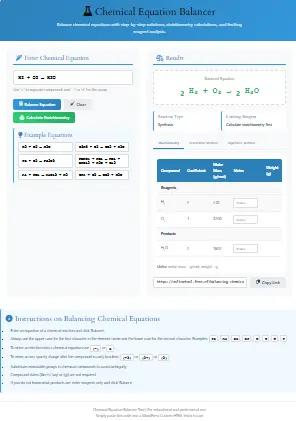
Using our chemical equation balancer begins with simple equation entry in the intuitive input interface. First, type your unbalanced equation using standard chemical notation—element symbols with appropriate capitalization (Na, not NA), numerical subscripts (H₂O), plus signs between compounds, and a reaction arrow (→) or equals sign (=) separating reactants from products. For example, enter “H2 + O2 → H2O” for the formation of water from its elements.
After entering your equation, click the “Balance Equation” button for instant balancing. Immediately, the tool displays the balanced chemical equation with proper subscript formatting and coefficient placement. For our water example, you’ll see “2 H₂ + O₂ → 2 H₂O” with clear coefficient indication. Simultaneously, the interface presents reaction type identification—in this case, “synthesis”—providing chemical context alongside mathematical results.
For educational reinforcement, explore the step-by-step solutions available through tabbed interfaces. Specifically, select the “Inspection Method” tab to view coefficient adjustments explained in logical sequence. Alternatively, choose “Algebraic Method” to see variable assignments and equation systems solved systematically. These detailed explanations transform simple answer-checking into active learning experiences, building balancing proficiency through observation and repetition.
Stoichiometry Calculations and Analysis
Beyond balancing, our tool excels at stoichiometry calculations through an interactive table interface. After obtaining a balanced equation, locate the stoichiometry table showing all compounds with their coefficients, molar masses, and input fields for moles/weight. To calculate quantitative relationships, enter a known value in any input field—for instance, type “5” in the moles column for hydrogen in our water example.
Immediately, the tool performs stoichiometry calculations for all other compounds based on balanced equation ratios. Consequently, you’ll see oxygen moles calculated as 2.5 (following the 2:1 H₂:O₂ ratio) and water moles as 5 (maintaining hydrogen conservation). Additionally, weight columns automatically populate using molar mass conversions, providing both molar and mass perspectives on the reaction quantities.
For limiting reagent determination, enter amounts for multiple reactants to identify which limits product formation. The limiting reagent calculator automatically highlights the limiting substance and calculates percent excess for other reactants. This feature proves invaluable for reaction planning, helping users optimize reagent proportions for maximum efficiency and minimal waste in chemical processes.
Advanced Function Usage and Special Features
Our chemical equation balancer includes specialized features for complex chemical scenarios. For redox reactions, the tool automatically detects electron transfer processes and applies appropriate balancing methodologies. When you enter a redox equation like “Cu + HNO₃ → Cu(NO₃)₂ + NO + H₂O,” the system recognizes oxidation state changes and provides specialized redox balancing with electron accounting.
For ionic equations, use the “Include States” option to add phase labels like (s), (l), (g), or (aq). The tool preserves these labels during balancing and can generate net ionic equations when appropriate. This functionality supports solution chemistry studies where phase identification and ionic participation matter for understanding reaction mechanisms and predicting products.
The example library provides quick access to common chemical equations for practice or demonstration. Simply click any example button to load pre-configured equations ranging from simple synthesis to complex redox processes. These examples serve as starting points for tool exploration or as practice problems for developing balancing proficiency across different reaction types.
Educational Benefits and Learning Applications
Building Conceptual Understanding Through Interactive Tools
Our chemical equation balancer transcends simple answer generation by fostering deep conceptual understanding through interactive engagement. Unlike static textbook examples, our tool allows immediate experimentation with equation variations, coefficient adjustments, and method comparisons. Consequently, users develop chemical intuition through hands-on exploration rather than passive observation, accelerating the learning process significantly.
Specifically, the tool supports scaffolded learning approaches by offering multiple solution methodologies with varying complexity levels. Beginners might start with inspection method demonstrations, following logical coefficient adjustments for simple equations. Intermediate learners can explore algebraic formulations, connecting mathematical systems to chemical principles. Advanced students might focus on redox methodologies, mastering electron transfer concepts through guided problem-solving.
Moreover, the instant feedback mechanism provides formative assessment opportunities without waiting for instructor evaluation. Students can test balancing attempts immediately, receiving corrective guidance through step-by-step solutions when errors occur. This immediate feedback loop reinforces correct approaches while identifying misconception patterns, allowing targeted remediation before incorrect methods become habitual.
Supporting Diverse Learning Styles and Needs
Different learners approach balancing chemical equations through varied cognitive pathways, and our tool accommodates this diversity through multimodal presentation. Visual learners benefit from color-coded element tracking and formatted equation displays. Analytical thinkers appreciate the systematic algebraic approaches with clear variable assignments. Sequential processors follow logical step-by-step progressions, while holistic learners overview complete solution methodologies.
Additionally, the tool supports differentiated instruction by allowing adjustable complexity levels. Novices can focus on basic balancing with simple examples, while advanced users tackle complex redox or organic reactions. Educators can assign appropriate challenge levels based on student proficiency, ensuring appropriate cognitive load for optimal learning without frustration or boredom.
Additionally, the tool supports differentiated instruction by allowing adjustable complexity levels. Novices can focus on basic balancing with simple examples, while advanced users tackle complex redox or organic reactions. Educators can assign appropriate challenge levels based on student proficiency, ensuring appropriate cognitive load for optimal learning without frustration or boredom.
Integration with Curriculum and Assessment
Our chemical equation balancer seamlessly integrates with standard chemistry curricula, supporting topics from introductory stoichiometry to advanced electrochemistry. Educators can incorporate the tool into lesson plans as demonstration aids, practice platforms, or assessment preparation resources. Students can use it for homework verification, exam review, or independent concept exploration beyond classroom instruction.
For assessment preparation, the tool’s example library includes equation types commonly found on standardized tests and final examinations. Practicing with these examples builds familiarity with question formats and balancing approaches expected in evaluative contexts. The step-by-step solutions provide immediate explanation for challenging problems, transforming assessment preparation into active learning rather than passive memorization.
Research indicates that technology-enhanced learning tools significantly improve chemistry comprehension and retention compared to traditional methods alone. By combining computational accuracy with pedagogical design, our balancer represents an evidence-based educational intervention supporting improved learning outcomes. The tool aligns with modern educational standards emphasizing conceptual understanding alongside procedural fluency in chemical problem-solving.
Comparative Analysis: Manual vs. Digital Equation Balancing
Efficiency and Accuracy Considerations
Manual balancing of chemical equations develops foundational skills through hands-on coefficient manipulation, fostering intimate engagement with atomic conservation principles. This traditional approach builds chemical intuition and reinforces mathematical relationships through physical calculation. However, manual methods become increasingly time-consuming with complex equations, potentially frustrating learners and diverting attention from conceptual understanding to mechanical manipulation.
Conversely, digital equation balancing tools offer immediate results for even the most complex reactions, freeing cognitive resources for conceptual analysis rather than arithmetic calculation. Our tool provides this efficiency while maintaining educational value through detailed solution methodologies. Therefore, users benefit from both computational speed and learning depth—a combination particularly valuable in time-constrained learning environments or when tackling extensive problem sets.
Accuracy represents another critical distinction between manual and digital approaches. Manual balancing risks arithmetic errors, especially with equations involving multiple elements, fractional coefficients, or uncommon compounds. These errors can propagate through subsequent stoichiometric calculations, compromising entire problem solutions. Our chemical equation balancer eliminates arithmetic mistakes through computational precision, ensuring mathematically perfect balancing for reliable subsequent calculations.
Educational Value and Skill Development
Critics of digital tools sometimes argue that they circumvent skill development, creating dependency that undermines manual proficiency. However, our chemical equation balancer addresses this concern through pedagogical design emphasizing process transparency over answer isolation. By revealing complete solution methodologies with explanatory commentary, the tool teaches balancing strategies rather than merely providing answers.
Empirical evidence suggests that scaffolded digital tools actually enhance manual skill development when used appropriately. Students observing systematic approaches through digital demonstrations internalize problem-solving patterns more effectively than through textbook examples alone. Subsequently, they apply these patterns to manual problems with improved accuracy and efficiency, demonstrating transfer of learning from digital to traditional contexts.
Furthermore, our tool supports deliberate practice through immediate feedback and varied example sets—key elements of skill mastery according to educational research. Learners can practice extensively without waiting for instructor correction, receiving guidance at the precise moment of need. This accelerated feedback cycle promotes faster skill acquisition than traditional homework-review cycles spanning days between attempt and correction.
Appropriate Integration in Learning Pathways
The most effective chemistry education integrates both manual and digital balancing approaches at appropriate developmental stages. Initially, students benefit from manual balancing practice with simple equations to internalize conservation principles and coefficient relationships. During this foundational phase, our tool can serve as a verification resource, allowing self-checking without revealing solution processes prematurely.
As equation complexity increases, transitioning to digital-assisted balancing preserves learning momentum while introducing advanced methodologies. Students can tackle more challenging reactions with tool support, observing systematic approaches for problems that might overwhelm manual attempts. This maintains engagement and confidence while expanding balancing repertoire beyond simple synthesis and decomposition reactions.
For advanced applications involving complex stoichiometry, limiting reagent analysis, or redox processes, our comprehensive chemical equation balancer becomes an essential tool for efficient problem-solving. Professionals and advanced students benefit from computational accuracy for practical applications where manual errors carry significant consequences. The tool thus supports users across the expertise spectrum from novice learners to practicing professionals.
Frequently Asked Questions
Our chemical equation balancer achieves 100% mathematical accuracy through computational algorithms that cannot make arithmetic errors. Unlike manual balancing prone to calculation mistakes, especially with complex equations involving multiple elements and fractional coefficients, our tool performs perfect atom counting and coefficient determination every time. However, accuracy depends on correct input formatting—users must provide valid chemical formulas with proper element capitalization for the tool to interpret equations correctly.
Currently, our tool focuses on chemical equations. Nuclear equations follow different conservation laws.
Definitely. While providing instant digital balancing, our tool’s primary educational goal is teaching manual balancing skills through transparent solution methodologies. By studying the step-by-step inspection method demonstrations, users learn systematic approaches to coefficient adjustment. The algebraic method explanations reveal mathematical relationships underlying balancing procedures. Many educators assign our tool as a learning aid precisely because it reveals balancing processes rather than hiding them behind instant answers.
We prioritize user privacy and data security. Our chemical equation balancer operates entirely client-side in your web browser, meaning equation inputs never transmit to external servers for processing. All calculations occur locally on your device, ensuring complete privacy for proprietary chemical equations, research formulations, or confidential educational materials. No equation history stores permanently unless you explicitly save results using your browser’s bookmarking or download functions.
Yes, our comprehensive tool supports chemistry education at all levels, including advanced college courses. The balancer handles complex organic reactions, biochemical processes, coordination compounds, and electrochemical cells beyond typical high school curriculum. College students benefit particularly from the redox balancing capabilities, net ionic equation generation, and sophisticated stoichiometry features that align with university-level chemistry expectations and laboratory requirements.
Our chemical equation balancer features fully responsive design that works seamlessly on smartphones, tablets, laptops, and desktop computers. The interface adapts to different screen sizes while maintaining full functionality, making it perfect for mobile use in classrooms, laboratories, or field settings. You can balance equations and perform stoichiometry calculations directly from your mobile device without downloading specialized apps or compromising feature access.
Conclusion: Transforming Chemical Equation Mastery
Balancing chemical equations represents far more than academic exercise—it embodies the fundamental principle of mass conservation that governs all chemical transformations. Throughout this comprehensive exploration, we’ve examined how digital tools like our chemical equation balancer enhance learning while ensuring computational accuracy. By combining instant balancing with educational transparency, our tool bridges traditional skill development and modern technological assistance, creating optimal conditions for chemistry mastery.
The evolution from manual trial-and-error to sophisticated digital balancing reflects broader educational transformation toward technology-enhanced learning. However, the core objective remains unchanged: developing deep understanding of chemical principles through engaged problem-solving. Our tool supports this objective by revealing balancing methodologies rather than obscuring them, by encouraging exploration rather than passive consumption, and by building confidence through immediate feedback and multiple solution pathways.
Looking forward, chemistry education continues integrating digital tools that amplify human understanding rather than replace foundational skill development. Our comprehensive chemical equation balancer exemplifies this integrative approach, serving as both practical calculator and educational companion. Whether you’re a student mastering stoichiometry, an educator demonstrating balancing techniques, or a professional verifying reaction equations, this tool provides reliable assistance while deepening chemical intuition through transparent computational processes.
Ultimately, mastery of balancing chemical equations opens doors to advanced chemical understanding, from reaction mechanisms to quantitative analysis. By making this mastery more accessible through intuitive digital assistance, we empower broader engagement with chemical sciences. We invite you to explore our tool’s capabilities, discover its educational features, and experience how modern technology can enhance traditional chemical problem-solving for learners at all levels.
Explore more of our educational tools: Percentage Calculator, Online Scientific Calculator, BMI Calculator, GPA Calculator, and Time Management Tools. For advanced chemistry resources, visit authoritative sources like American Chemical Society and Royal Society of Chemistry.