Create AI Flashcards From Your Notes: A Real Example
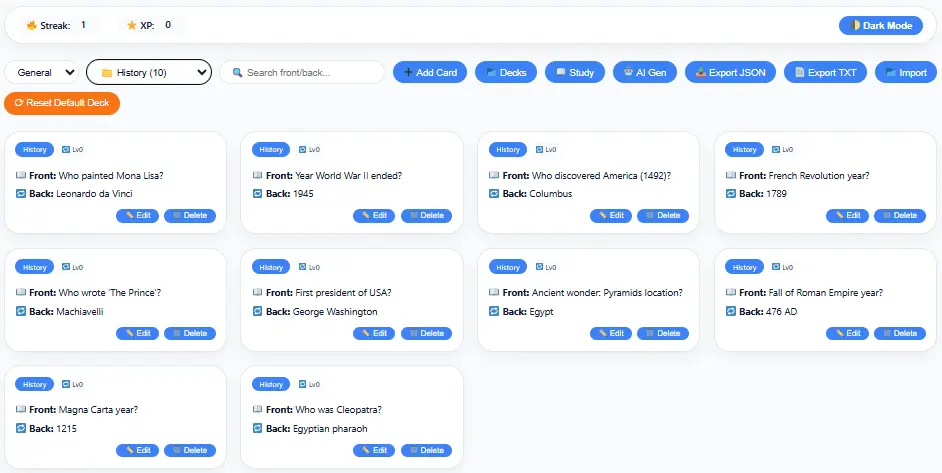
FlashForge Ultimate turns study material into flashcards that you can review, edit, and organize into decks. The easiest way to see how it works is to start with a short piece of study material.
Step 1: Enter your study notes
For example, a student studying AP U.S. History could enter:
The Declaration of Independence was adopted by the Continental Congress on July 4, 1776. It announced that the thirteen American colonies considered themselves independent states and explained the political reasons for separating from Great Britain.
Step 2: Review the generated flashcards
The tool can turn that information into cards such as:
Question: When was the Declaration of Independence adopted?
Answer: July 4, 1776.
Question: What did the Declaration of Independence announce?
Answer: That the thirteen American colonies considered themselves independent states.
Question: What was the purpose of the Declaration?
Answer: It explained the colonies’ reasons for separating from Great Britain.
Step 3: Edit the cards
AI-generated cards should be treated as a starting point. Review each card and change wording, add missing information, or remove cards that are not useful for your exam.
Step 4: Study the deck
Once the cards are ready, use the available study modes to review the material. You can move through cards, practice recall, and return to difficult material during later study sessions.
Why Example-Based Flashcards Work Better
A useful flashcard should test one clear piece of information rather than reproduce an entire paragraph. For example, instead of putting a complete textbook paragraph on the answer side, separate it into several questions about the date, event, cause, effect, and historical significance.
This makes the cards easier to review and gives you more opportunities to actively recall the information.
Best Uses for FlashForge Ultimate
You can use the flashcard maker for:
- APUSH and other AP History courses
- Biology and science vocabulary
- Foreign-language vocabulary
- Definitions and key terms
- Exam review
- Lecture notes
- Textbook chapters
- Important dates, people, events, and concepts
AI Flashcards Still Need Review
AI-generated flashcards can save time, but you should check the cards before relying on them for an exam. Look for missing context, unclear questions, duplicate cards, or information that needs to be corrected or expanded.
The best workflow is:
Study notes → AI-generated cards → student review → edited deck → active recall practice
📖 Key Features of Flash Forge Ultimate
- AI Flashcard Generator — Converts supplied notes or study material into question-and-answer cards.
- Deck System — Organizes cards by subject or topic.
- Spaced Repetition — Helps schedule repeated review of cards.
- Study Modes — Includes flip-card, multiple-choice, and typing practice.
- Import & Export — Allows users to move flashcards between supported formats.
- Dark Mode — Provides an alternative interface for studying in low-light conditions.

APUSH Timeline Examples
A timeline becomes more useful when you understand why an event matters, not just when it happened.
| Date | Event | Why It Matters for APUSH |
|---|---|---|
| 1776 | Declaration of Independence | Established the colonies’ argument for independence and natural rights. |
| 1787 | Constitutional Convention | Created the framework for the U.S. Constitution and raised questions about federal power. |
| 1861 | Civil War begins | Began the major conflict over the Union, slavery, and the future of the nation. |
| 1863 | Emancipation Proclamation | Changed the Union’s war aims and made ending slavery a central part of the conflict. |
| 1929 | Stock Market Crash | Helped trigger the Great Depression and contributed to major changes in federal economic policy. |
| 1933 | New Deal begins | Expanded the federal government’s role in responding to the economic crisis. |
| 1964 | Civil Rights Act | Prohibited discrimination in important areas of American public life and marked a major development in the civil rights movement. |
How to Use the APUSH Timeline for Essay Writing
Don’t use the timeline only to memorize dates. Use it to build historical connections.
For an APUSH essay, you can work backward and forward from an event:
Event → Causes → Historical context → Effects → Related developments
For example:
1863: Emancipation Proclamation
- What events helped lead to it?
- How did the Civil War change the government’s position on slavery?
- What changed after the proclamation?
- How did emancipation connect to Reconstruction?
- What later developments continued the struggle over civil rights?
This approach turns a list of dates into a set of historical relationships that can be used as evidence and context in APUSH writing.
Example: Building Context From a Timeline Event
Suppose an essay asks about changes in the federal government’s role during the Civil War.
Instead of writing only:
The Emancipation Proclamation was issued in 1863.
Use the timeline to connect the event to the broader historical situation:
The Civil War initially centered on preserving the Union, but the conflict increasingly became connected to the institution of slavery. As the war continued, the federal government took stronger measures against slavery, including the Emancipation Proclamation in 1863. This represented an important expansion of federal wartime action and changed the political meaning of the conflict.
The timeline gives you the event. Your job is to explain the historical connection.
How to Study With the Timeline
For each major event, ask four questions:
- What caused this event?
- What changed because of it?
- Which larger APUSH theme does it connect to?
- How could I use it as evidence in an essay?
This turns timeline review into active historical reasoning instead of simple memorization.
🚀 Advanced Features of the Tool
🤖 AI-Based Learning Intelligence
Firstly, the system analyzes user input intelligently, and therefore, it generates meaningful flashcards automatically. Moreover, it improves accuracy, and consequently, enhances learning outcomes.
📊 Progress Tracking System
Additionally, FlashForge Ultimate includes XP tracking and streak systems, and therefore, users stay motivated. Moreover, progress tracking improves consistency, and consequently, builds strong study habits.
🧠 Active Recall Optimization
Moreover, the tool is designed around active recall principles, and therefore, it strengthens memory retention. As a result, students can recall information faster during exams.
🔄 Smart Review System
Furthermore, the system automatically prioritizes difficult cards, and therefore, users focus on weak areas. Consequently, study efficiency improves significantly.
🧭 How to Use Flash Forge Ultimate
Step 1: Create a Deck
Firstly, users should create a deck, and therefore, they can organize subjects properly. Moreover, structured organization improves clarity.
Step 2: Add Flashcards
Secondly, users can manually add flashcards or use AI generation, and therefore, they can save time. Additionally, AI improves accuracy.
Step 3: Start Studying
Moreover, users can choose study modes, and therefore, they can learn through interactive methods like MCQs and flashcards.
Step 4: Track Progress
Additionally, users can monitor XP and streaks, and therefore, they stay motivated consistently.
Step 5: Improve with Spaced Repetition
Finally, the system schedules review sessions automatically, and therefore, users achieve long-term retention.
Example Flashcards
Q: What is photosynthesis?
A: The process by which plants convert sunlight into chemical energy.
Q: Which organelle performs photosynthesis?
A: Chloroplasts.
⭐ Why Use an AI Flashcard Maker Online?
Using an AI flashcard maker online is highly beneficial, and therefore, it transforms the way students learn and revise. Moreover, AI reduces manual effort, and consequently, users can focus more on understanding concepts instead of creating notes.
Additionally, it works as an AI study tool, and therefore, it automatically generates flashcards from text input. Furthermore, it improves learning speed, and as a result, students can prepare for exams more efficiently.
Moreover, learners can combine this tool with structured planning using the Daily Routine Planner, and therefore, they can maintain consistency in their study habits.
How This Tool Works
Our AI Flashcard Maker analyzes your topic or notes and identifies key concepts, definitions, dates, formulas, and facts. It then converts them into question-and-answer flashcards designed for active recall learning.
The Science Behind Flashcards
Example:
Flashcards are effective because they use active recall, a learning technique that requires students to retrieve information from memory rather than simply rereading notes. Research in cognitive science has consistently shown that active recall improves long-term retention and exam performance.
🧠 Productivity Ecosystem (Internal Tools Integration)
Moreover, FlashForge Ultimate works best as part of a complete productivity system, and therefore, users can combine it with other tools for maximum efficiency.
For example, learners can improve focus using the Productivity Focus Hub, and consequently, they can eliminate distractions during study sessions.
Additionally, students preparing for exams can track their performance using the APUSH Score Calculator, and therefore, they can evaluate progress effectively.
Furthermore, writing-focused learners can improve academic quality using the Free Thesis Checker, and consequently, they can enhance assignment accuracy.
Moreover, users can improve writing structure using the Thesis Statement Generator, and therefore, they can build stronger academic arguments.
In addition, learners preparing essays can also benefit from the Free Essay Writing Tool, and consequently, they can improve writing speed and quality.
🌐 Trusted External Learning Resources
Additionally, for deeper academic understanding, users can explore:
Moreover, these sources provide reliable educational research, and therefore, they strengthen learning foundations.
Why Our AI Flashcard Maker Helps You Learn Faster
Our tool is built on decades of cognitive science research. Understanding the “why” can help you get the most out of every study session.
When you ask your brain to pull up information from memory—instead of just rereading notes—you’re strengthening the neural pathways responsible for long-term retention. Think of our tool as your personal memory coach, scientifically timing every review to keep information fresh in your mind and making sure you’re always retrieving, not just recognizing.
How Our AI Flashcard Maker Creates Study Cards
- Identifies important concepts.
- Extracts definitions and key facts.
- Converts information into question-answer format.
- Organizes content for active recall.
- Helps students review information more efficiently.
Many successful flashcard tools explain their generation process because users want transparency.
🎯 Who Should Use This Tool?
Moreover, this AI flashcard maker online is perfect for:
- Students preparing for exams
- Medical and engineering learners
- Language learners
- Teachers creating study materials
- Competitive exam candidates
Additionally, anyone searching for study flashcards online free can benefit significantly.
Pros and Limitations
Example:
Limitations
- AI-generated flashcards may occasionally miss context.
- Always review flashcards before exams.
- Complex subjects may require manual editing.
Example AI-Generated Flashcards
Topic: Photosynthesis
Question
What is the primary purpose of photosynthesis?
Answer
To convert light energy into chemical energy stored in glucose.
Topic: American Revolution
Question
What was a major cause of the American Revolution?
Answer
Colonial opposition to taxation without representation.
Real examples demonstrate experience and expertise.
Popular Ways Students Use AI Flashcards
Medical Students
- Anatomy
- Physiology
- Pharmacology
AP Students
- APUSH
- AP World History
- AP Biology
Language Learners
- Vocabulary
- Grammar
- Pronunciation
Professional Exams
- CPA
- MCAT
- LSAT
- Bar Exam
This broadens topical authority.
How to Study More Effectively With Flashcards
- Review cards regularly instead of cramming.
- Focus on understanding rather than memorization alone.
- Keep questions concise.
- Study difficult cards more frequently.
- Mix old and new material.
🔬 From the Desk of Cognitive Scientists: Two Principles That Drive Real Learning
Our flashcard system is built on two evidence-based learning strategies that have been validated in cognitive science research for decades.
1. The Testing Effect (Active Recall)
The most effective way to learn is to actively retrieve information from memory rather than passively reviewing it. This is known as the testing effect—a well-established phenomenon in cognitive psychology that refers to enhanced long‑term retention from active recall. Research shows that actively retrieving information, even when the attempt is unsuccessful, can enhance subsequent learning. In fact, students who use retrieval-based flashcards regularly perform significantly better on exams, regardless of whether they study on paper or digitally.
2. Spaced Repetition
Our brains are wired to forget information over time unless we strategically review it. Spaced repetition is a technique where learners review material at increasing intervals to enhance long‑term memory retention. This combats the forgetting curve—the exponential rate at which we lose newly learned information when it’s not reinforced.
When you combine spaced repetition with active recall—reviewing at optimal intervals while actively retrieving information—you create a powerful learning engine that has been shown to significantly improve long‑term retention and academic performance compared to traditional methods.
📊 What the Research Says
🎯 Decoding the Science: How Our Tool Applies These Principles
Here’s how each principle translates into features you can use right now:
- Active Recall in Action: When you flip a card and try to recall the answer before revealing it, you’re engaging in active retrieval. Our system encourages this by randomizing card order and prompting you to answer honestly before checking. Don’t just flip—always attempt to recall first. Every retrieval strengthens memory.
- Spaced Repetition Scheduling: Our algorithm tracks your performance on each card and schedules future reviews based on your confidence level. Cards you struggle with appear more frequently; cards you master are spaced further apart. This adaptive scheduling maximizes learning efficiency and minimizes wasted time.
- Progress Tracking: Your streak and XP aren’t just for motivation—they’re behavioral reinforcement mechanisms that encourage consistent, spaced practice over time. Regular short sessions beat one long cram session every time.
⚠️ Common Flashcard Mistakes (and How Our Tool Helps You Avoid Them)
Based on learning science research, here are the most common errors students make when using flashcards. Our tool is designed to help you avoid these pitfalls:
💡 Pro Tips from Learning Science
To get the most out of our AI Flashcard Maker, incorporate these evidence-backed strategies into your routine:
- Use “Flashcards-Plus”: Don’t just memorize the answer. After flipping a card, explain the concept in your own words and try to generate a real-world example. This elaborative encoding technique strengthens understanding and retention beyond rote memorization.
- Don’t Skip Hard Cards: It’s tempting to mark a card as “easy” when you’re unsure, but that hurts your learning. Be honest with your confidence ratings—that’s how the spaced repetition algorithm learns to help you better.
- Study in Short Bursts: Research shows that spacing intervals of about 8–12 hours provide high learning performance and fit well into daily schedules. Aim for 10–15 minute sessions daily rather than hour-long marathons.
- Trust the Process, Not Your Gut: Students tend to favor study strategies that feel fluent and easy, even when those strategies produce weaker long‑term outcomes. If spaced repetition feels harder than cramming, that’s a sign it’s working.
❓ Frequently Asked Questions (FAQs)
It is a tool that automatically generates flashcards using artificial intelligence.
Yes, it is completely free, and therefore, accessible to everyone.
Yes, users can study without any cost or limitations.
It is a learning method that improves memory by revising information at intervals.
Yes, users can create unlimited decks for different subjects.
Yes, AI automatically generates flashcards from text.
Yes, it is ideal for exam revision and practice.
Yes, it works smoothly on all devices.
Yes, import/export features are available.
It combines AI, spaced repetition, and multiple study modes in one tool.
🏁 Conclusion
In conclusion, FlashForge Ultimate is not just a simple online flashcard app, but rather a complete AI-powered learning system designed to improve memory, retention, and academic performance.
Moreover, with features like AI generation, spaced repetition, decks, and multiple study modes, it becomes one of the most powerful free flashcard maker online tools available today.
Additionally, its support for study flashcards online free makes it accessible globally, and consequently, it helps students from all backgrounds.
Therefore, if you want to study smarter, memorize faster, and improve exam results, FlashForge Ultimate is the perfect solution for you.
About the Author
Saad Ahmed is the founder of DailyToolSpot, where he develops educational and productivity tools for students, teachers, and exam preparation.
About This Tool
This tool was created for students who want to spend less time creating flashcards and more time studying. The design is based on active recall principles commonly used in modern learning systems and digital study platforms.
The Science of Active Recall and Spaced Repetition
Many flashcard competitors mention these concepts briefly, but few explain them in depth. Research-backed educational content can help your page stand out from generic AI-tool pages and provide unique value to students.